


Monastery of Saint George of Mangana: A Byzantine Landmark in Istanbul
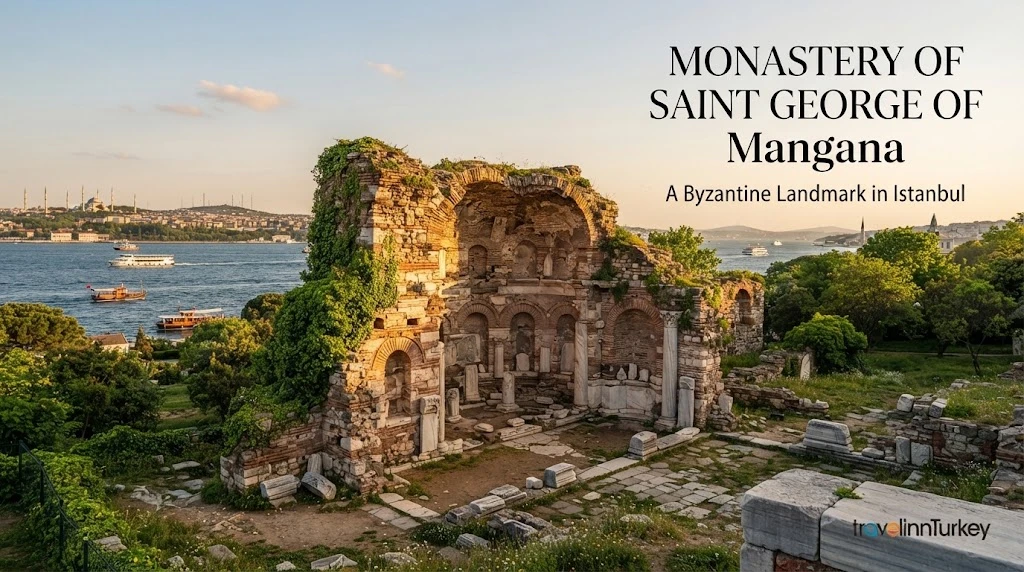
Monastery of Saint George of Mangana
A Byzantine Landmark in Istanbul
There are places in Istanbul that announce their history with magnificent monuments, ancient walls, and preserved churches. And then there are places that ask you to look more carefully.
The Monastery of Saint George of Mangana belongs to the second kind.
Today, very little remains to immediately tell the visitor that this area was once part of one of the important religious and imperial landscapes of Byzantine Constantinople. Yet beneath the modern city, along the historic eastern edge of Istanbul, traces of another Constantinople can still be sought.
And this is exactly the kind of place Niobe loves.
Niobe is not only a storyteller. She is also a historical researcher—someone who enjoys following fragments, comparing old descriptions with the modern city, and asking a simple question:
What happened here?
A Walk Along the Istanbul Seaside
Niobe begins her walk near the seaside, where the modern city stretches toward the Bosphorus.
The sound of the water accompanies her as she walks, but her eyes are not simply looking at the sea.
She is searching.
Somewhere around this landscape once stood the Mangana complex, an important Byzantine area associated with the imperial palace, churches, monasteries, gardens, and other buildings.
Today, the surroundings have changed dramatically.
Modern Istanbul has grown over the remains of Constantinople, and many Byzantine structures disappeared through earthquakes, construction, neglect, and the transformation of the city over centuries.
For Niobe, however, the absence of a monument does not mean the absence of history.
It means the investigation has begun.
The Byzantine Mangana Complex
The Mangana district was located near the eastern part of Constantinople, close to the sea and the area that today forms part of historic Istanbul.
The wider complex became particularly important during the Byzantine period. It was connected with the imperial world and included religious foundations, residences, gardens, and other structures.
Among them was the Monastery of Saint George of Mangana, dedicated to Saint George.
The monastery was not an isolated building in an otherwise empty landscape. It belonged to a much larger urban and imperial environment.
Imagine the area centuries ago.
Instead of today's roads and modern buildings, there would have been the architecture of Constantinople, religious communities, imperial institutions and the magnificent waters of the Bosphorus nearby.
Niobe pauses.
She looks toward the sea.
The landscape is familiar, yet strangely different from the one described in Byzantine history.
Searching for Saint George
Finding the monastery today is not like visiting Hagia Sophia or the Church of Chora, where the historical building still stands before the visitor.
Saint George of Mangana is a different kind of historical discovery.
Its remains are fragmentary, and identifying the exact traces requires knowledge of the archaeological landscape and the historical development of the area.
This is what makes the search fascinating.
Niobe walks slowly.
She looks at the ground.
She studies the surrounding topography.
She remembers that Istanbul is a city built layer upon layer.
Roman Constantinople lies beneath Byzantine Constantinople.
Byzantine Constantinople lies beneath Ottoman Istanbul.
And modern Istanbul continues to grow above all of them.
Every archaeological fragment therefore becomes a small window into another city.
A Monastery Connected to Byzantine History
The Monastery of Saint George of Mangana is especially interesting for visitors fascinated by the religious and political history of Byzantium.
The Mangana complex was associated with the Byzantine imperial court, and the monastery became an important religious foundation.
Its history belongs to the extraordinary period when Constantinople was one of the world's great Christian capitals.
Monasteries were not simply places where monks lived and prayed.
They could also be centres of learning, religious devotion, pilgrimage and political influence.
The history of Saint George of Mangana therefore gives us another way to understand Byzantine Constantinople—not only through emperors and battles, but through the people and communities who lived their lives within the city's sacred landscape.
Niobe the Historical Researcher
Niobe's journey is different from an ordinary sightseeing walk.
She does not begin with a checklist:
“See this monument. Take a photograph. Move on.”
Instead, she follows questions.
Where exactly was the monastery?
What did it look like?
Who lived there?
Why was Saint George important?
What happened to the buildings?
And perhaps most importantly:
How much of Byzantine Constantinople is still hidden beneath today's Istanbul?
This is where Niobe becomes more than a storyteller.
She becomes a historical researcher.
Her adventures can begin with a photograph, an old map, a Byzantine text, an archaeological fragment or even a name that survives in historical records.
Sometimes the destination is a famous monument.
Sometimes it is only a trace.
Following the Traces of Lost Istanbul
Walking through Istanbul with a historical researcher in mind changes the way you see the city.
A wall is no longer simply a wall.
A street may follow an ancient route.
A hill may preserve the memory of a Byzantine neighborhood.
A piece of stone may have belonged to a building that disappeared centuries ago.
And the seaside itself can become part of the investigation.
The waters surrounding Istanbul have witnessed the rise and transformation of Constantinople for more than a millennium.
Niobe stands by the shore and imagines the city that once occupied this landscape.
She cannot bring the monastery back.
But she can follow its traces.
And sometimes, that is enough to make a lost place feel unexpectedly close.
Why Visit the Mangana Area?
For travellers interested in Byzantine history, hidden Istanbul, archaeology and Orthodox heritage, the story of Saint George of Mangana offers a fascinating reason to explore beyond Istanbul's most famous monuments.
It is particularly rewarding for visitors who enjoy discovering places that require research and imagination rather than simply following a conventional tourist route.
The area can be approached as part of a wider exploration of historic Istanbul, connecting the Byzantine past with surviving monuments, archaeological remains and the modern city.
For Niobe, this is exactly what makes Istanbul extraordinary.
The city does not always show you its history.
Sometimes, you have to search for it.
The Story Continues
Niobe's search for the Monastery of Saint George of Mangana does not necessarily end when she finds a fragment or identifies a possible location.
For a historical researcher, one discovery usually creates another question.
Perhaps the next step is an old Byzantine map.
Perhaps an archaeological report.
Perhaps another monastery.
Perhaps another forgotten church somewhere along the shores of Constantinople.
And so Niobe continues walking.
The sea is beside her.
Modern Istanbul surrounds her.
But beneath the sounds of today's city, she is listening for another Constantinople.
A Constantinople of monasteries, emperors, monks, pilgrims and forgotten stories.
The traces may be small. The history is enormous.
And Niobe intends to keep searching.
Travel Inn Turkey – Discover the Istanbul Beneath Istanbul
Follow Niobe as she explores the lesser-known historical places of Istanbul, investigates forgotten Byzantine sites and discovers the stories hidden beneath the modern city.
Because sometimes the most fascinating journey is not to a famous monument.
It is to a place that almost disappeared.
Our partners