


Agia Kyriaki Church in Istanbul: A Greek Orthodox Church in Kumkapı
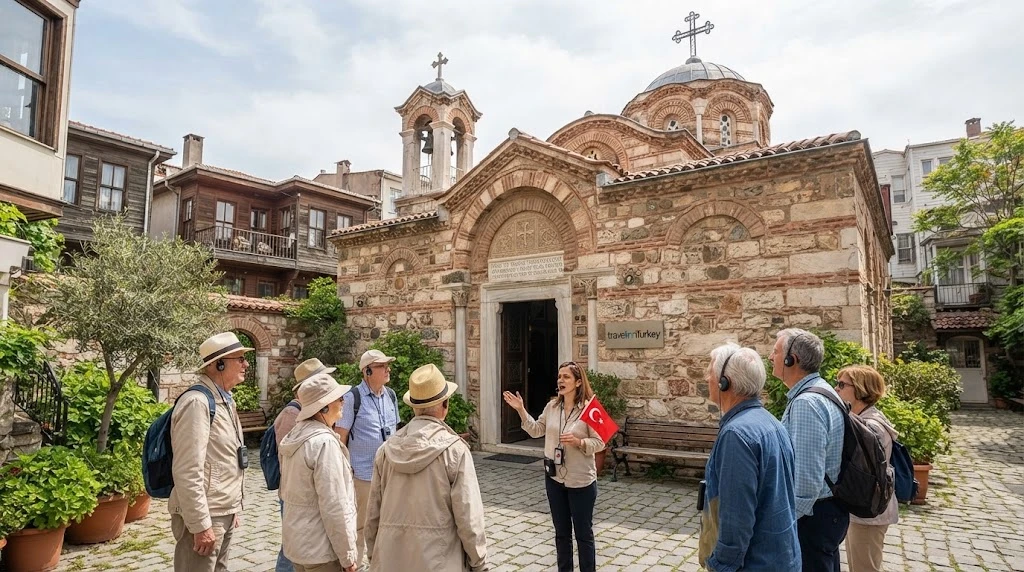
Saint Kyriaki, a Greek Orthodox Church in Istanbul
Three Faiths, One Street and a Living Greek Heritage
Another discovery by Niobe and Travel Inn Turkey.
Especially every summer, the bells of Agia Kyriaki Church in Kumkapi, Istanbul, remind the neighborhood that its history is still alive. Agia Kyriaki Church, also known as Aya Kiryaki Rum Orthodox Church, is a Greek Orthodox church in Kumkapi, Fatih, Istanbul.
I visited the church on the day of its celebration, when Greek visitors from Greece and elsewhere had returned to Istanbul to honor Saint Kyriaki and, for many of them, to revisit a place connected with the childhood memories of their parents and grandparents.
But that day offered me something more than a church celebration.
It offered me a moment to think about three religions, one street, and three different ways of praying.
Three faiths, one Istanbul street
It was Friday, Summer.
At Agia Kyriaki, Orthodox Christians had gathered for the celebration of the saint. At the same time, directly opposite the church, Muslims were gathering at the mosque for Friday prayers.
Inside the church, the Orthodox liturgy was taking place. On this particular celebration, the Ecumenical Patriarch traditionally visits the church, together with the local bishop and clergy, to perform the religious duties of the day. Catholic clergy had also been invited to participate in the occasion.
Standing there, I found myself thinking about something I often think about while walking through Constantinople:
How many different histories, beliefs and memories can exist within a few meters of one another?
One person enters a church.
Another enters a mosque.
Someone else walks past carrying memories inherited from a family that once lived here.
And the street continues its daily life around all of them.
This is one of the things that makes Istanbul so fascinating.
Returning to the land of their childhood
What touched me most was seeing the Greek visitors who had come for the celebration.
For some, this was not simply a religious visit.
It was a return.
Some had attended school here as children. Some remembered playing in the courtyard of Agia Kyriaki. The school building connected with the church stands along the small inner street, just opposite the mosque.
Imagine returning decades later to the place where you once went to school, played with your friends and heard the church bells.
The buildings may have changed.
The streets may have changed.
But memory has its own way of preserving a place.
For these visitors, Kondoskali was not simply another neighborhood of Istanbul. It was part of their personal history.
And then there is the bakery...
There is another detail I love about this corner of Kondoskali.
Down on the lower street is a bakery.
The smell of freshly baked koulouri and other pastries rises through the streets and seems to reach all the way up toward Agia Kyriaki.
It is such a small detail, but these are the details that make historical places feel alive.
A church.
A mosque.
An old school.
A bakery.
People returning from Greece.
Children who once played in the courtyard.
And Istanbul continuing around them.
This is not history locked inside a museum.
This is living history.
A carefully preserved hidden treasure
I was also struck by how carefully maintained Agia Kyriaki is.
The church has a character that is easy to miss if you are simply walking through Kondoskali without knowing what is hidden here.
One particularly charming detail caught my attention: the vine branches that decor the exterior of the church.
It is one of those small visual details that Niobe always looks for.
Because sometimes the smallest detail tells you more about a place than the grand monuments do.
The Holy Water of Saint Basil
There is another reason to visit the courtyard of Agia Kyriaki.
Within the church grounds is the Agiasma of Saint Basil (Agios Vasileios), a holy-water site connected with the Orthodox tradition.
Visitors who would like to see it should make arrangements with the church authorities in advance and respect the religious character of the site.
For those interested in the lesser-known Christian heritage of Istanbul, this is another remarkable discovery hidden within the neighborhood.
Agia Kyriaki and Panagia Elpida — two churches, only steps apart
And Niobe's exploration does not end at Agia Kyriaki.
Very close by stands another remarkable church: Panagia Elpida.
The two churches are separated by only a few steps, yet together they reveal a remarkable chapter of Istanbul's Greek Orthodox heritage.
This is precisely the kind of corner I encourage visitors to explore slowly.
Don't simply arrive, take a photograph and leave.
Walk the surrounding streets.
Look at the buildings.
Listen.
Notice the bakery below.
Look toward the mosque.
Find the school.
And imagine the children who once ran through these streets.
Another school, another chapter waiting to be written
There is also a more difficult side to this story.
Like so many historic buildings in Istanbul, the old school connected with this community represents a changing city. Buildings that once served generations of children can eventually take on completely different functions — perhaps becoming accommodation, a guesthouse or another type of property.
And this raises an important question:
What happens when a building loses its original purpose but survives physically?
Does it become simply an old building?
Or can it continue to tell the story of the people who once filled it with life?
For Niobe, the answer is clear.
Its story remains.
Why should you visit Agia Kyriaki?
If you are exploring Istanbul beyond the famous monuments of Sultanahmet, Agia Kyriaki is the kind of place worth adding to your walk.
Here you can discover:
- An active Greek Orthodox church in Kondoskali
- The annual celebration of Saint Kyriaki
- A historic Greek/Rum community connection
- The nearby mosque and the remarkable co-existence of different religious traditions
- The former school and its connection with the local community
- The Agiasma of Saint Basil
- Traditional neighborhood streets and bakeries
- Panagia Elpida, only a short walk away
- A quieter and more personal side of Istanbul's Christian heritage
And most importantly, you can experience something that cannot be understood from a guidebook alone:
the feeling of walking through a neighborhood where several layers of Istanbul's history continue to exist side by side.
Niobe's Istanbul
I often wonder how many people walk through Kondoskali without realizing what is hidden behind its walls.
Perhaps they see an old building.
I see a school.
Perhaps they see a church.
I see generations of children playing in its courtyard.
Perhaps they hear the call to prayer from the mosque.
I hear another part of Istanbul's story.
And perhaps someone visiting from Greece sees something completely different.
They see the place where their parents or grandparents once lived.
That is why I continue walking.
That is why I continue looking behind walls, through small streets and around corners.
Because Istanbul still has stories waiting to be discovered.
This is another story of Niobe and Travel Inn Turkey — from Agia Kyriaki, Kondoskali, where three faiths, memories of childhood and the living heritage of Constantinople meet within a few steps of one another.
Our partners