


Istanbul’s Armenian Heritage: Churches, the Patriarchate and Historic Neighborhoods
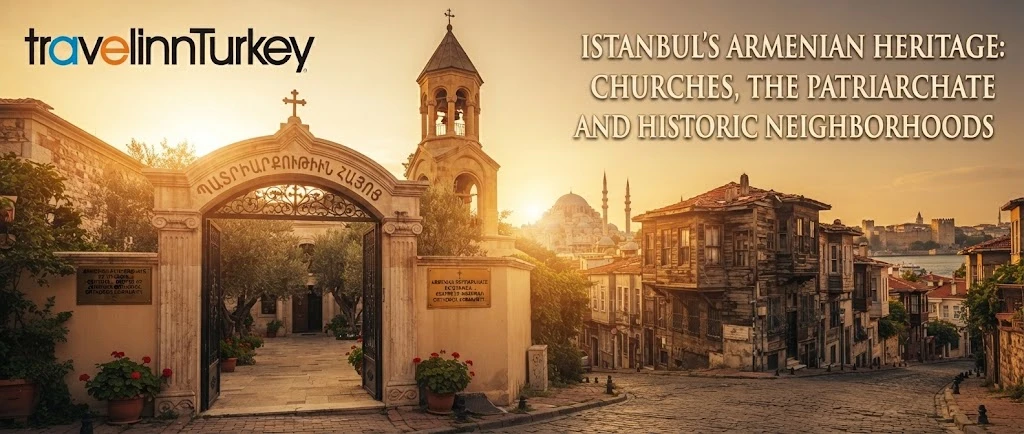
Niobe Discovers Istanbul’s Armenian Heritage
Churches, Patriarchate and Historic Neighborhoods
Sometimes, you discover a city without actually planning to discover it.
For Niobe, Istanbul has always been a city of surprises. She loves walking without a strict plan, turning into a street simply because something catches her eye. A door, an old building, a forgotten inscription, a church hidden behind modern life — each one can become the beginning of another story.
And this time, her curiosity led her closer to Istanbul’s Armenian community.
The First Discovery: A Church by the Sea
One day, while walking around the Yedikule seaside, Niobe noticed something that immediately caught her attention.
A church.
She stopped and looked more carefully. It was an Armenian church.
She had walked through this part of Istanbul many times, but somehow she had never thought about the Armenian presence in this neighborhood.
Who worshiped here?
Who lived around this church?
What did these streets look like many decades ago?
She took note of it, but continued her walk.
The question, however, stayed in her mind.
A Second Clue in Nisanca
Another day, Niobe was walking towards the Thursday Bazaar in Nisanca when she noticed something unusual on an old building.
There was Armenian writing.
She stopped again.
This time, the discovery was even more meaningful. The building was connected with the Armenian Patriarchate of Constantinople, one of the important institutions of Istanbul's Armenian community.
Suddenly, the two discoveries began to connect in her mind.
The church by the sea.
The Armenian writing.
The Patriarchate.
These were not isolated traces. They were pieces of a much larger story.
The Silver Door at Kumkapi
Then came another discovery.
While walking at Kumkapi, very close to an Orthodox church, Niobe noticed a closed silver-colored door.
It would have been easy to walk past it.
But Niobe had learned that in Istanbul, a simple door can sometimes hide a remarkable story.
She looked closer.
Another Armenian church.
And once again, she found herself asking the same question:
Where did Istanbul's Armenian families live, work, pray and build their communities?
By now, this was no longer just curiosity.
It had become a little personal journey for Niobe.
Following the Armenian Traces of Istanbul
For a long time, these discoveries remained in her mind.
She began thinking about the Armenian neighborhoods of Istanbul and how different the city must have looked in the past.
Istanbul was not created by one community.
Its history was shaped by Greeks, Armenians, Jews, Turks and many other communities who lived, worked, traded, prayed and built their lives here.
Walking through neighborhoods such as Kumkapi, Samatya, Nisanca and the areas around the old city walls, Niobe began to look at Istanbul differently.
The old churches were no longer simply beautiful historical buildings.
They became clues.
An inscription became a story.
A closed door became a question.
A neighborhood became a chapter in the history of a city shared by many communities.
Istanbul: A City of Many Faiths
Perhaps this is one of the things that makes Istanbul so fascinating.
You can walk down an ordinary street and discover an Orthodox church, an Armenian church, a synagogue, a mosque or another place of worship — sometimes only a few minutes apart.
Each community has its own traditions, memories, architecture and stories.
And together, these stories form part of Istanbul.
A former church but now a mosque.
Niobe does not want to look at this history only through dates and historical events.
She wants to understand the people.
The families.
The children who grew up in these neighborhoods.
The shopkeepers who opened their doors every morning.
The people who went to church, celebrated their traditions and called these streets home.
The Past Should Teach the Future
As Niobe continued exploring, she also thought about something deeper.
The past cannot be changed.
What happened belongs to history, and history should be remembered honestly.
But perhaps the most important reason to remember is to help future generations learn from it.
For Niobe, discovering Istanbul's Armenian heritage is not about dividing people according to their religion or nationality.
It is about understanding the people who helped create the city we see today.
It is about respect.
It is about sharing.
And most importantly, it is about teaching our children that people with different languages, traditions and beliefs can live alongside one another.
As Niobe began to look deeper, she discovered that the Armenian presence in Istanbul was not limited to the churches she had happened to encounter. Armenians had lived, worked, traded, created businesses, practiced crafts, and built community life across many parts of the city. Samatya was one of the oldest and most important Armenian residential areas, while Kumkapi became the spiritual heart of the community, home to the Armenian Patriarchate since the 17th century. Along the Marmara coast, Yenikapi (Langa) and Narlikapi were also associated with Armenian communities and churches, while Yedikule became particularly important for Armenian institutions, including the Surp Pirgic Armenian Hospital. In Gedikpasa, Armenian residents, craftsmen, merchants, and cultural figures contributed to the life of the neighborhood. On the Golden Horn, Balat and Haskoy had Armenian communities alongside other historic populations, while Topkapi, Edirnekapi and Karagumruk also became areas of Armenian settlement. Across the Golden Horn, Galata and Pera (Beyoglu) developed into important centers of Armenian commercial, professional, cultural, and residential life, especially during the 19th century. As the city expanded, Armenian families and institutions became increasingly visible in Pangalti, Sisli and Kurtulus, as well as along the Bosphorus in Besiktas, Ortakoy and Kurucesme. The story continued on the Asian side, with significant Armenian communities in Uskudar, Kuzguncuk, Selamsiz and Kadikoy, while Bakirkoy and Yesilkoy became important in the modern period. Even the Princes' Islands, particularly Kinaliada, became closely associated with Istanbul's Armenian community. Suddenly, Niobe realized that the few Armenian churches and buildings she had discovered were not isolated traces—they were fragments of a much larger Armenian geography woven into the history of Istanbul.
Istanbul's Armenian heritage is still visible today in its churches, patriarchate, historic neighborhoods and community institutions. From the Armenian Patriarchate and Surp Asdvadzadzin Church in Kumkapi to Surp Kevork Church in Samatya, and from Galata and Beyoglu to Uskudar and Kadikoy, these places reveal an important part of Istanbul's multicultural history. For travelers who want to go beyond the city's famous landmarks, an Armenian heritage walk offers an opportunity to discover another layer of Istanbul—one shaped by centuries of faith, architecture, community and cultural life.
Niobe's Istanbul Is Still Being Discovered
Her Armenian journey is far from finished.
There are still churches she has not entered, streets she has not explored and stories she has not heard.
Every walk may reveal another Armenian inscription.
Another old building.
Another church hidden behind a modern façade.
Another piece of Istanbul's multicultural past.
And perhaps that is what Niobe loves most about Istanbul.
You never really finish discovering it.
You simply learn to look more carefully.
Follow Niobe as she continues walking through Istanbul — one new story at a time.
Our partners