

Aya Ekaterini Ayazmasi in Moda, Istanbul: A Hidden Orthodox Holy Spring
Aya Ekaterini Ayazmasi in Moda
A Hidden Orthodox Holy Spring in Istanbul
Niobe arrives in Kadikoy with no particular hurry.
Some of the best discoveries in Istanbul begin this way — without a strict plan, without following the busiest streets, and simply by walking.
This time, Niobe starts in Kadikoy and slowly makes her way towards Moda, following the relaxed streets, green corners and beautiful coastline of the Asian side of Istanbul.
It is one of those walks where the city seems to become quieter with every step.
And then, hidden beneath a restaurant, Niobe discovers something unexpected.
Aya Ekaterini Ayazmasi — the Ayazma of Agia Ekaterini, or Saint Catherine.
A tiny Orthodox sacred space beneath the historic Koco Restaurant, close to Moda Pier.
It is one of those Istanbul places that can easily be missed.
Where is Aya Ekaterini Ayazmasi?
Aya Ekaterini Ayazmasi is in Moda, in the Caferaga neighborhood of Kadikoy on Istanbul's Asian side.
It is located very close to Moda Pier, beside the waterfront, beneath the historic Koco Restaurant.
The ayazma is recorded as an Orthodox and Rum heritage site dating from the 20th century. The cultural inventory for Istanbul identifies it specifically as the Aya Ekaterini Ayazmasi in Moda and records it as accessible.
You are not travelling to a remote archaeological site.
You are walking through one of Istanbul's most familiar neighborhoods — and underneath an established restaurant is a small Orthodox sacred space.
That contrast is part of the story.
Walking from Kadikoy to Moda
The journey is part of the experience.
Niobe begins in Kadikoy, one of the liveliest districts on Istanbul's Asian side, and walks towards Moda.
The route can be wonderfully relaxed.
There is no need to rush.
Kadikoy's market, cafes, small shops and streets gradually give way to the greener and more residential atmosphere of Moda.
Eventually, the Sea of Marmara appears.
The waterfront opens up.
The sound of the city changes.
And suddenly Niobe is looking at the Moda coastline, where the sea, old buildings, trees and neighborhood life come together.
Kadikoy and Moda are known today for their cafes, art, music, seaside walks and relaxed atmosphere, but the area also preserves layers of older cultural history.
This is exactly the kind of Istanbul Niobe enjoys discovering.
A Hidden Ayazma Beneath Koco
An ayazma is a sacred spring associated with Orthodox Christian devotion.
Aya Ekaterini Ayazmasi is particularly unusual because the sacred space survives beneath Koco Restaurant.
Koco itself has a long history.
The restaurant traces its origins to 1928, when Konstantinos Koco Korostos, a Greek from Imbros (Gokceada), established the premises under the name Moda Park Restaurant. Koco's current official history describes the Aya Ekaterini Orthodox spring beneath the restaurant as one of the site's distinctive features.
So Niobe is not simply visiting an old restaurant.
She is discovering a place where the history of Moda's Rum community, Orthodox religious tradition and modern Istanbul continue to exist almost on top of one another.
How Was Aya Ekaterini Ayazmasi Discovered?
The story of the ayazma leads back to 1924.
According to local historical accounts, Rum fishermen in the Moda waterfront area discovered water emerging from a rock near the fishing shelter.
The discovery was associated with an old religious site.
The remains believed to belong to an earlier church found around the area, together with an icon associated with Aya Ekaterini — Saint Catherine. The water was consequently regarded as sacred.
A small wooden structure was subsequently built over the sacred spring and became known as the Aya Ekaterini chapel and ayazma.
From a Small Chapel to Koco Restaurant
The story becomes even more unusual as Moda changes.
The original wooden structure was eventually removed.
In the 1930s, the building above the ayazma was redeveloped, and the sacred spring was preserved underneath.
Historical research on the building records that in 1934, the wooden structures around the ayazma were demolished and a new concrete structure associated with Moda Park Restaurant was constructed above it. The ayazma itself was retained.
This is how the relationship between the sacred space and the restaurant developed.
Today, the restaurant is known as Koco.
Koco's own current website continues to describe the Aya Ekaterini Ayazmasi beneath the restaurant as one of its defining features.
For Niobe, this is one of the strangest and most memorable combinations in Istanbul:
a historic meyhane above, an Orthodox sacred space below.
How Can You Recognize the Entrance?
This is where Niobe's curiosity becomes useful.
The ayazma is easy to miss because there is no large church façade announcing its presence.
According to descriptions of the site, the entrance is reached near the Koco Restaurant entrance, close to Moda Pier.
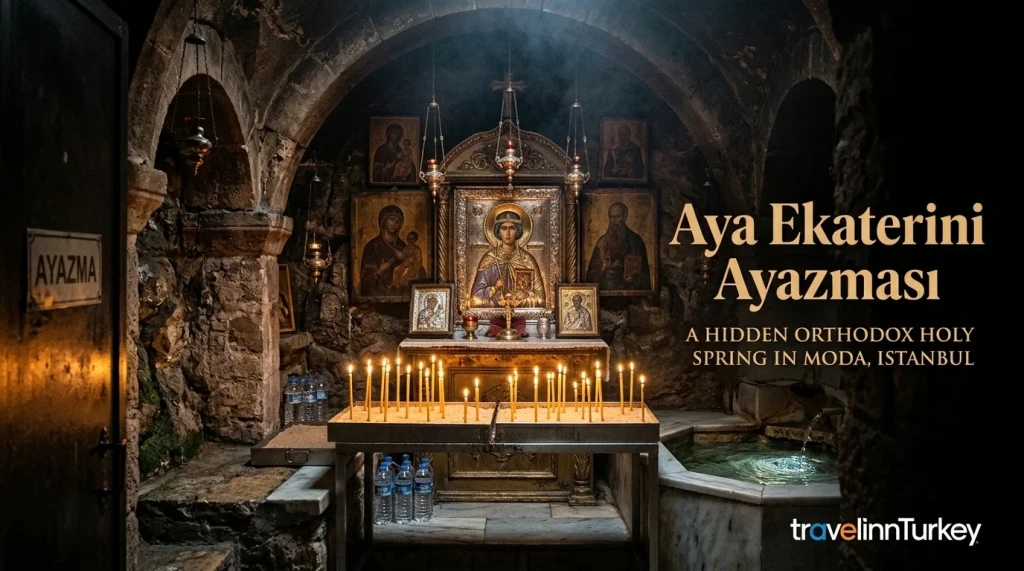
A small metal door marked “Ayazma” provides the clue.
Behind it, steps lead down towards the chapel.
For a visitor who has never heard of the place, the entrance can feel surprisingly discreet.
Niobe might easily walk past it.
That is precisely why this place fits her way of discovering Istanbul.
She looks for the small signs.
The unusual doors.
The places that are not immediately obvious.
The history hidden behind everyday life.
The Chapel and Its Icons
The chapel is very small.
This is not a monumental Istanbul church with a large nave, dome or imposing entrance.
It is intimate.
Inside, visitors can see religious images and icons, including an icon associated with Saint Catherine.
Descriptions of the ayazma also mention a marble fountain and the original rock associated with the spring. Historical descriptions record a larger silver-covered icon of Saint Catherine among the religious objects inside.
The atmosphere is very different from Istanbul's major tourist monuments.
There is no grand ceremonial architecture competing for attention.
Instead, there are icons, candles, marble and the feeling of a place that has remained connected to personal devotion.
For Niobe, this makes the experience more personal.
She is not simply looking at an old building.
She is entering a place where people have prayed.
An Orthodox and Rum Heritage Site
Aya Ekaterini Ayazmasi belongs to Istanbul's long Rum Orthodox heritage.
The term Rum refers to the Greek Orthodox Christian communities historically associated with the Ottoman Empire and Constantinople/Istanbul.
Moda and Kadikoy were part of a much broader multicultural urban environment in which Greek Orthodox, Armenian, Jewish, Muslim and other communities lived, worked and worshiped.
The ayazma is therefore more than a curiosity.
It is a small surviving piece of that multicultural history.
The Istanbul cultural inventory classifies Aya Ekaterini Ayazmasi as Orthodox and Rum and identifies it as a 20th-century ayazma.
Today, the place exists within a completely different urban environment.
Restaurants, cafes, apartments, pedestrians and seaside walkers surround it.
Yet underneath all of this, the small sacred space remains.
That is one of the reasons Niobe finds it so fascinating.
Can Visitors Enter Aya Ekaterini Ayazmasi?
Yes — visiting is currently possible, but travelers should understand that this is not a conventional museum with a fixed public timetable.
Koco's current official website states that the Aya Ekaterini Ayazmasi beneath the restaurant is open for its guests to visit. Its current English-language site describes the holy spring as a place that guests can visit.
Koco's own recent article also explains that visitors can ask the restaurant staff and be guided to the ayazma.
Therefore, the best approach is simple:
Ask the Koco staff politely if the ayazma is accessible when you visit.
Do not assume that the small door is an unrestricted tourist entrance.
It is a functioning sacred space located within a working restaurant.
Visitors should therefore behave respectfully, especially if people are praying.
Can You Light a Candle?
Visitors have traditionally been able to light candles and pray at the ayazma.
Recent descriptions of the site and Koco's own account continue to mention candle lighting and prayer.
For a traveler, however, this should be approached as a religious space rather than a sightseeing attraction.
If candles are being lit, follow the arrangements already provided inside.
Keep voices low.
Do not photograph people who are praying without permission.
And remember that the space has religious significance for Orthodox Christians.
What Happened to the Original Spring Water?
This is an important detail for modern visitors.
The water that originally emerged naturally from the rock is not the same situation visitors encounter today.
The Istanbul cultural inventory records that the original spring has dried up and that the water now flowing from the fountain is mains water.
Earlier descriptions likewise distinguish between the historic natural spring and the water available today.
So visitors should not expect to encounter an untouched natural spring still bubbling from the original rock.
The importance of the place today is primarily its religious, cultural and historical heritage.
The story of the original spring remains an essential part of understanding why the ayazma exists.
Is Aya Ekaterini Ayazmasi Currently Open?
As of 2026, there is evidence that the site remains accessible.
Koco's current official website explicitly says that the Aya Ekaterini Ayazmasi is open for its guests to visit.
A current 2026 local listing also records the ayazma at the Moda location, although it does not provide separate opening hours for the ayazma itself.
This means the safest travel advice is:
The ayazma is currently visitable, but access should be confirmed with Koco on the day.
The restaurant itself currently operates daily, but that should not be interpreted as a guarantee that the chapel will be available at every hour.
Niobe Looks More Closely
Standing inside the tiny chapel, Niobe looks around.
There are no enormous columns.
No imperial mosaics.
No monumental courtyard.
Instead, she sees icons.
Candles.
Marble.
A small sacred space beneath a modern restaurant.
And she begins to think about how many people must have passed through this part of Moda without knowing what was beneath their feet.
That is one of Istanbul's great secrets.
History does not always announce itself.
Sometimes it hides behind a small door.
A Different Kind of Istanbul Discovery
Niobe has already learned that exploring Istanbul requires looking beyond the obvious.
A palace may be hidden behind a modern street.
A Byzantine story may survive in an ordinary neighborhood.
A small chapel may be tucked away beneath a building.
And an Orthodox ayazma may exist beneath a restaurant in Moda.
This is Istanbul.
The city constantly places different centuries next to one another.
That is why Niobe enjoys walking rather than simply checking monuments off a list.
She wants to know what is behind the door.
What is beneath the street.
What remains from the communities that lived here before us.
And what stories are still quietly being carried into the present.
A Peaceful Stop During a Moda Walk
Aya Ekaterini Ayazmasi is not a place that requires hours.
It can be a small but meaningful stop during a wider Kadikoy and Moda exploration.
Walk from Kadikoy.
Explore Moda.
Follow the coast.
Find Koco.
Ask about the ayazma.
Step quietly downstairs.
Look at the icons.
Light a candle if appropriate.
And then return to the streets of modern Istanbul.
The contrast is extraordinary.
Above you is a busy neighborhood.
Below you is a small Orthodox sacred space connected with a story that began with a spring discovered by Rum fishermen in 1924.
The natural spring itself may no longer flow as it once did.
But the memory of the place survives.
And perhaps that is what makes the ayazma worth discovering.
Niobe's Final Thought
Niobe leaves Moda slowly.
She looks back towards the sea.
She thinks about the fishermen who once discovered water emerging from the rocks.
She thinks about the Orthodox community that regarded the spring as sacred.
She thinks about the little chapel, the icons and the candles.
And then she looks at the modern restaurant above it.
Almost a century has passed.
The neighborhood has changed.
The people have changed.
The city has changed.
But the small sacred space remains.
And Niobe smiles.
Because Istanbul has reminded her once again:
You are never really finished exploring this city.
There is always another door.
Another staircase.
Another forgotten story.
Another small sacred place waiting to be discovered.
Travel with Travel Inn Turkey!
Travel Tip from Niobe
If you want to visit Aya Ekaterini Ayazmasi, don't treat it like a conventional museum attraction.
It is a small Orthodox sacred space beneath a working restaurant.
Ask the Koco staff politely about access when you arrive, and be prepared for access to depend on the circumstances of the day.
If you visit, allow time to explore Moda Pier, the Moda coastline, Baris Manco House and Kadikoy as well.
The ayazma is most rewarding when it becomes part of a larger walk through the living history of Istanbul's Asian side.
And remember:
Sometimes the most interesting places in Istanbul are the ones you almost walk past!
Our partners