


Aya Paraskevi Ayazma in Kazlıçeşme, Istanbul: A Hidden Greek Orthodox Holy Spring
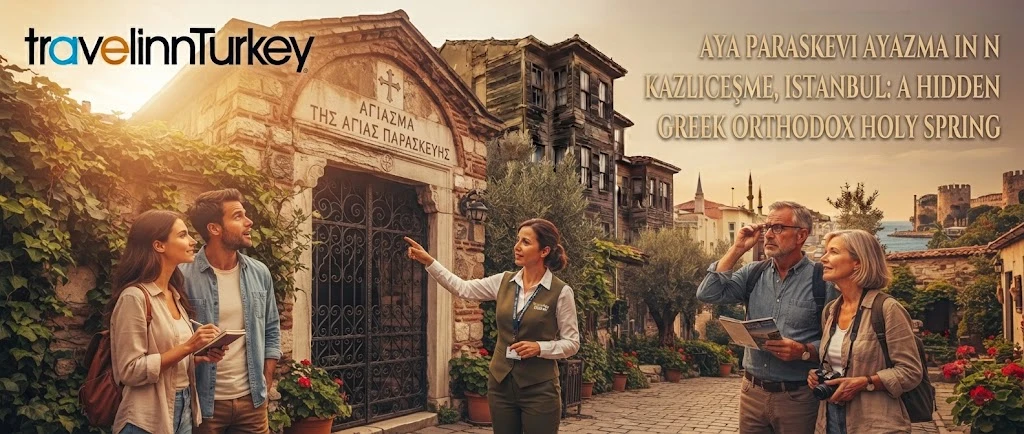
A Hidden Greek Orthodox Holy Spring Outside Istanbul's Walls
There are places in Istanbul that can easily disappear behind modern streets, apartment buildings and the rapid rhythm of the city. Yet some of them preserve a memory that reaches deep into the Byzantine and Greek Orthodox past of Constantinople.
One such place is the Agia Paraskevi Ayazma in Kazlicesme, on the historic area outside the ancient walls of Constantinople.
For Niobe, this is exactly the kind of discovery that makes exploring Istanbul so fascinating: a small and easily overlooked sacred place connected with the Orthodox tradition and with the old religious landscape beyond the city walls.
Agia Paraskevi Ayazma – A Sacred Spring in Kazlicesme
The word Ayazma comes from the Greek αγίασμα (Agiasma), meaning a holy or sacred place, particularly a spring or source of water associated with a saint.
The Agia Paraskevi Ayazma in Kazlicesme is associated with Saint Paraskevi, one of the most venerated female saints of the Orthodox Christian tradition.
Unlike Istanbul's monumental churches, this is a much smaller sacred site. Its importance lies not in its size, but in the continuity of Orthodox devotion that these small places represent.
For centuries, holy springs and ayazmas formed an important part of the religious landscape around Constantinople. Pilgrims could visit them, pray, drink or collect the holy water, and commemorate the saint to whom the place was dedicated.
Outside the Walls of Constantinople
Kazlicesme lies west of the historic peninsula, beyond the famous Theodosian Walls of Constantinople.
Today, the area is part of modern Istanbul. But historically, the landscape outside the walls was very different from the densely built city we see today.
Monasteries, churches, chapels, cemeteries, holy springs and pilgrimage sites could be found beyond the defensive walls. Some survived for centuries; others disappeared almost completely.
This makes the Agia Paraskevi Ayazma particularly interesting for anyone trying to understand the religious geography of old Constantinople beyond the famous monuments of Sultanahmet and the historic peninsula.
Considered a Chapel of Saint Constantine of Ypsomatheion
The Agia Paraskevi site is also traditionally considered exokklisi — εξωκκλήσι — of Saint Constantine of Ypsomatheion.
The Greek word exoklisi refers to a small chapel or church located away from the main settlement or parish church. Such chapels were often connected with rural areas, cemeteries, estates, monasteries or pilgrimage traditions.
The reference to Saint Constantine of Ypsomatheion adds another layer to the history of this little-known corner of Istanbul.
Ypsomatheion, known today as Psamatia / Samatya, was one of the important historic areas of Constantinople and later Istanbul. Its name appears frequently in the history of the city's Orthodox Christian communities.
The connection between an ayazma in Kazlicesme and an exokklisi associated with Saint Constantine of Ypsomatheion is therefore part of a much wider historical landscape that connected sacred places inside and outside the old city.
Why Niobe Finds Places Like This
When visitors think about Greek Orthodox Istanbul, they often think first of famous landmarks such as the Ecumenical Patriarchate, Balikli, Panagia of Blachernae or the churches of Fener.
But Istanbul's Orthodox heritage is much larger than its famous monuments.
There are ayazmas, small chapels, forgotten foundations, old cemeteries and sacred springs scattered throughout the city. Some are hidden beneath modern buildings; others survive in quiet corners that most visitors simply pass without noticing.
For Niobe, discovering these places is like opening a small historical window.
There may be no monumental dome.
There may be no grand entrance.
Sometimes there is simply a small sacred space, a spring and a tradition that has survived through generations.
And that can be enough to tell an extraordinary story.
Saint Paraskevi and Orthodox Tradition
Saint Paraskevi is particularly venerated throughout the Orthodox world.
Her name is associated with the Greek word Παρασκευή, meaning Friday, and churches and chapels dedicated to her can be found throughout Greece, the Balkans, Asia Minor and communities of the Orthodox diaspora.
Holy springs dedicated to Saint Paraskevi are also found in different parts of the Orthodox world, reflecting the long-standing tradition of connecting particular places with the saint's intercession.
The Agia Paraskevi Ayazma of Kazlicesme belongs to this broader tradition of sacred springs and local pilgrimage.
A Different Way to Discover Istanbul
The story of Kazlicesme reminds us that Istanbul is not only a city of palaces, mosques, bazaars and monumental Byzantine buildings.
It is also a city of small sacred places.
A journey through Istanbul's Christian heritage can lead far beyond the well-known tourist route. It can take you to neighborhoods where traces of Greek Orthodox life remain in unexpected forms.
An ayazma can be just as meaningful to a historical traveller as a monumental church.
For those interested in Greek Orthodox Istanbul, Byzantine Constantinople, Christian heritage and hidden historical places, Agia Paraskevi Ayazma in Kazlicesme is a fascinating discovery.
Niobe's Discovery
Niobe's Istanbul is not only about visiting the monuments that everyone knows.
It is about looking twice.
Sometimes the most interesting story is hidden behind a modern street, in an old neighborhood, or in a small sacred place that has survived almost unnoticed.
The Agia Paraskevi Ayazma of Kazlicesme, traditionally connected with the exokklisi of Saint Constantine of Ypsomatheion, is one of those places.
A quiet reminder that beyond the walls of Constantinople, sacred landscapes continued to connect communities, saints and traditions with the city for centuries.
And perhaps that is the real pleasure of discovering Istanbul:
the city still has stories waiting to be found.
Niobe Discoveries | Travel Inn Turkey
Follow Niobe as she explores the lesser-known churches, ayazmas, monasteries, neighborhoods, traditions and forgotten stories of Istanbul and Turkey.
Discover Istanbul beyond the usual landmarks — one hidden story at a time.
Our partners