


Casa Botter Istanbul: Exploring Art Nouveau on Istiklal Street
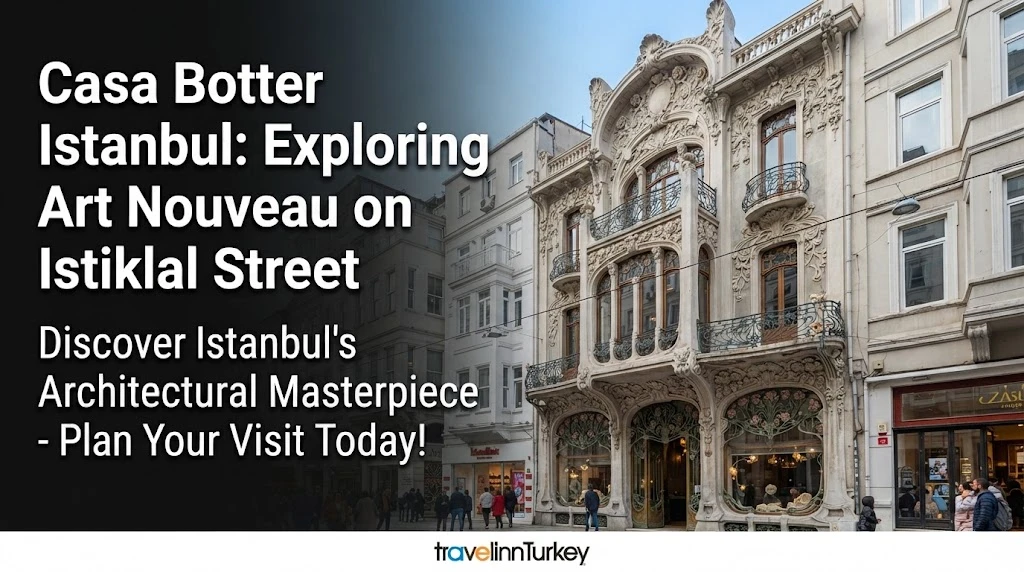
Casa Botter
Istanbul Exploring Art Nouveau on Istiklal Street
Walking along Istiklal Street in Istanbul, visitors encounter historic churches, consulates, passages, cafes, apartment buildings and elegant 19th- and early-20th-century architecture. Among these remarkable buildings, Casa Botter, also known as Botter Apartment, stands out for its distinctive Art Nouveau facade and fascinating connection with Ottoman-era fashion. Casa Botter is one of Istanbul’s most interesting architectural landmarks and an important stop for travelers interested in the city's artistic and cultural heritage.
Today, Casa Botter represents much more than an attractive historic building. It connects several aspects of Istanbul's past: Ottoman palace culture, European fashion, Art Nouveau architecture, the cosmopolitan character of Pera and the city's continuing transformation into a major cultural center. Originally created for Jean Botter, the Dutch tailor associated with the Ottoman Palace, the building was designed by the Italian architect Raimondo D’ Aronco and completed around 1901. It is widely recognized as Istanbul's first Art Nouveau building.
The Story Behind Casa Botter
The story of Casa Botter begins with Jean Botter, a Dutch tailor and fashion designer who worked in Istanbul during the reign of Sultan Abdulhamid II. Botter became closely associated with the Ottoman Palace and was responsible for introducing contemporary European fashion influences to Istanbul's elite. His connection with the palace helped establish his reputation as one of the city's leading fashion figures.
The building that carries his name was commissioned as a combination of fashion house, workshop and family residence. This mixed commercial and residential arrangement was particularly suited to the cosmopolitan character of Pera, where businesses, residences, embassies, hotels, cafes and cultural institutions existed side by side.
Casa Botter was therefore not simply an apartment building. Its lower levels were designed around Jean Botter's professional activities, while the upper floors provided accommodation for the Botter family. The ground floor contained the fashion house, with workshop and working areas on the lower levels, while the upper parts of the building were used as the family's living spaces.
Raimondo D’ Aronco and the Birth of Art Nouveau in Istanbul
One of the most important names connected with Casa Botter is Raimondo D’Aronco, the Italian architect who spent many years working in Istanbul. D’ Aronco became one of the most influential architects of the late Ottoman period and played an important role in introducing and developing new European architectural ideas in the city.
Casa Botter, designed around 1900–1901, is particularly significant because of its Art Nouveau character. The style can be seen in the building's flowing lines, floral decoration, ornamental details and elaborate ironwork. Rather than relying entirely on the rigid symmetry of traditional architectural styles, Art Nouveau introduced more organic forms inspired by nature.
The façade is especially rewarding for visitors who take time to look closely. Decorative floral motifs, curved forms and ornamental ironwork create a sense of movement across the otherwise narrow frontage. The decorative language makes Casa Botter immediately recognizable among the historic buildings of Istiklal Caddesi.
What Makes Casa Botter Special?
Casa Botter is important because it represents several different chapters of Istanbul's history in a single building. Architecturally, it is one of the city's best-known early Art Nouveau structures. Socially, it reflects the cosmopolitan lifestyle of Pera during the final decades of the Ottoman Empire. Commercially, it is associated with one of Istanbul's earliest and most prestigious fashion houses.
The building also illustrates how European cultural trends were adapted to Istanbul. Art Nouveau was developing in European cities at the time, and D’ Aronco incorporated this modern architectural vocabulary into the rapidly changing urban environment of Pera. Casa Botter consequently became part of the architectural transformation that gave the district much of its distinctive character.
For travelers, this is one of the reasons Casa Botter deserves more attention than simply being photographed while walking along Istiklal Caddesi. Its façade tells a story about a period when Istanbul was simultaneously Ottoman, European, cosmopolitan and rapidly modernizing.
Casa Botter and Ottoman Fashion
Fashion is at the heart of Casa Botter's history. Jean Botter's establishment became an important center for fashionable clothing in Ottoman Istanbul, serving members of the Palace and the city's elite. The building's original relationship between commercial space, workshop and residence provides a rare insight into how an early modern fashion business operated in the city.
The Botter Fashion House was associated with European-inspired clothing and helped connect Istanbul's elite with contemporary fashion trends. According to the Istanbul Metropolitan Municipality's historical information, Casa Botter is known as the first building in the Ottoman Empire used as a fashion house.
This connection makes the building particularly interesting for travelers who want to explore Istanbul beyond its famous mosques and palaces. Casa Botter demonstrates that fashion, design and architecture were also important parts of the city's cultural history.
From Pera to Modern Istiklal Caddesi
When Casa Botter was built, Istiklal Caddesi was known as Grande Rue de Pera and formed the center of the cosmopolitan Pera district. The street was lined with prestigious residences, commercial establishments, diplomatic buildings, hotels, restaurants and cultural venues.
Casa Botter was therefore created in one of the most fashionable and internationally connected parts of Istanbul. Its location was not accidental. A prestigious fashion house needed to be visible to the city's wealthy residents, foreign communities and visitors, and Pera provided exactly that environment.
Today, the surroundings have changed considerably, but the architectural character of the street still preserves traces of this earlier cosmopolitan Istanbul. Casa Botter is one of the buildings that allows visitors to connect the modern Istiklal Caddesi with its late Ottoman past.
What Happened to the Botter Family?
The success of the Botter Fashion House did not last indefinitely. Changing political and economic conditions affected the business, particularly after the Balkan Wars and the First World War. Interest in the fashion house declined, and in 1917 the Botter family sold the building to Mahmut Nedim Bey, the son of Ottoman statesman Nedim Pasha, before moving to Paris.
Over the following decades, Casa Botter experienced changes in ownership and use. Like many historic buildings in Beyoglu, it eventually suffered from deterioration and periods of neglect. The building's story therefore reflects the broader transformation of historic Pera during the 20th century.
The Restoration of Casa Botter
After years of deterioration, Casa Botter entered a new chapter through restoration work undertaken by the Istanbul Metropolitan Municipality's IBB Miras teams. Conservation work addressed the building's historic character while also preparing it for contemporary cultural use. Restoration included work on the facade and structural improvements, including earthquake strengthening.
The restored building was brought back into Istanbul's cultural life as Casa Botter Art and Design Center. The center began welcoming visitors in 2023 and has hosted exhibitions, cultural events and artistic activities.
This transformation is particularly significant because the restoration did not simply preserve Casa Botter as a static monument. Instead, the historic building was given a new cultural function, allowing contemporary Istanbul to continue using a structure that originated more than a century ago.
Visiting Casa Botter Today
Casa Botter is located at Istiklal Caddesi No. 235, Beyoglu, Istanbul, making it easy to include in a walking itinerary through historic Beyoglu. It is particularly convenient for visitors exploring the area between Taksim Square and Sishane and the historic streets around Asmalimescit.
According to the Istanbul Metropolitan Municipality's current information, Casa Botter is open Tuesday to Sunday from 10:00 to 19:00 and closed on Mondays. Exhibition schedules and access to individual spaces can change, so travelers should check current information before visiting.
For visitors interested in architecture, the exterior itself is worth seeing. Take a few minutes to examine the facade rather than simply passing by. The decorative ironwork, floral elements and sculptural details reveal the Art Nouveau vocabulary that makes Casa Botter such an unusual building on Istiklal Caddesi.
What to See Near Casa Botter
Casa Botter is ideally positioned for a broader exploration of Beyoglu. After visiting the building, travelers can continue along Istiklal Caddesi toward Tunel, exploring historic passages, churches, cultural institutions and elegant apartment buildings along the way.
The nearby Asmalimescit area is also worth exploring, with its narrow streets, restaurants, cafes and historic buildings. Continuing toward Galata brings visitors closer to the Galata Tower and the historic streets descending toward Karakoy.
For travelers interested specifically in Istanbul's architectural heritage, Casa Botter can also be combined with a wider Art Nouveau and late Ottoman architecture walk through Beyoglu.
Why Casa Botter Should Be on Your Istanbul Itinerary
Casa Botter offers a different perspective on Istanbul. The city's most famous landmarks often tell stories of sultans, empires and religion, while Casa Botter tells a story about fashion, design, architecture, commerce and cosmopolitan life.
Its Art Nouveau facade provides a visual reminder of Istanbul's connection with European artistic movements at the beginning of the 20th century. Its association with Jean Botter reveals the importance of fashion in Ottoman high society, while the work of Raimondo D’ Aronco demonstrates how international architects helped shape the modern appearance of Istanbul.
For anyone walking along Istiklal Caddesi, Casa Botter is therefore more than another historic facade. It is a surviving piece of the city's transformation from Ottoman Pera to modern Istanbul.
Discover Casa Botter with Niobe
For travelers who want to explore Istanbul beyond the standard sightseeing route, places such as Casa Botter reveal another side of the city. Istanbul's history is not confined to its major monuments; it can also be discovered through apartment buildings, forgotten workshops, historic streets, architectural details and the stories of the people who lived and worked there.
Casa Botter brings together these layers in one remarkable location: an Ottoman-era fashion house, the work of Raimondo D’ Aronco, the rise of Art Nouveau in Istanbul and the modern revival of Beyoglu's cultural heritage.
The next time you walk along Istiklal Caddesi, look carefully at No. 235. Behind its distinctive Art Nouveau facade is a story that connects Ottoman Istanbul, European design, fashion and today's cultural scene. Casa Botter is one of the city's architectural treasures—and an excellent reminder that some of Istanbul's most fascinating stories are found just beyond the city's most famous landmarks.
Niobe_
Our partners