


Column of the Goths in Gülhane Park: A Hidden Roman Landmark in Istanbul
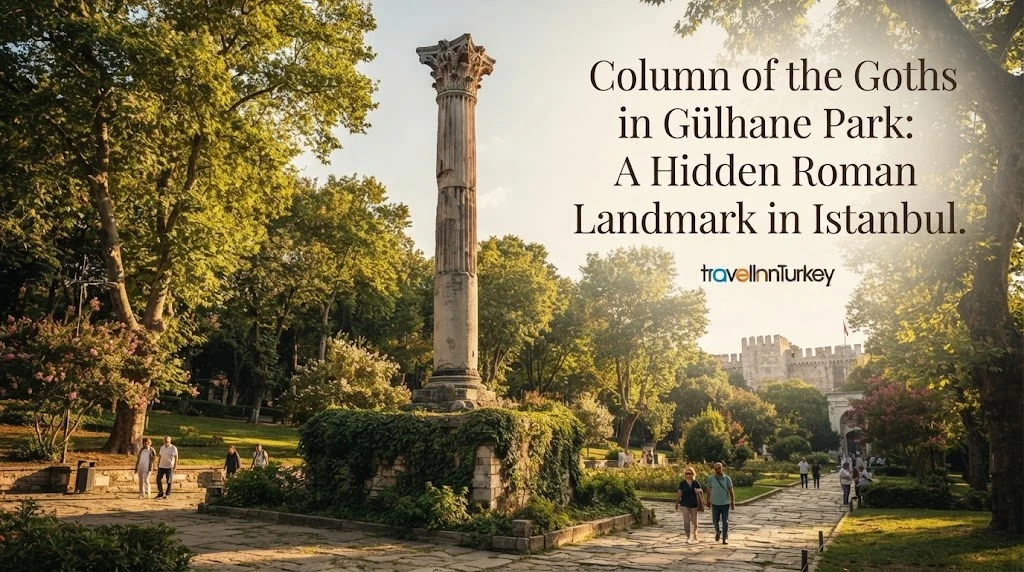
Column Of The Goths in Gulhane Park
A Hidden Roman Landmark in Istanbul
There are days when you leave home with absolutely no intention of discovering anything.
You simply want to walk.
That was me in Istanbul.
I had passed through Gulhane Park so many times that I thought I knew it. It was my favorite little escape from the crowds around the tram line—a green oasis in the middle of Istanbul's Old City, right beside Topkapi Palace.
But apparently, I had been walking through history without actually looking at it.
Gulhane Park was once part of the outer gardens of Topkapi Palace, the imperial palace of the Ottoman sultans. It was opened as a public park in 1912.
I knew that.
What I didn't know was how much older history was hiding among the trees.
My usual shortcut
There are two entrances following the tram line, and I often use one as a more pleasant alternative by walking along the busy streets.
Instead of following the crowds, I enter the greenery.
Trees above me. Paths beneath my feet. Istanbul gradually becoming quieter.
And if I continue downhill, the park eventually opens also toward Sarayburnu, where the views across the Bosphorus and the Sea of Marmara are absolutely worth the walk.
It is one of those places where I sometimes stop and think:
"How can this still be Istanbul?"
Then one day I decided not to rush.
I remembered that I had always wanted to explore a little further into these former royal gardens.
So, instead of simply passing through, I started looking around.
And Istanbul immediately rewarded me.
Then I met the Goths
Hidden among the greenery stood something I certainly wasn't expecting to find on an ordinary walk through a park:
the Column of the Goths.
An enormous ancient marble column rising approximately 18.5 meters into the trees.
It is generally dated to the Roman period, although its exact date and original purpose remain uncertain. Its name comes from the Latin inscription on its base, which refers to victory over the Goths.
I stood there thinking:
"Wait… this is inside Gulhane Park?"
Yes.
The same park where people come to walk, sit beneath the trees, take photographs and escape the traffic.
And there it was.
A monument from the ancient world.
No grand museum entrance.
No enormous queue.
Just a Roman column standing quietly among the trees.
That is one of the things I love most about Istanbul.
You can think you know a place—and then a piece of the past suddenly appears in front of you.
And then it became even older
The Column of the Goths was not my only surprise.
The deeper I looked, the more I realized that Gulhane is not simply an Ottoman royal garden.
This area carries layers of Istanbul's history going back through the Byzantine and Roman periods.
Nearby are remains associated with the Byzantine past of the area, including the remains of religious buildings. The official history of Fatih notes that the wider Gulhane area was once considered sacred because of places such as the Hagios Georgios monastery and the Panagia Hodegetria holy spring.
There is also the Gulhane Cistern, a Byzantine structure discovered during the transformation of the area into a public park. The cistern is generally dated somewhere between the 5th and 7th centuries, although its exact builder and original function remain uncertain.
Suddenly, my simple walk had become an archaeological expedition.
Well…
At least in my head it had.
From emperors to sultans to Istanbulites
What fascinated me most was the enormous number of lives that had passed through this same landscape.
Roman Constantinople.
Byzantine Constantinople.
Ottoman Istanbul.
Modern Istanbul.
The gardens that once belonged to the imperial world of Topkapi Palace eventually became a public park.
And today, people simply walk through them.
Someone is taking a photograph.
Someone is sitting under a tree.
Someone is hurrying to catch the tram.
Someone is walking toward Sarayburnu.
And underneath all of this is a city that refuses to disappear.
Gulhane itself has another fascinating chapter. The Gulhane Edict of 1839, which launched the Tanzimat reform period, was proclaimed here. Much later, in 1928, Mustafa Kemal Ataturk famously introduced the new Latin alphabet to the public in Gulhane.
So even the park I had been using as my shortcut had witnessed moments that changed the history of the country.
My Istanbul lesson of the day
I passed into Gulhane Park because I wanted to avoid the crowds.
I discovered a Roman column.
Then I started noticing Byzantine history.
Then I remembered the Ottoman palace gardens.
Then I realized that I was standing in one of the most historically layered corners of Istanbul.
And this is exactly why I never want to rush through this city.
Istanbul doesn't always announce its treasures.
Sometimes they are behind a museum door.
Sometimes they are hidden beneath a street.
Sometimes they are inside a former imperial garden.
And sometimes…
you simply have to stop walking and look.
My lesson of the day?
Every day has something to give.
Even the days when you think you are only taking a shortcut.
And perhaps tomorrow I will take another shortcut.
I have a feeling Istanbul has a few more surprises waiting for me.
My tip: Schedule a visit at Gulhane park when its tulip season!
Niobe_
Our partners