


Eirene Tower: The Hidden Byzantine Tower in Istanbul
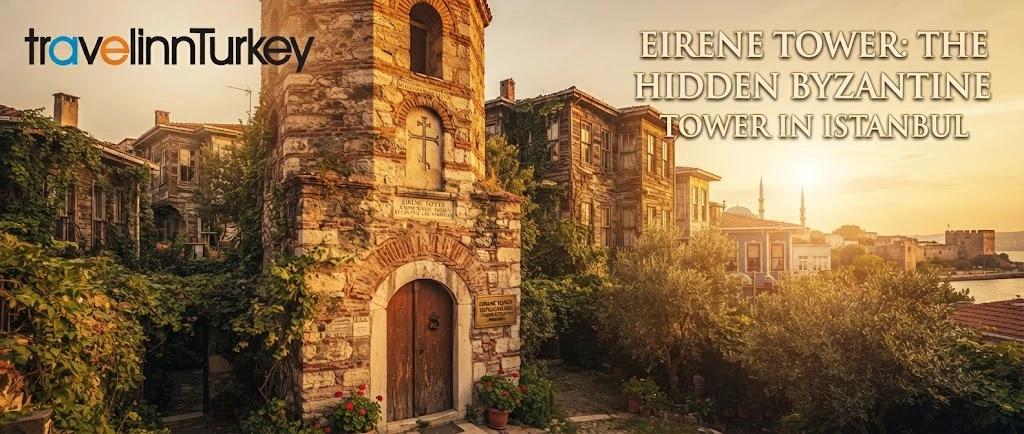
Eirene and the Hidden Byzantine Tower in Istanbul
A 1,200-Year-Old Secret in Valide Han
There are days when I walk through Istanbul with a destination in mind.
And then there are days when Istanbul chooses the destination for me.
Today was one of those days.
I found myself wandering through the busy streets of Eminonu, surrounded by shops, merchants, sounds, smells and the endless movement of Istanbul. I was not looking for a famous monument. I simply wanted to walk and see where the streets would take me.
Somewhere among the historic hans and narrow passages, I discovered something I had never really noticed before:
Eirene Tower
And suddenly, an ordinary walk became a journey into another layer of Istanbul.
A byzantine tower hidden inside a historic han
The Eirene Tower stands in the third courtyard of Valide Han, in the Sagir Han area of Eminonu. Istanbul Metropolitan Municipality describes it as a structure believed to date from the Middle Byzantine period. The 16th-century French traveller Pierre Gilles, who wrote about Istanbul, is credited with giving the tower the name Eirene.
That was the first thing that fascinated me.
Istanbul is famous for its great monuments — Hagia Sophia, Topkapi Palace, the Blue Mosque, Galata Tower.
But sometimes the most interesting stories are hiding behind an ordinary doorway.
And Eirene Tower feels exactly like that.
What was this mysterious tower?
The history of Eirene Tower is not completely certain, which somehow makes the discovery even more intriguing.
Its architecture points toward the Middle Byzantine period, but its original purpose is not firmly established. Different historical traditions and accounts have associated the tower with several functions, including a watchtower, church, chapel, dungeon and treasury.
Imagine that.
A single small tower surviving through centuries of Istanbul's history while the city around it repeatedly changed.
Byzantine Istanbul.
Ottoman Istanbul.
Modern Istanbul.
And the tower remained.
From Byzantine times to the Ottoman world
The story of Eirene Tower did not end with the Byzantine period.
According to historical accounts, the structure later became connected with the Cerrah Mehmet Pasa Palace and subsequently with Buyuk Valide Han, the enormous Ottoman commercial complex associated with Kosem Sultan.
Standing there today, it is difficult to imagine how many people must have passed through this area over the centuries.
Merchants.
Travellers.
Craftsmen.
Pilgrims.
Ottoman officials.
And ordinary people simply trying to make their way through one of the busiest commercial parts of the city.
The tower witnessed them all.
Looking up and wondering
One of the things that caught my attention was the architecture.
The tower is relatively small — around 17 metres high — but its presence is much greater than its size suggests. Historical information about the structure describes a distinctive ribbed-vaulted ceiling with numerous recesses, while traces of later decorative work have also been identified.
I found myself wondering what the tower looked like centuries ago.
What did its walls hear?
What happened behind its doors?
Who climbed its stairs?
And how many people walked past it without knowing the story hidden inside?
Perhaps that is one of the most beautiful things about Istanbul.
You can live here, walk here, visit the famous monuments again and again — and still discover something new.
Today, history meets art
The Eirene Tower has found another life in modern Istanbul.
Today it is connected with an art gallery where traditional arts such as marbling, miniature painting and calligraphy are practiced and exhibited. The gallery describes the tower as a place where visitors can experience art within a historic structure.
That combination feels very Istanbul to me.
An ancient building does not necessarily have to remain frozen in the past.
It can continue to live.
It can become a place for artists.
It can welcome visitors.
It can tell its old story while creating a new one.
How Can You Find Eirene Tower from the Grand Bazaar?
From the Grand Bazaar, Eirene Tower is only a short walk away, although finding it can be confusing because it is not situated on a major tourist street.
Travel Inn Turkey tip: Allow extra time rather than treating Eirene Tower as a quick photograph stop. The surrounding han district is part of the experience and gives visitors a glimpse of Istanbul's continuing tradition of workshops and small-scale commerce.
Can You Visit Eirene Tower?
Yes, the tower can currently be visited in connection with the Eirene Tower Art Gallery, although visitors should understand that this is not a conventional Byzantine monument with a standard archaeological museum-style entrance.
Niobe's Istanbul
Today I came looking for nothing in particular.
I left having discovered a tower that had survived centuries.
That is what I love about Istanbul.
You can begin your morning looking for a cup of coffee, walk into a historic han, turn your head toward an old stone wall — and suddenly find yourself standing in front of a piece of Byzantine history.
Eirene Tower reminded me once again that Istanbul is not a city you simply visit. It is a city you discover, layer by layer.
And sometimes the best discoveries are not the monuments everybody tells you to see.
They are the ones you find when you take a wrong turn.
Today, my wrong turn led me to Eirene Tower.
Tomorrow?
Who knows where Istanbul will take me.
Perhaps the greatest mystery of Eirene Tower is not what survives, but what has disappeared: after centuries of earthquakes, rebuilding and changing uses, the tower remains standing, while its original purpose and much of its early history remain uncertain.
Niobe_
Our partners