


Ephesus & House of the Virgin Mary: Exploring Ancient History and Christian Heritage
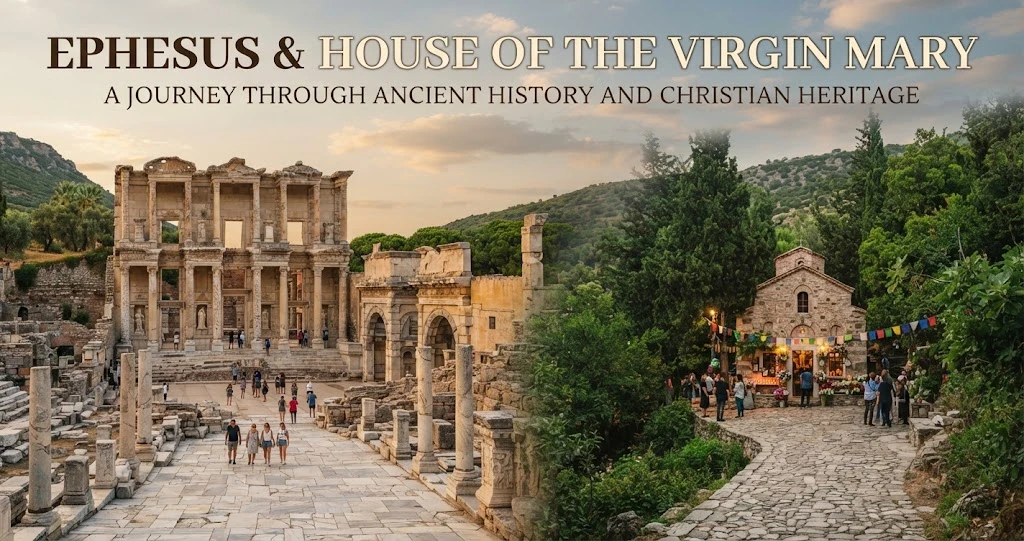
Ephesus & House of the Virgin Mary: A Journey Through Ancient History and Orthodox Heritage
Few places in Turkey bring together ancient history, Roman architecture and Orthodox heritage as naturally as Ephesus.
Located near Selcuk in Izmir Province, Ephesus was once one of the most important cities of the ancient Mediterranean. Its marble streets, monumental temples, theater, library and houses offer an extraordinary glimpse into life during the Hellenistic and Roman periods.
Just a short drive from the ancient city is another place with a very different atmosphere: the House of the Virgin Mary, known in Turkish as Meryem Ana Evi. Surrounded by trees on Mount Koressos, this modest shrine has become an important Christian pilgrimage destination.
Together, Ephesus and the House of the Virgin Mary offer a fascinating journey from the ancient world to the beginnings and development of Christianity in Anatolia.
Where Are Ephesus and the House of the Virgin Mary?
Ephesus is located near the modern town of Selcuk, approximately 80 kilometres from Izmir.
The House of the Virgin Mary is situated on the slopes of Mount Bulbuldag, approximately 7 kilometres from the ancient city of Ephesus. The two sites can easily be visited together on the same day.
Ephesus forms part of the UNESCO World Heritage property of Ephesus, which was inscribed on the World Heritage List in 2015. The property includes the Ancient City of Ephesus, Ayasuluk Hill, the Artemision and the House of the Virgin Mary.
This makes the area much more than an archaeological attraction. It is a landscape where thousands of years of religious, political, commercial and cultural history can be experienced within a relatively small area.
A Brief History of Ephesus
The history of Ephesus stretches back thousands of years.
The wider Ephesus area contains evidence of settlement going back to the 7th millennium BCE. Over the centuries, the settlement moved and developed in response to changes in the coastline and the silting of the Kaystros River.
The city became particularly important during the Hellenistic period. In the 4th century BCE, Lysimachos, one of the generals of Alexander the Great, established a new city in the area.
Ephesus later became part of the Roman world and developed into the capital of the Roman province of Asia. During the Roman Imperial period, it became a wealthy and influential centre of commerce, politics and culture.
Many of the monuments visitors see today date from this period.
The city was not simply a place of trade and government. It was also an important religious centre, first associated with the worship of Artemis and later with Christianity.
UNESCO describes Ephesus as an exceptional testimony to Hellenistic, Roman Imperial and early Christian cultural traditions.
Ephesus and Early Christianity
Ephesus has a particularly important place in Christian history.
The city became one of the major centres of early Christianity in Asia Minor. St. Paul is traditionally associated with the Christian community of Ephesus, and the city later became one of the important centres of Christian thought and pilgrimage.
Ephesus is also associated with the Council of Ephesus in 431 CE, an important event in the history of Christianity concerning the status and title of Mary.
UNESCO highlights the city's role in the spread of Christianity throughout the Roman Empire and identifies the remains of the Church of Mary and the Basilica of St. John as important evidence of Ephesus's Christian heritage.
For this reason, visiting Ephesus can be particularly meaningful for travellers interested in biblical history, early Christianity and the development of Christian communities in Anatolia.
The House of the Virgin Mary
After exploring the ancient city, many visitors continue to the House of the Virgin Mary.
The small stone building stands in a peaceful wooded setting on Mount Bulbuldag.
The atmosphere is very different from the busy streets of ancient Ephesus.
Instead of monumental Roman architecture, visitors encounter a modest chapel and pilgrimage site surrounded by nature.
The House of the Virgin Mary is traditionally believed by many Christians to be the place where Mary spent the last years of her life on earth.
According to Christian tradition, Mary came to the Ephesus area with St. John after the crucifixion of Jesus. The tradition connects her final years with Ephesus.
However, it is important to distinguish religious tradition from archaeological certainty. The identification of the structure as Mary's house has not been established as an archaeological fact. It remains a place of faith and pilgrimage for many Christians.
Turkey's official tourism information describes the site as a pilgrimage destination and notes the tradition connecting Mary with Ephesus.
The Discovery of the House
The modern history of the shrine is connected with the 19th century.
The location became associated with the visions of the German Augustinian nun Anne Catherine Emmerich. According to the tradition surrounding the discovery, her descriptions helped guide researchers to the location.
The site was subsequently identified and developed as a place of pilgrimage.
Today, the House of the Virgin Mary is recognized as part of the UNESCO World Heritage property of Ephesus. UNESCO's documentation identifies it as a pilgrimage site approximately 7 kilometers from the ancient city.
The Wall of Wishes
One of the most distinctive features outside the shrine is the Wall of Wishes.
Visitors leave written prayers, wishes and personal intentions at the site.
The tradition gives the visit a personal and emotional dimension, even for travellers who are visiting primarily for historical or cultural reasons.
Nearby, visitors can also find a spring traditionally associated with the site.
For many pilgrims, these elements are an important part of the experience.
Why Visit Ephesus and the House of the Virgin Mary Together?
Visiting the two sites together creates a much richer understanding of the region.
Ephesus represents the ancient Mediterranean world: Greek influence, Roman power, trade, philosophy, architecture and the worship of ancient deities.
The House of the Virgin Mary represents a later religious tradition connected with Christianity and pilgrimage.
The two places therefore tell different chapters of the same regional story.
The transition from Artemis and the religious traditions of ancient Anatolia to the rise of Christianity is one of the themes that makes Ephesus historically unique.
UNESCO specifically recognizes the continuity of religious and cultural traditions at Ephesus, from ancient Anatolian traditions through the Roman period and into Christianity.
What Else Can You See Near Ephesus?
If you have enough time, consider adding several nearby attractions to your Ephesus itinerary.
Basilica of St. John
Located on Ayasuluk Hill in Selcuk, the Basilica of St. John was built over the traditional burial place associated with St. John.
Its ruins provide another important connection between Selcuk and early Christianity.
Isa Bey Mosque
Built in the 14th century, Isa Bey Mosque represents another chapter in the history of the area, showing how Selcuk continued to develop long after the ancient city of Ephesus declined.
Ayasuluk Hill
Ayasuluk Hill is historically important because it preserves evidence from different periods of the region's history.
Together with Ephesus and the surrounding monuments, it demonstrates how the landscape continued to evolve after the ancient city itself lost its former importance.
Sirince Village
For travelers with additional time, Sirince offers a completely different experience.
The historic village is known for its traditional architecture, narrow streets, local food and peaceful atmosphere.
It can be a pleasant addition to an Ephesus day, particularly for visitors who want to experience the modern cultural landscape of the region.
Ephesus and the House of the Virgin Mary: A Journey Through Time
What makes Ephesus special is not simply the number of monuments.
It is the extraordinary story connecting them.
Here, visitors can stand in a city shaped by Greek culture, walk through the streets of a powerful Roman metropolis, see the remains of one of the ancient world's most famous sanctuaries, and then travel a short distance to a peaceful Christian pilgrimage site.
Ephesus is therefore more than an archaeological site.
It is a place where different civilizations, religions and centuries meet.
For history lovers, archaeology enthusiasts, Christian pilgrims and travelers simply looking for an unforgettable cultural experience in Turkey, an Ephesus and House of the Virgin Mary tour is one of the most rewarding journeys on the Aegean coast.
Experience Ephesus with a Local Guide
Ephesus is much easier to appreciate when the ruins are connected with the people, stories and events that shaped the city.
A knowledgeable local guide can help bring the Library of Celsus, the Great Theater, Curates Street, the Terrace Houses and the Christian heritage of the region to life.
At Travel Inn Turkey, we can help you combine Ephesus with the House of the Virgin Mary and other nearby highlights into a private or personalized itinerary.
Whether you are interested in ancient history, Roman civilization, archaeology, Christian heritage, or simply want to discover one of Turkey's most remarkable archaeological sites, Ephesus offers an unforgettable journey through more than two thousand years of history.
Our partners