


Istanbul’s Historic Streets: The Stories Behind the Old City
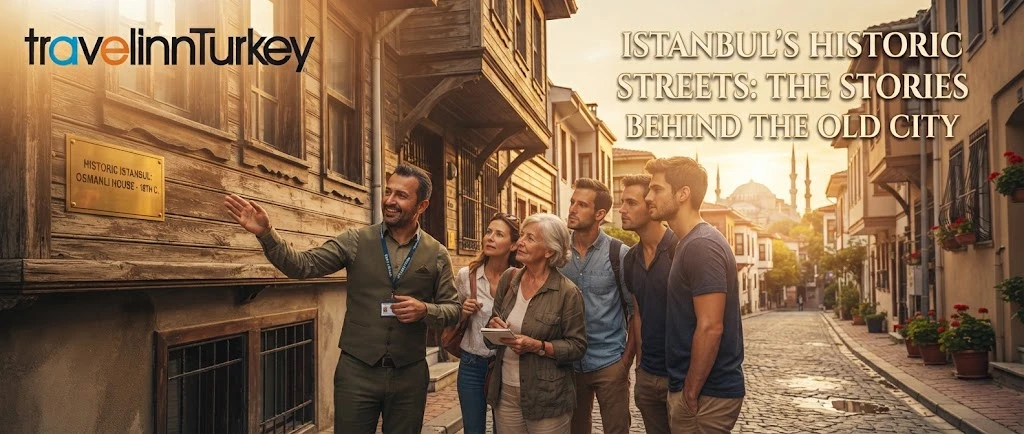
The Strange Story Behind Istanbul’s Historic Streets
Niobe never walks through Istanbul without asking one question: What happened here before us?
A street may look ordinary today. There may be cars, cafes, apartment buildings, small shops and people rushing to work. But in Istanbul, an ordinary-looking street can hide an extraordinary past.
Some of the city's streets follow routes that are centuries old. Others have changed names, direction and purpose many times. A road that today leads you towards a restaurant or a neighborhood market may once have been used by Byzantine emperors, Ottoman sultans, merchants, pilgrims or soldiers.
And this is exactly why Niobe loves exploring Istanbul with Travel Inn Turkey.
She does not simply want to see the famous monuments.
She wants to understand what is between them.
Istanbul Is Older Than Its Streets
Istanbul has been known by different names throughout its long history: Byzantion, Constantinople and Istanbul.
Each period left its own mark on the city.
The Byzantine capital developed around important ceremonial, religious and commercial routes. Later, Ottoman Istanbul transformed many of these areas while continuing to use established routes and neighborhood connections.
The result is one of the most fascinating things about walking in Istanbul:
You can sometimes walk through several centuries without realizing it.
A modern street can conceal the outline of an ancient road. A small passage may lead towards a building that has survived from another era. A neighborhood name may preserve a memory of people or places that disappeared long ago.
Niobe finds this irresistible.
The Streets Have Changed Their Names
One of the strange things about Istanbul is that its streets have not always had the names we know today.
Names changed as neighborhoods changed.
Greek, Byzantine, Ottoman and Turkish influences can all be found in the city's geographical memory.
Sometimes an old name survives in historical documents.
Sometimes it survives only in local tradition.
And sometimes the name disappears completely while the street itself continues to exist.
For Niobe, this creates a kind of historical detective game.
What was this street called 500 years ago?
Who walked here?
What stood here before today's buildings?
And perhaps the most interesting question:
What has disappeared without leaving anything obvious behind?
Walking Where Constantinople Once Stood
The historic peninsula is particularly fascinating.
Around areas such as Sultanahmet, Eminonu, Sirkeci, Samatya, Balat and Fener, today's streets cross landscapes that have been continuously occupied and transformed for centuries.
Ancient Constantinople was not simply a collection of famous monuments.
It was a living city.
People needed roads to reach markets, harbors, churches, palaces, workshops and homes.
Some routes connected important parts of the city. Others were local streets serving neighborhood communities.
Many of these routes changed dramatically over time, but the basic geography of the city remained surprisingly persistent.
That is why walking through Istanbul can feel different from visiting a museum.
The museum is underneath your feet.
Niobe's Favourite Kind of Discovery
Niobe has a particular weakness for streets that do not look important.
Give her a grand palace and she will admire it.
Give her a magnificent Byzantine church and she will investigate it.
But give her a narrow street with an old stone wall, an unusual doorway or a forgotten inscription...
She will stop immediately.
Because that is where the questions begin.
Perhaps the wall belongs to a much older building.
Perhaps the street follows the edge of a vanished complex.
Perhaps the name preserves a forgotten story.
Or perhaps there is simply nothing left.
And that, too, is part of Istanbul's history.
The Strange Stories Hidden in Ordinary Places
Istanbul constantly reminds visitors that history does not always announce itself.
You may pass an old fountain without noticing it.
You may walk beside a surviving piece of Byzantine masonry.
You may sit in a modern cafe built into a historic structure.
You may cross a street that once connected two important parts of Constantinople.
The city does not always provide a sign saying:
“Something important happened here.”
You have to look.
That is what Niobe tries to do.
She looks up.
She looks down.
She checks the corners.
She studies old maps.
And, occasionally, she wonders why Istanbul has managed to put a modern building directly beside something that is hundreds of years old!
Istanbul Is Never Boring
This is perhaps Niobe's favorite lesson.
In Istanbul, you are never really just walking from one place to another.
You are moving through layers of history.
Byzantine Constantinople.
Ottoman Istanbul.
The nineteenth-century city.
The twentieth century.
And the Istanbul of today.
They all exist together.
Sometimes beautifully.
Sometimes confusingly.
Sometimes almost invisibly.
But they are there.
And that is why Travel Inn Turkey believes that discovering Istanbul should not stop at the famous sights.
Hagia Sophia, the Blue Mosque, Topkapi Palace and the Grand Bazaar deserve their place on every traveller's list.
But there is another Istanbul waiting beyond them.
An Istanbul of old streets, forgotten corners, hidden chapels, ancient walls, historic houses, fountains, gates and stories that are still waiting to be discovered.
So, Which Is Istanbul's Oldest Street?
Niobe would love a simple answer.
Unfortunately, Istanbul does not make things that easy.
There is a difference between the oldest surviving street, the oldest known street route, and a modern street following an ancient road.
Historical Constantinople had a sophisticated network of major avenues and smaller streets, but the modern city has been repeatedly rebuilt, altered and renamed.
So rather than searching for one magical “oldest street,” Niobe prefers a better question:
Which streets still allow us to understand how Istanbul developed?
That question opens a much bigger adventure.
And there are many streets waiting for her.
Follow Niobe Through Istanbul and Not Only
Niobe's explorations are not about ticking monuments off a list.
They are about curiosity.
She wants to know what is behind the door, beneath the pavement, around the corner and underneath the modern city.
And with Travel Inn Turkey, her explorations can become your own journey.
Because sometimes the most memorable part of a trip is not the monument you planned to see.
It is the street you almost walked past.
So keep walking with Niobe.
There are still plenty of streets to investigate.
And in Istanbul, every corner seems to have a story.
Our partners