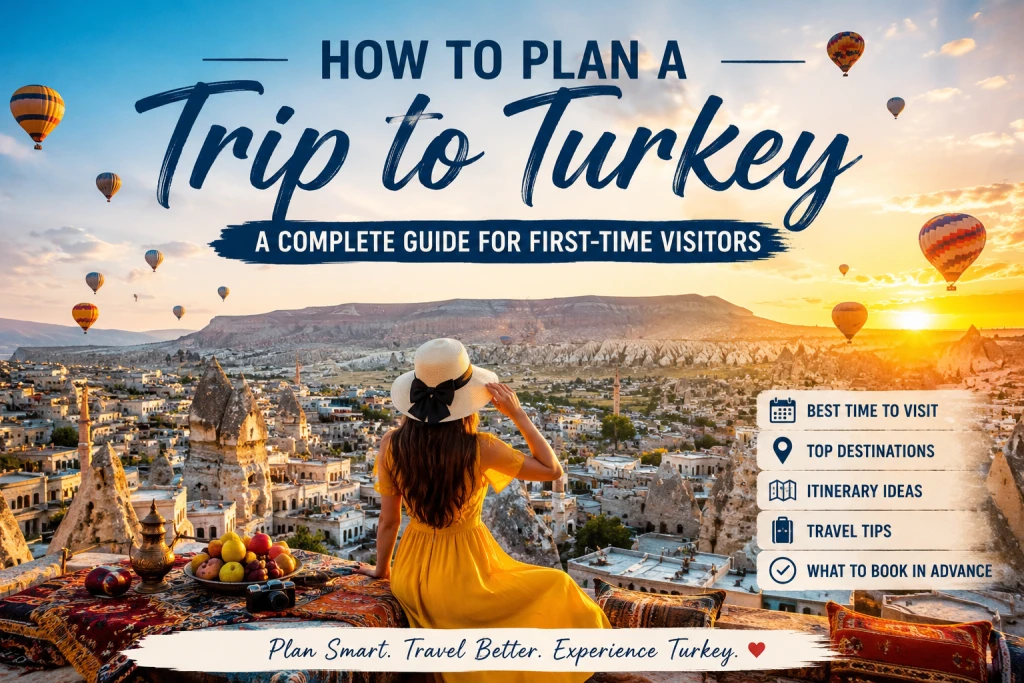
Planning a trip to Turkey is easiest when you make a few key decisions in the right order: choose your travel dates, decide how many days you have, select destinations that fit your timeframe, plan transportation, set a realistic budget, and book the most important hotels, flights and experiences in advance.
For most first-time visitors, 5–7 days is enough for Istanbul and Cappadocia. With 8–10 days, you can add Ephesus or Pamukkale, while 12–14 days allows you to explore several regions at a more comfortable pace.
The most important rule is simple: don’t try to see all of Turkey on your first trip. Plan around realistic travel time, not the number of destinations you can put on a map.
TABLE OF CONTENTS
Planning a trip to Turkey for the first time can be exciting — and slightly overwhelming.
Turkey is not simply one destination. It is a large and geographically diverse country where you can explore historic cities, ancient ruins, spectacular landscapes, Mediterranean beaches, traditional villages and vibrant modern neighborhoods within the same trip.
The challenge is deciding what actually fits into your available time.
A good Turkey itinerary is not about visiting the maximum number of places. It is about choosing the right destinations, connecting them efficiently and leaving enough time to enjoy each one.
This guide explains how to plan a trip to Turkey step by step, from choosing the best time to visit and deciding how many days you need to booking transportation, hotels and experiences.
1. Decide When to Visit Turkey
Turkey can be visited throughout the year, but the best time depends on your destinations and the type of experience you want.
A traveler planning a cultural trip through Istanbul, Cappadocia and Ephesus has different priorities from someone planning a Mediterranean beach holiday.
Spring: Excellent for Sightseeing
April and May are particularly appealing for travelers interested in sightseeing, history and outdoor activities.
Spring is a good time to explore:
The weather is generally comfortable for walking and sightseeing, while landscapes are often greener than during the summer.
Summer: Ideal for the Turkish Coast
June, July and August are popular months for beach holidays.
Destinations such as Antalya, Fethiye and Bodrum are especially attractive during the summer.
However, inland destinations can become very hot, particularly during the middle of the day.
If you are visiting Turkey in summer:
Autumn: One of the Best Seasons for a Multi-City Trip
September and October can be excellent months for combining Istanbul, Cappadocia, ancient sites and coastal destinations.
The weather is generally more comfortable than during peak summer, while many coastal areas remain pleasant.
For travelers planning a classic multi-destination Turkey itinerary, autumn can offer an excellent balance of weather and sightseeing conditions.
Winter: A Different Side of Turkey
Winter is often overlooked.
Istanbul remains an interesting year-round destination, while Cappadocia can look completely different under snow.
Winter can also offer more availability and potentially lower accommodation prices outside holiday periods.
However, travelers should allow additional flexibility for weather-related changes, particularly when planning outdoor activities or domestic travel.
What Is the Best Time to Visit Turkey?
For a first-time sightseeing trip, spring and autumn are generally among the easiest seasons to plan.
For a beach-focused holiday, summer and early autumn are more suitable.
The best time ultimately depends on where you want to go and what you want to do.
2. Decide How Many Days You Need in Turkey
One of the most important decisions is determining how much time you actually have.
Turkey is geographically large, and travel between regions can take much longer than it appears on a map.
Remember that a one-hour flight does not mean a one-hour journey. You also need to consider transportation to the airport, check-in, security, baggage collection and transfers at your destination.
HOW MANY DAYS ARE ENOUGH FOR TURKEY?
3 to 4 days: Istanbul
5 to 7 days: Istanbul and Cappadocia
8 to 10 days: Istanbul, Cappadocia and Ephesus or Pamukkale
12 to 14 days: Istanbul, Cappadocia, historical sites and the Turkish coast
15 or more days: A deeper multi-region Turkey itinerary
IS 5 DAYS ENOUGH FOR TURKEY?
Yes, if you keep the itinerary focused.
A practical five-day trip could include 3 nights in Istanbul and 2 nights in Cappadocia.
This gives you a taste of Turkey’s historic, cultural and natural highlights without spending most of the trip traveling.
IS 7 DAYS ENOUGH FOR TURKEY?
Yes.
Seven days is one of the best timeframes for a first visit.
The classic combination is Istanbul and Cappadocia.
You can experience historic landmarks, Turkish cuisine, Bosphorus views, unique landscapes, cave hotels and the famous Cappadocia balloon experience.
IS 10 DAYS ENOUGH FOR TURKEY?
Ten days gives you considerably more flexibility.
You can combine Istanbul, Cappadocia, Ephesus and Pamukkale.
The route should be designed around transportation connections rather than simply adding destinations.
IS 14 DAYS ENOUGH FOR TURKEY?
Two weeks allows you to create a much more relaxed itinerary.
You can potentially combine Istanbul, Cappadocia, Ephesus, Pamukkale and Antalya or another Turkish Riviera destination.
The advantage of two weeks is not simply seeing more places. It allows you to spend more time actually experiencing them.
You do not need to visit every famous place in Turkey.
Instead, choose destinations according to your interests.
ISTANBUL
Istanbul is the natural starting point for many first-time visitors.
It combines centuries of history with modern Turkish life.
Highlights include Hagia Sophia, the Blue Mosque, Topkapi Palace, Basilica Cistern, Grand Bazaar, the Bosphorus, Galata and Karakoy.
For a first visit, three nights is a comfortable starting point.
Best for:
CAPPADOCIA
Cappadocia is famous for its extraordinary landscapes, fairy chimneys, cave hotels and hot air balloon flights.
The region also offers valleys, underground cities, open-air museums, viewpoints, hiking and traditional villages.
Two or three nights is a good starting point for most first-time visitors.
Best for:
EPHESUS
Ephesus is one of Turkey’s most important ancient sites.
It is particularly valuable for travelers interested in Roman history, archaeology and ancient civilizations.
Best for:
PAMUKKALE
Pamukkale is known for its white travertine terraces and the ancient city of Hierapolis.
It can be combined with Ephesus as part of an Aegean itinerary.
Best for:
ANTALYA AND THE TURKISH RIVIERA
Antalya is an excellent option for travelers who want to combine sightseeing with beaches and relaxation.
Other coastal destinations can also be considered depending on your interests and season.
Best for:
GALLIPOLI AND TROY
Gallipoli and Troy are especially interesting for travelers with an interest in military history and ancient civilizations.
They are not essential for every first-time itinerary, but they can be meaningful additions for the right traveler.
Best for:
CHOOSE DESTINATIONS BASED ON YOUR INTERESTS
If you love history and culture, consider Istanbul and Ephesus.
If you love unique landscapes, consider Cappadocia and Pamukkale.
If this is your first trip to Turkey, Istanbul and Cappadocia are an excellent combination.
If you love beaches, consider Antalya, Fethiye or Bodrum.
If you love ancient history, consider Ephesus, Troy and Hierapolis.
If you want a balanced trip, consider Istanbul, Cappadocia and Ephesus or Pamukkale.
BUILD A REALISTIC TURKEY ITINERARY
Once you know when you are traveling and how many days you have, you can build your route.
The key principle is:
Plan by travel time, not by the number of destinations.
EXAMPLE: 7-DAY TURKEY ITINERARY
Days 1 to 3: Istanbul
Explore the historic areas and major landmarks.
Consider:
Days 4 to 6: Cappadocia
Travel from Istanbul to Cappadocia.
Allow time for:
Day 7: Departure
Depending on your international flight, you can return to Istanbul or depart through a suitable connecting airport.
This combination gives first-time visitors a strong introduction to two very different sides of Turkey.
EXAMPLE: 10-DAY TURKEY ITINERARY
A classic structure could be:
Days 1 to 3: Istanbul
Days 4 to 5: Cappadocia
Days 6 to 7: Pamukkale
Days 8 to 9: Ephesus and the surrounding area
Day 10: Departure
The exact order should depend on your flights and transportation connections.
EXAMPLE: 14-DAY TURKEY ITINERARY
With two weeks, you can add a coastal destination.
A possible route is:
Istanbul → Cappadocia → Pamukkale → Ephesus → Antalya
The exact itinerary should be adapted to your arrival and departure airports.
DO NOT TRY TO SEE EVERYTHING
One of the most common mistakes is attempting to fit Istanbul, Cappadocia, Pamukkale, Ephesus, Antalya and other destinations into a very short trip.
Every additional destination creates hotel check-outs, transfers, airport time, travel time and hotel check-ins.
A shorter itinerary with enough time in each destination is usually more enjoyable than a rushed checklist of famous places.
UNDERSTAND HOW TO TRAVEL AROUND TURKEY
Turkey has several transportation options.
The right choice depends on your route, budget and available time.
DOMESTIC FLIGHTS
For long-distance travel, domestic flights are often the most efficient option.
Flights can be particularly useful between Istanbul and Cappadocia, Istanbul and Izmir, and Istanbul and Antalya.
When calculating flight time, remember to include the entire airport process.
INTERCITY BUSES
Turkey has an extensive intercity bus network.
Buses can be useful for travelers who have a flexible schedule, want to control transportation costs or prefer not to fly short or medium-distance routes.
However, an inexpensive bus journey may not always be the best choice during a short vacation if it takes many additional hours.
TRAINS
Train travel can be useful on selected routes.
However, Turkey’s major tourist destinations are not all connected by convenient direct rail services.
Check the actual route before building your itinerary around trains.
PRIVATE TRANSFERS
Private transportation can be particularly useful for:
WHICH TRANSPORTATION OPTION SHOULD YOU CHOOSE?
For long-distance travel, domestic flights are often the most practical.
For budget-focused travel, intercity buses can be useful.
For suitable rail routes, trains can be a good option.
For families and small groups, private transportation can provide additional convenience.
For complex multi-city itineraries, a combination of domestic flights and private transfers can be particularly effective.
Do not compare transportation only by ticket price.
Compare the total time and convenience.
INDEPENDENT TRAVEL VS. GROUP TOURS VS. PRIVATE TOURS
There is no single best way to travel around Turkey.
The right choice depends on your travel style.
INDEPENDENT TRAVEL
Independent travel can be ideal if you enjoy planning, want flexibility, prefer choosing your own hotels and restaurants, and are comfortable managing transportation.
Turkey is possible to travel independently, but multi-city itineraries require more organization.
GROUP TOURS
Group tours can be a good option if you prefer a structured itinerary, want a professional guide, do not want to manage transportation and enjoy traveling with other people.
The main disadvantage is reduced flexibility.
PRIVATE TOURS
Private tours are particularly useful for travelers who have limited time, want a customized itinerary, are traveling with family or friends, prefer private transportation or want flexibility during sightseeing.
WHICH IS BETTER?
There is no universal answer.
Independent travel provides maximum flexibility.
Group tours simplify logistics.
Private tours provide a high level of customization.
Choose the format that matches your priorities rather than assuming one option is automatically better.
SET A REALISTIC TURKEY TRAVEL BUDGET
The cost of a Turkey trip varies significantly depending on how you travel.
Instead of asking only whether Turkey is cheap or expensive, consider your travel style.
Your total budget may include:
BUDGET TRAVEL
Budget travelers can prioritize simple hotels, public transportation, intercity buses and independent sightseeing.
MID-RANGE TRAVEL
Many international visitors choose comfortable hotels, domestic flights, selected guided tours and a mixture of independent and organized activities.
PRIVATE AND PREMIUM TRAVEL
A higher-end trip may include boutique or luxury hotels, private guides, private transportation, customized itineraries and premium experiences.
IMPORTANT BUDGET TIP
Turkey’s travel costs can change with season, demand and exchange rates.
For that reason, travelers should check current prices when planning rather than relying on old price guides.
A dedicated and regularly updated article such as “How Much Does a Trip to Turkey Cost?” can provide more detailed current budget information.
DECIDE WHERE TO STAY
Hotel location can have a major impact on your trip.
A cheaper hotel is not necessarily better value if you spend significant time and money commuting.
WHERE TO STAY IN ISTANBUL
Sultanahmet is ideal for travelers who want to be close to the major historic attractions.
Sirkeci is a practical central location with convenient access to the historic peninsula and transportation.
Galata and Karakoy are good choices for travelers interested in restaurants, cafes, nightlife and contemporary Istanbul.
Taksim is useful for travelers who want easy access to shopping, restaurants and city life.
WHERE TO STAY IN CAPPADOCIA
Goreme is a popular choice for first-time visitors because of its central location and access to many attractions.
Uchisar is known for scenic views and a quieter atmosphere.
Urgup offers a different town atmosphere and a wide selection of accommodation.
When choosing a hotel, consider location, transportation, reviews and the overall experience — not just the nightly price.
KNOW WHAT TO BOOK IN ADVANCE
Not every part of your trip needs to be booked months ahead.
However, some elements are worth planning early.
CONSIDER BOOKING EARLY
WHAT CAN OFTEN REMAIN FLEXIBLE?
Depending on the season:
Prioritize the experiences that are limited by availability and keep less important parts of your itinerary flexible.
CHECK YOUR TRAVEL DOCUMENTS
Before booking your trip, check the entry requirements that apply to your nationality.
Requirements can change, so do not rely on old travel articles or social media posts.
Check:
Always verify visa and entry information through official Turkish government sources before traveling.
For travelers who may require an e-Visa, use the official Turkish e-Visa system rather than unofficial third-party websites.
AVOID COMMON TURKEY TRIP PLANNING MISTAKES
MISTAKE 1: TRYING TO VISIT TOO MANY DESTINATIONS
The most common mistake is creating an itinerary that looks impressive on paper but leaves little time for actual experiences.
MISTAKE 2: UNDERESTIMATING TRAVEL TIME
Always calculate the complete journey:
Hotel → transfer → airport → flight → baggage → transfer → hotel.
MISTAKE 3: IGNORING AIRPORT LOCATIONS
Istanbul has more than one major airport.
Always check the exact airport before booking flights and transfers.
MISTAKE 4: PLANNING EVERY HOUR
Allow room for traffic, weather, delays, rest and unexpected discoveries.
MISTAKE 5: CHOOSING HOTELS ONLY BY PRICE
A convenient location can save hours of travel during your trip.
MISTAKE 6: BOOKING IMPORTANT EXPERIENCES TOO LATE
Popular activities can have limited availability, especially during busy seasons.
MISTAKE 7: MOVING HOTELS EVERY NIGHT
Changing hotels constantly creates unnecessary logistics.
Whenever possible, stay several nights in the same destination.
TURKEY TRAVEL PLANNING CHECKLIST
THREE TO SIX MONTHS BEFORE
ONE TO THREE MONTHS BEFORE
TWO TO FOUR WEEKS BEFORE
ONE WEEK BEFORE
These are planning frameworks rather than fixed schedules.
Your final itinerary should depend on your interests, travel dates and arrival and departure airports.
7 DAYS: ISTANBUL + CAPPADOCIA
Best for:
This combination provides an excellent introduction to Turkey without requiring excessive travel.
10 DAYS: ISTANBUL + CAPPADOCIA + EPHESUS OR PAMUKKALE
Best for:
This itinerary provides a broader view of Turkey while remaining manageable.
14 DAYS: ISTANBUL + CAPPADOCIA + AEGEAN + TURKISH RIVIERA
Best for:
Two weeks allows you to slow down and create a better balance between sightseeing and relaxation.
HOW TO MAKE YOUR TURKEY ITINERARY BETTER
Before finalizing your plan, ask yourself five questions.
Am I spending more time traveling than sightseeing?
If yes, simplify the route.
Does every destination have a clear reason to be included?
Avoid adding places simply because they are famous.
Have I allowed enough time for transfers?
Always calculate door-to-door travel time.
Is my itinerary balanced?
Try to combine active sightseeing days with slower experiences.
What experience would I regret missing?
Build the itinerary around your personal priorities.
A memorable trip is not necessarily the one with the most destinations.
It is the one that gives you enough time to enjoy the places you chose.
FREQUENTLY ASKED QUESTIONS
HOW FAR IN ADVANCE SHOULD I PLAN A TRIP TO TURKEY?
For a multi-city trip, several months of advance planning can provide better flight, hotel and tour availability. The ideal timeframe depends on the season and destinations.
HOW MANY DAYS ARE ENOUGH FOR A FIRST TRIP TO TURKEY?
Seven to ten days is a good starting point for most first-time visitors. Seven days works particularly well for Istanbul and Cappadocia, while ten days allows you to add another destination.
WHAT IS THE BEST MONTH TO VISIT TURKEY?
There is no single best month for the entire country. Spring and autumn are generally excellent for sightseeing, while summer is particularly suitable for coastal holidays.
WHICH DESTINATIONS SHOULD FIRST-TIME VISITORS INCLUDE?
Istanbul and Cappadocia are the most common starting combination. With more time, consider Ephesus, Pamukkale, Antalya or other destinations according to your interests.
IS TURKEY EASY TO TRAVEL AROUND INDEPENDENTLY?
Yes. Turkey has extensive transportation options, but multi-city itineraries require careful planning. Domestic flights are often useful for covering long distances.
SHOULD I BOOK DOMESTIC FLIGHTS IN ADVANCE?
If your itinerary depends on specific flight connections, booking in advance can make your trip easier to organize. Availability and prices vary by season.
IS IT BETTER TO TAKE A TOUR IN TURKEY?
It depends on your travel style. Independent travel provides flexibility, group tours simplify logistics and private tours allow a more customized experience.
HOW MUCH MONEY SHOULD I BUDGET FOR TURKEY?
Your budget depends on accommodation, transportation, dining, tours, season and activities. Build your budget by category rather than relying on a single fixed amount.
DO I NEED A VISA TO VISIT TURKEY?
Visa requirements depend on your nationality and travel document. Always check the current requirements through official Turkish government sources before traveling.
WHAT SHOULD I BOOK BEFORE ARRIVING IN TURKEY?
Prioritize international and domestic flights, accommodation, popular experiences, major tours and important airport transfers. Leave less critical activities flexible when possible.
FINAL THOUGHTS: START WITH A REALISTIC PLAN, NOT A LONG WISH LIST
Planning a trip to Turkey becomes much easier when you stop trying to include everything.
Turkey offers historic cities, ancient civilizations, extraordinary landscapes, Mediterranean beaches, distinctive food and countless cultural experiences. You could spend weeks exploring the country and still leave something for another trip.
For a first visit, focus on the experiences that matter most to you.
If you have a week, Istanbul and Cappadocia can provide an excellent introduction to Turkey.
With ten days, you can begin adding destinations such as Ephesus or Pamukkale.
With two weeks or more, you can create a broader journey that includes historical sites, landscapes and the Turkish coast.
The most important planning rule is simple:
Plan around experiences, not just destinations.
A well-paced itinerary will usually be more memorable than a rushed trip that attempts to check every famous place off a list.
PLANNING A CUSTOMIZED TRIP TO TURKEY?
If you prefer not to organize every flight, hotel, transfer and tour yourself, Travel Inn Turkey can help create a customized Turkey itinerary based on your travel dates, interests, group size and available time.
From Istanbul and Cappadocia to Ephesus, Pamukkale and the Turkish Riviera, a tailor-made itinerary can combine the destinations and experiences that make the most sense for your trip.
Explore Travel Inn Turkey’s Turkey tour packages, private tours and destination experiences to start planning your journey.