


Lala Hayrettin Mosque in Istanbul | Theotokos Chalkoprateia
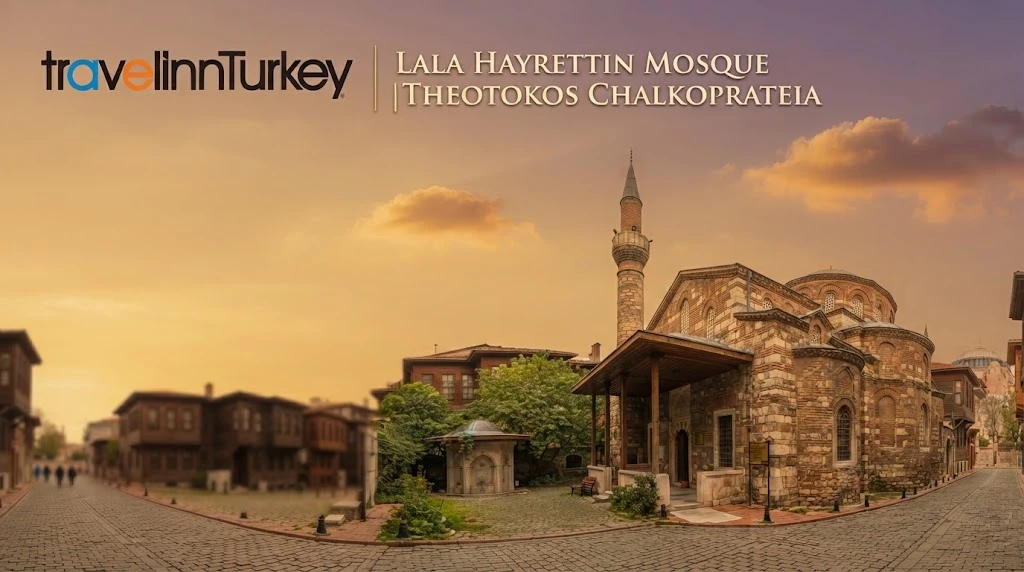
Byzantine Church of Theotokos Chalkoprateia in Istanbul
From Byzantine Sanctuary to a Mosque
There are places in Istanbul where history does not belong to a single period. One building can carry the memory of several centuries, several religions and several civilizations. The Byzantine Church of Theotokos of Chalkoprateia is one of these extraordinary places.
Today, the site is associated with the Lala Hayrettin Mosque, also known as Acem Aga Mescidi, in the Alemdar area of Istanbul's historic peninsula. Hidden almost in the shadow of Hagia Sophia, its story reaches back more than 1,500 years.
What does Chalkoprateia mean?
The name Chalkoprateia is generally understood as referring to the “Copper Market” or an area associated with copper workers and traders. It was an important neighborhood of Constantinople, situated only a short distance from Hagia Sophia.
The Byzantine church was dedicated to the Theotokos — the Mother of God, the Virgin Mary — and became one of the important Marian sanctuaries of Constantinople.
Historical sources are not completely consistent about its foundation. Some traditions associate its construction with Empress Pulcheria, sister of Emperor Theodosius II, while other sources connect its construction or completion with Empress Verina, wife of Emperor Leo I, in the fifth century.
That uncertainty actually makes the story more interesting. Even the origins of this ancient church are part of the historical puzzle of Constantinople.
A very important Byzantine church of Constantinople
The Chalkoprateia Byzantine church was not simply a neighborhood church.
It was one of the major churches dedicated to the Virgin Mary in Constantinople and formed part of a group of important Marian sanctuaries in the imperial capital.
The church was a three-aisled basilica, with an apse, narthex and atrium. Over the centuries it was repaired and altered several times. Justin II is associated with repairs after damage, while the church was substantially modified during the Byzantine period.
Its importance increased particularly because of the sacred objects associated with the Virgin Mary.
The Holy Belt of the Virgin Mary
One of the most fascinating chapters in the history of Chalkoprateia concerns the Holy Belt, or Girdle, of the Virgin Mary.
A chapel connected with the church was associated with the preservation of this important Marian relic. For centuries, Chalkoprateia was therefore not merely a place of worship but also a destination connected with one of the most important relic traditions of Byzantine Christianity.
Imagine Constantinople many centuries ago.
Pilgrims, clergy, members of the imperial court and ordinary residents would have passed through this part of the city, while the church stood close to the heart of the Byzantine capital.
Today, it is difficult to imagine that world when walking through the busy streets around Sultanahmet.
What happened after the Fourth Crusade?
The history of Chalkoprateia also reflects the difficult history of Constantinople.
During the Latin occupation of Constantinople from 1204 to 1261, the church was looted and lost parts of its treasures and possessions. It survived into the later Byzantine period, but eventually fell into decline.
By the time of the Ottoman conquest, the great Byzantine complex was already in a ruined condition.
From Byzantine church to Ottoman mosque
Around 1484, approximately three decades after the Ottoman conquest of Constantinople, the remains of the church were converted into a mosque by Lala Hayrettin.
This is where another name enters the story: Acem Aga Mescidi.
The mosque became associated with Acemi Ahmed Aga, who contributed to its endowment. Consequently, both Lala Hayrettin and Acem Aga became names connected with the building.
Importantly, the entire Byzantine basilica was not simply transformed into a mosque. Much of the original church had already disappeared, and the Ottoman prayer space incorporated only part of the surviving structure, particularly the eastern portion and apse.
Fires, destruction and disappearance
The building experienced further damage over the centuries.
It was repaired in the eighteenth century, including a major restoration in 1756, but later suffered further deterioration. By the twentieth century it had fallen into a very poor condition.
The minaret was demolished in 1937, and the structure eventually became little more than a ruin.
For a building that had once been one of Constantinople's important Marian churches, this was a remarkable transformation.
What can still be seen today?
And this is where the story becomes particularly interesting for anyone exploring Istanbul.
Only fragments of the original Byzantine complex survive. Archaeological investigations have revealed remains of the church, including portions of its walls and other structures associated with the complex.
An octagonal structure connected with the church complex has also attracted considerable scholarly attention. Its function has been debated, with interpretations including a baptistery or a chapel associated with St. Jacob. Byzantine fresco fragments have survived in this area.
The remains are therefore not necessarily the kind of monument that you walk into and immediately recognize as a magnificent Byzantine church.
Instead, Chalkoprateia is a place that requires imagination.
A Lesser known Byzantine story beside Hagia Sophia
Perhaps that is what makes Chalkoprateia so fascinating.
Visitors come to this part of Istanbul to see Hagia Sophia, the Blue Mosque, the Basilica Cistern and Topkapi Palace. Yet only a short distance away are fragments connected with another important chapter of Constantinople's history.
Standing here, you can almost follow the layers:
Byzantine Constantinople → Ottoman Istanbul → modern Istanbul.
A Christian basilica became an Ottoman mosque. The mosque later became a ruin. Archaeologists uncovered traces of the earlier Byzantine complex. And today, the surviving remains form another small piece of the enormous historical puzzle that is Istanbul.
Niobe's thought
I sometimes think that Istanbul's greatest stories are not always the ones standing proudly in front of us.
Sometimes they are hidden behind a wall, beneath a modern building or reduced to a few ancient bricks.
Chalkoprateia is one of those stories.
I passed through the Sultanahmet area knowing that Hagia Sophia was only a few steps away, but the history of this forgotten church reminded me that Istanbul has never had only one story.
Every street seems to have another one underneath it.
And perhaps that is the real magic of walking through Istanbul: you are never simply walking through a modern city. You are walking through Constantinople, Byzantium and Ottoman Istanbul at the same time.
Visiting Chalkoprateia with Travel Inn Turkey
For travelers interested in Byzantine Istanbul, Chalkoprateia can be combined with Hagia Sophia, the Basilica Cistern, the Hippodrome, the Church of St. Sergius and Bacchus, the Great Palace area and other lesser-known Byzantine remains of the Historic Peninsula.
It is particularly interesting for travelers who want to go beyond Istanbul's famous monuments and discover the hidden archaeological and religious history of the city.
Travel Inn Turkey can help you explore Istanbul not only through its famous landmarks, but also through the stories hidden between them.
Our partners