


Mısır Apartmanı: Istanbul’s Art Nouveau Landmark on Istiklal Street
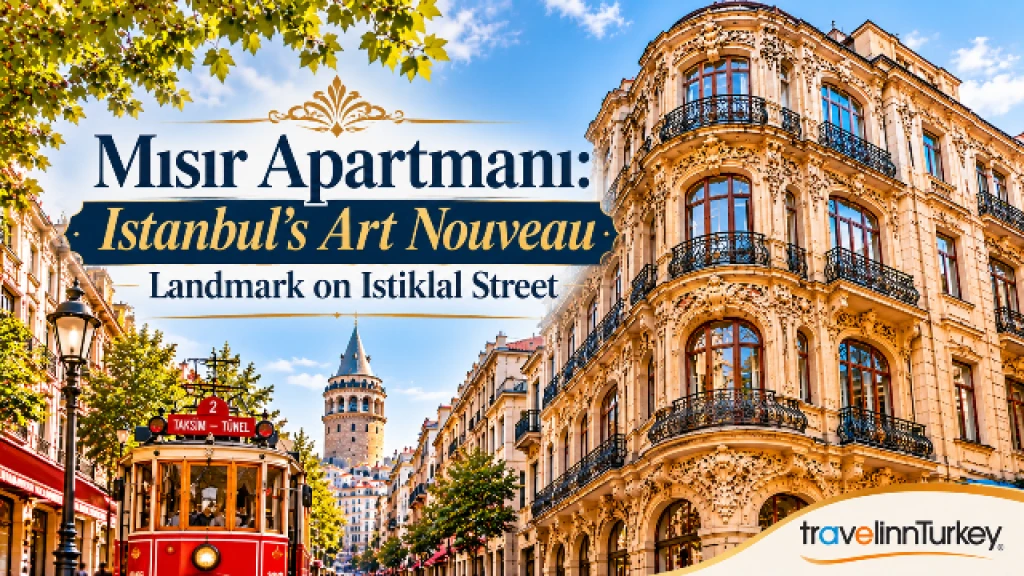
Misir Apartmani (Egypt Apartment):
Istanbul's Art Nouveau Landmark on Istiklal Street
There are buildings on Istiklal Street that are difficult to miss, and then there are buildings whose stories make you stop and look again. For me, Misir Apartmani — the Egypt Apartment — is one of those places.
When I walk along Istiklal Caddesi, I am always tempted to look beyond the shops, cafes and crowds and pay attention to the buildings themselves. They reveal another Istanbul, one shaped by the late Ottoman period, European architectural influences, artists, writers and the people who once lived and worked here. Misir Apartmani is one of the finest examples of that history.
Located at Istiklal Caddesi, Misir Apartmani is one of the best-known historic apartment buildings on the avenue. Its elegant Art Nouveau architecture, its connection with the Egyptian-born Ottoman statesman Abbas Halim Pasa, and most importantly its association with Mehmet Akif Ersoy, give the building a special place in Istanbul's cultural history. Current mapping information lists the building at No. 167, while historical and academic sources have also recorded other numbering systems over time.
The Story Behind the Name Misir Apartmani
The name Misir Apartmani, meaning Egypt Apartment, is connected to its patron, Abbas Halim Pasa, a member of the prominent Egyptian branch of the Ottoman aristocracy. The building was originally conceived not simply as an ordinary apartment block but as a prestigious winter residence.
Its story begins in the early twentieth century, at a time when Beyoglu was developing into one of Istanbul's most cosmopolitan districts. European architectural styles were increasingly visible along the Grand Rue de Pera, today's Istiklal Street, and wealthy residents commissioned impressive buildings that reflected the changing character of the city.
Misir Apartmani emerged from this period of transformation.
Hovsep Aznavur and the Art Nouveau Design
The architect behind Misir Apartmani was Hovsep Aznavur, an Ottoman Armenian architect whose work contributed significantly to Istanbul's architectural landscape.
Construction began in 1905 and was completed in 1910. The building is associated with the Art Nouveau movement, a style recognizable for its decorative lines, organic forms, floral details and emphasis on elegant facades. Academic research identifies Misir Apartmani as one of Istanbul's notable early reinforced-concrete buildings and places it at the intersection of Istiklal Caddesi and the surrounding streets of Beyoglu.
What I particularly like about Misir Apartmani is that its decoration does not feel completely detached from the character of Istanbul. Its European-inspired architectural language was adapted to the city in which it stood, creating a fascinating combination of international fashion and Ottoman-era urban culture.
A Remarkable Building on Istiklal Street
Look closely at the facade and you will notice the details that make Misir Apartmani different from an ordinary nineteenth- or early twentieth-century apartment building.
The facade features decorative stonework, large windows, projecting sections and balconies. Floral and ornamental details give the building the characteristic movement associated with Art Nouveau. The building's scale also makes it particularly impressive when seen among the much busier commercial buildings of modern Istiklal Street.
Academic architectural research describes the building as having an extensive footprint and multiple levels, while historical accounts note that its original configuration was different from the structure seen today. Later alterations changed the building, including the addition of floors and an elevator.
This is one reason I think it is worth slowing down when walking along Istiklal Caddesi. You can easily pass Misir Apartmani without realizing how much history is contained behind its facade.
From Winter Mansion to Historic Apartment
Misir Apartmani was originally constructed as a winter mansion for Abbas Halim Pasa. After his death, the building's function changed and it gradually became an apartment building with different residents and occupants.
Later modifications altered the original structure. Sources record that the building was sold in 1940 to businessman Hayri Ipar, after which additional floors and an elevator were introduced.
The building therefore tells more than one architectural story. What we see today is not simply the structure completed in 1910, but a building that has changed with Istanbul itself.
Misir Apartmani and Mehmet Akif Ersoy
For me, however, the most moving part of the story begins with Mehmet Akif Ersoy.
Ersoy is remembered above all as the poet of the Istiklal Marsi, Turkey's national anthem. His connection with Misir Apartmani gives the building a significance that goes far beyond architecture.
After spending more than a decade in Egypt, Mehmet Akif Ersoy returned to Turkey in 1936. During the final months of his life, he stayed at Misir Apartmani. Academic research records that he lived there from 16 June 1936 until his death on 27 December 1936.
That knowledge changes the way I look at the building.
When you stand outside Misir Apartmani today, you are not simply looking at an Art Nouveau apartment. You are standing outside a place associated with the final chapter in the life of one of Turkey's most important poets.
The Mehmet Akif Ersoy Memorial House
The connection between Mehmet Akif Ersoy and Misir Apartmani has not been forgotten.
The apartment where he spent his final months was transformed into the Mehmet Akif Ersoy Hatira Evi, or Mehmet Akif Ersoy Memorial House. It was opened to visitors in 2021, marking the centenary of the adoption of the Turkish national anthem. The memorial space was designed to preserve and present aspects of the poet's life and literary legacy.
The memorial includes spaces dedicated to his life and work, including a library, documentary area, poetry room and exhibition space. This makes Misir Apartmani particularly interesting for travelers who want to discover the literary history of Istanbul rather than only its famous monuments.
More Than Just an Art Nouveau Building
One of the things I have learned while exploring Istanbul is that architecture is often the easiest doorway into a much larger story.
Misir Apartmani connects several different worlds. Its patron was associated with Egypt and the Ottoman elite. Its architect was an Ottoman Armenian. Its architecture reflected European Art Nouveau. Its location was part of the cosmopolitan world of Pera and Beyoglu. And its later history became connected with Mehmet Akif Ersoy and Turkish literary and national history.
That mixture is what makes Istanbul so fascinating.
A single building can bring together Ottoman history, European architecture, Armenian architectural heritage, Egyptian connections and Turkish literature.
Where Is Misir Apartmani?
Misir Apartmani stands on Istiklal Caddesi in Beyoglu, in the Galatasaray area and close to St. Anthony of Padua Church.
It is particularly easy to include in an Istiklal Street walking tour because you can combine it with many other historic buildings, passages, churches, galleries and cultural landmarks along the avenue.
If you are walking from the Taksim direction toward Galatasaray, keep your eyes on the historic facades rather than concentrating only on the pedestrian street. Misir Apartmani is one of the buildings that rewards this kind of slower exploration.
Why I Think You Should Look Up at Misir Apartmani
I often think that visitors to Istanbul become so focused on famous landmarks that they miss the stories hidden in ordinary-looking streets.
Misir Apartmani is a perfect example.
It is not a palace like Dolmabahce. It is not a mosque like Suleymaniye. It is not an ancient Byzantine monument. Instead, it is an urban building that quietly witnessed the transformation of Istanbul from the late Ottoman period into the twentieth century.
Its Art Nouveau facade tells one story.
Its architect tells another.
Its original owner tells another.
And Mehmet Akif Ersoy's final months give it an intensely personal human story.
Misir Apartmani: A Must-See Historic Building on Istiklal Street
If you are exploring Istiklal Street in Istanbul, I recommend adding Misir Apartmani to your list of buildings to look for.
Do not simply take a photograph of the facade and continue walking. Take a moment to look at the architectural details and remember what happened here. This is a building that has survived more than a century of enormous change in Istanbul.
For me, Misir Apartmani represents exactly what makes exploring Istanbul so rewarding: history is not always behind museum doors. Sometimes it is standing directly in front of you, above the shops and cafes, waiting for you to look up.
And when I look at Misir Apartmani, I do not see only one of Istiklal Street's beautiful Art Nouveau buildings. I see a place where architecture and literature meet — a place that preserves the memory of Mehmet Akif Ersoy, one of Turkey's most important poets, and another fascinating chapter in the extraordinary story of Istanbul.
Niobe_
Our partners