


Panayia Vlaherna Meryem Ana Ayazması: A Historic Holy Spring in Istanbul
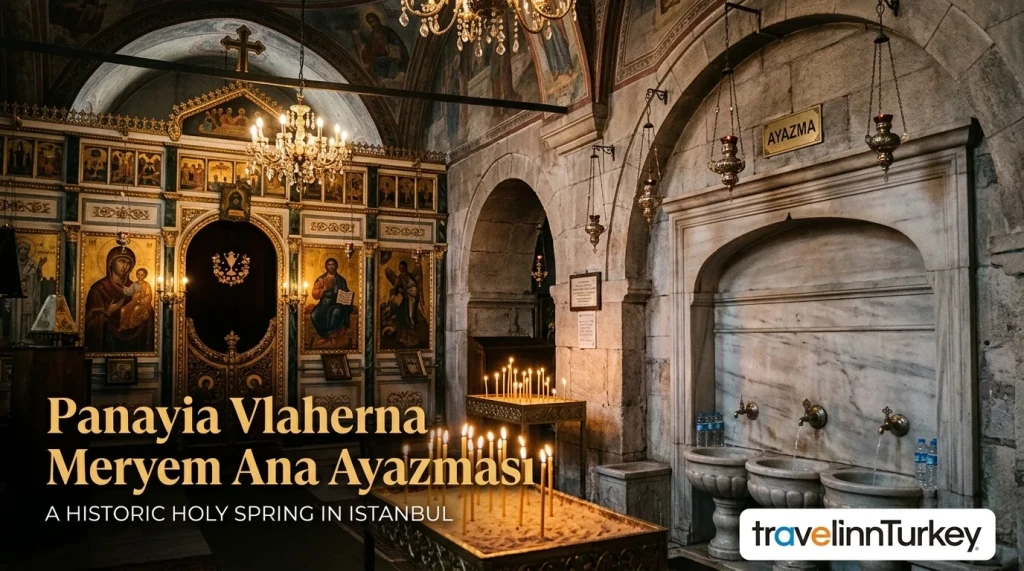
Panayia Vlaherna Meryem Ana Ayazmasi
A Historic Byzantine Holy Spring in Istanbul
Istanbul is famous for Hagia Sophia, the Blue Mosque, Topkapi Palace and the Grand Bazaar, but some of the city's most fascinating places are much smaller and easier to miss.
In the historic Ayvansaray neighborhood, near the Golden Horn, stands Panayia Vlaherna Meryem Ana Kilisesi and Ayazmasi, a small Greek Orthodox church associated with one of the most important Marian holy places of Byzantine Constantinople.
For travelers interested in Byzantine history, Orthodox Christianity and the lesser-known historical sites of Istanbul, Panayia Vlaherna offers a very different experience from the city's major monuments.
The present church is relatively modest, but the history connected with this location reaches back more than 1,500 years.
What Is Panayia Vlaherna Ayazmasi?
The Turkish word ayazma comes from the Greek word hagiasma, meaning a holy or sacred place associated with blessed water.
The Panayia Vlaherna Ayazmasi is a holy spring dedicated to the Virgin Mary, known in Turkish as Meryem Ana.
Today, the site is located in Ayvansaray, in Istanbul's Fatih district, at Ayvansaray Kuyusu Sokak. The surviving church and holy spring are associated with the historic Blachernae district of Constantinople.
The Byzantine Origins of Blachernae
The story of Vlaherna begins in the Byzantine period.
Around 450 AD, Empress Aelia Pulcheria began building a church near a holy spring outside the walls of Constantinople. After her death, the construction was completed by her husband, Emperor Marcian.
The location gradually became one of the most important religious centers associated with the Virgin Mary in Constantinople.
During the reign of Emperor Leo I, additional buildings were constructed beside the church. One of them, known as the Ayia Soros, became famous because it housed relics associated with the Virgin Mary, including her mantle and robe, which tradition says had been brought from Palestine in the fifth century.
The complex was subsequently restored and enlarged during the reigns of Justin I and Justinian I in the sixth century.
A Sacred Place for Byzantine Emperors
The importance of Blachernae grew considerably over the centuries.
The surrounding district eventually became closely connected with the imperial residence known as the Palace of Blachernae. Byzantine emperors increasingly used the area, turning Blachernae into an important political as well as religious center.
The church was especially associated with devotion to the Virgin Mary.
One of the most famous traditions connected with the site concerns the Blachernitissa, an icon of the Virgin Mary.
According to Byzantine accounts, the icon became associated with a miraculous event in which a veil covering the image was said to rise and reveal the Virgin's face before descending again. The tradition became known as the "habitual miracle."
Whether viewed as religious tradition or part of Byzantine history, these stories demonstrate the extraordinary importance that Blachernae held in medieval Constantinople.
The Miracle Associated With the Virgin Mary
Blachernae also became associated with the protection of Constantinople.
One of the most enduring traditions concerns the siege of Constantinople by the Avars and Persians in 626.
According to Orthodox tradition, the Virgin Mary appeared during the crisis and protected the city. The story became deeply connected with the religious identity of the Blachernae sanctuary.
A later tradition also explains why the church has historically had an unusual connection with Friday services rather than the usual Sunday tradition. The story attributes this to the miraculous protection of Constantinople.
Today, this unusual tradition remains one of the details that makes Panayia Vlaherna particularly interesting to visitors researching the religious history of Istanbul.
What Happened to the Original Byzantine Church?
The original Byzantine complex did not survive.
The church was damaged and rebuilt several times during its long history. A major fire in 1070 destroyed the church, after which it was rebuilt during the reigns of Romanos IV Diogenes and Michael VII Doukas.
The sanctuary survived for several more centuries, but its history eventually came to a tragic end.
On 29 June 1434, a fire accidentally started by children hunting pigeons on the roof destroyed the church and much of the surrounding area.
The great Byzantine sanctuary of Blachernae disappeared, although the sacred spring and the memory of the site continued.
The Church You See Today
The building visitors see today is not the original Byzantine church.
The present church was constructed in the nineteenth century on the historic site associated with the earlier sanctuary and holy spring.
Sources differ slightly on the construction date, with historical documentation associating the present structure with the Orthodox Furriers' Guild and the rebuilding of the site in the 1860s. A recent academic study records the church as having been built in 1869.
This distinction is important for travelers.
You are not standing inside the original fifth-century Byzantine church. Instead, you are visiting a later church built at a location whose religious significance goes back to Byzantine Constantinople.
The continuity of the holy spring is what makes the site particularly fascinating.
The Ayazma and Its Holy Water
The ayazma is one of the most meaningful parts of the site.
For centuries, Orthodox Christians have regarded sacred springs as places of prayer and spiritual healing. At Vlaherna, the water is associated with the Virgin Mary.
The surviving spring is much more modest than the monumental Byzantine church that once stood here. Yet its continued presence creates a remarkable link between modern Istanbul and the religious landscape of Constantinople.
The Turkish Encyclopedia of Islam describes the Blachernae ayazma as a Marian holy spring located inside the historic city walls and notes that water continues to collect at the site.
For visitors, the importance of the water is therefore not simply architectural. It is part of a living religious tradition.
Where Is Panayia Vlaherna Ayazmasi?
Panayia Vlaherna is located in the Ayvansaray neighborhood of Fatih, close to the Golden Horn and the historic land walls of Istanbul. Its location makes it possible to combine a visit with several other historical sites in the Ayvansaray, Balat and Golden Horn area.
Why Visit Panayia Vlaherna?
Panayia Vlaherna is not the kind of Istanbul attraction where you should expect a huge monument or a long museum visit.
Its appeal is different.
It is a place for travelers who want to discover the layers of Istanbul's history.
Here, a small modern Orthodox church stands on a site connected with a major Byzantine Marian sanctuary, imperial Constantinople, ancient religious traditions and the sacred spring that gave the location much of its importance.
For anyone interested in Byzantine Istanbul, the site offers an opportunity to think beyond the famous monuments and discover the smaller places where history has continued quietly.
A Different Side of Byzantine Istanbul
Many visitors associate Byzantine Istanbul almost exclusively with Hagia Sophia.
But Constantinople was filled with churches, monasteries, shrines, holy springs, palaces and religious institutions.
Blachernae was one of the most important areas of this Byzantine world.
Its history also demonstrates how Istanbul's past is not divided neatly into Byzantine, Ottoman and modern periods. Different communities, buildings and traditions have continued to overlap in the same neighborhoods.
Panayia Vlaherna is a particularly good example of this continuity.
Visiting With Respect
Panayia Vlaherna remains a functioning Orthodox place of worship rather than simply a tourist attraction.
Visitors should therefore behave respectfully, especially during religious services.
Dress modestly, keep voices low and follow any instructions given by the church caretaker or clergy. Photography may also be restricted inside the church at certain times.
Opening arrangements and service times can change, so travelers should check locally before planning their visit.
Panayia Vlaherna and the Hidden History of Istanbul
One of the great pleasures of exploring Istanbul is discovering places that are almost invisible to the average visitor.
Panayia Vlaherna may not have the monumental scale of Hagia Sophia, but its story reaches deep into the history of Constantinople.
Behind the small church is the memory of a much larger Byzantine sanctuary, imperial ceremonies, devotion to the Virgin Mary, sacred water and centuries of religious tradition.
The original church disappeared long ago, but the sacred landscape survived.
That is what makes Panayia Vlaherna Ayazmasi worth discovering.
Travel Inn Turkey: Discover the Istanbul Most Travelers Miss
At Travel Inn Turkey, we believe that discovering Istanbul means looking beyond the famous landmarks.
The city's real character can often be found in its historic neighborhoods, ancient churches, forgotten Byzantine remains, Ottoman streets, hidden courtyards and small places of worship.
Panayia Vlaherna is one of those places.
If you are interested in Byzantine history, Orthodox heritage and the hidden historical treasures of Istanbul, adding Ayvansaray and Blachernae to your Istanbul itinerary can reveal a completely different side of the city.
Travel Inn Turkey can help you discover Istanbul through its history, culture, neighborhoods and unforgettable stories.
Our partners