


Saint Therapon’s Holy Spring in Istanbul: A Hidden Orthodox Shrine
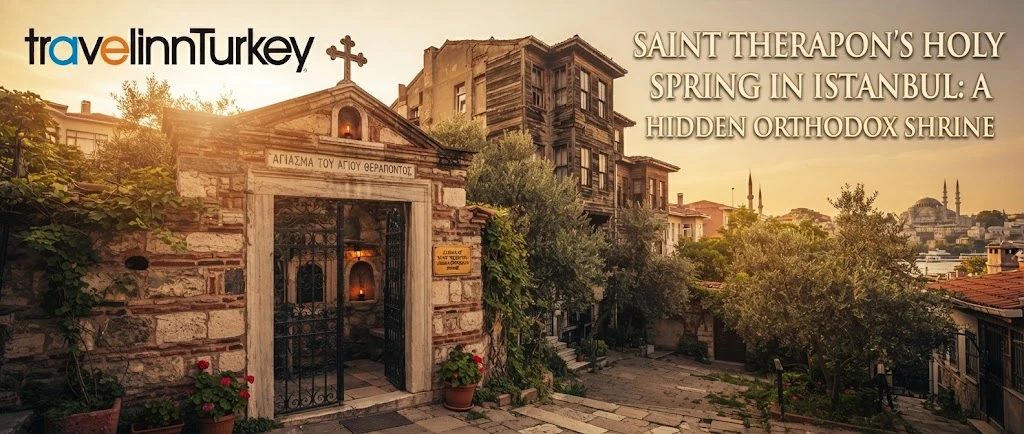
Saint Therapon Holy Spring in Istanbul
A Hidden Orthodox Shrine
There are places in Istanbul that you discover because you are looking for them.
And then there are places that seem to find you.
Agios Therapontas Ayazma, also known as Aya Therapon Ayazmasi, is one of those places.
Hidden almost unnoticed among the buildings and busy streets of Istanbul, this small Orthodox holy spring is surprisingly close to Hagia Sophia. Yet, unless you already know where to look, you could walk past it many times without realizing what is behind its unassuming entrance.
I know this because I did exactly that.
I Walked Past It Many Times
I had passed along this street very often.
The area around Hagia Sophia is always busy. Visitors are walking towards the monuments, trams are passing nearby, shops are open and the streets are filled with the everyday movement of Istanbul.
There was nothing about one particular building that suggested there was a holy place inside.
No large church façade.
No impressive dome.
No obvious cross.
Just a tall building standing among the others.
Then, one day, something caught my attention.
The smell of incense.
More precisely, the distinctive sweet and smoky scent of livani, the incense traditionally burned in Orthodox churches.
I stopped for a moment and looked around.
Where was the church?
There was no obvious church in sight.
I continued on my way.
But the smell stayed in my mind.
A Door That Was Open
Another day, I passed the same place again.
This time, something was different.
The door was open.
Curiosity won.
I went inside.
There were only a few steps leading down from street level, and suddenly the character of the place changed completely.
Behind the ordinary street façade was a small, quiet and deeply atmospheric Orthodox holy place.
There was a priest inside, together with only a few people.
It was certainly not a planned visit. I had been walking with shopping bags in my hands and, almost instinctively, I apologized to the priest for entering in that state.
But I explained why I had come.
I told him that I had passed the building before and that, on the first occasion, the smell of incense had caught my attention even though I could see no church nearby.
The priest listened and explained that not everyone knows about this place.
He also told me about the days when the Ayazma is open, allowing people to enter, light a candle and pray.
That small conversation made the discovery even more meaningful.
I had not searched for Agios Therapontas Ayazma.
I had simply followed a scent.
What Is an Ayazma?
The word Ayazma comes from the Greek hagiasma, meaning a holy or sanctified place.
In Istanbul, the term is traditionally associated with holy springs and sacred water, particularly places connected with the Orthodox Christian tradition.
Many ayazmas are extremely modest in appearance. Some are hidden beneath buildings, inside courtyards, below street level or incorporated into structures that give almost no indication of their religious importance from the outside.
This is part of what makes Istanbul's ayazmas so fascinating.
They are not always monuments that announce themselves.
Sometimes, they are places that survive quietly within the modern city.
Agios Therapontas Ayazma
The Agios Therapontas Ayazma is dedicated to Saint Therapon (Agios Therapontas), a Christian saint and martyr traditionally associated with healing.
The holy place is located in the historic area around Hagia Sophia, making it particularly interesting for visitors exploring Istanbul's Byzantine and Orthodox heritage.
Its location is also remarkably convenient.
The tram stop is directly opposite the holy place, while Hagia Sophia is only a short walk away.
For thousands of visitors coming to Istanbul to see the great monuments of the historic peninsula, it is easy to imagine walking past this place without ever realizing that a small Orthodox sanctuary is hidden just a few steps away.
A Hidden Orthodox Place in the Heart of Istanbul
What makes Agios Therapontas Ayazma special is not its size.
It is precisely the opposite.
There is no monumental architecture competing for attention.
There is no large entrance inviting tourists inside.
Instead, the experience is intimate.
You descend a few steps from the pavement and enter a space that feels separated from the noise of the city above.
For someone interested in the Orthodox heritage of Istanbul, these small sacred places offer a different perspective from the famous churches and monuments.
They reveal a quieter layer of the city's history.
Visiting Agios Therapontas Ayazma
Because this is a functioning religious place rather than simply a tourist attraction, visitors should approach it with respect.
The Ayazma is not necessarily open continuously. Opening days and hours can depend on the religious community and the priest responsible for the place.
If the door is open, visitors may be able to enter, light a candle and pray.
It is advisable to dress respectfully and maintain the quiet atmosphere of the sanctuary.
And perhaps, if you are lucky, you may notice what first caught my attention:
the smell of incense before you even realize where it is coming from.
A Different Way of Discovering Istanbul
Istanbul is famous for Hagia Sophia, the Blue Mosque, Topkapi Palace and the Grand Bazaar.
But sometimes the most memorable discoveries are not the places listed on every tourist map.
They are the small doors.
The forgotten corners.
The old fountains.
The ayazmas hidden beneath modern buildings.
And sometimes, all it takes is a familiar scent drifting into the street.
For me, Agios Therapontas Ayazma began with the smell of livani.
I walked past it without knowing what was there.
Then I walked past it again.
And when the door was finally open, a few steps took me from the busy streets of Istanbul into a small and peaceful Orthodox holy place.
That was how I discovered Agios Therapontas Ayazma.
And perhaps that is the best way to discover some of Istanbul's hidden places—not by searching for them, but by paying attention when the city quietly gives you a reason to stop.
Niobe_
Our partners