


Studios Monastery in Istanbul: A Hidden Byzantine Landmark in Yedikule
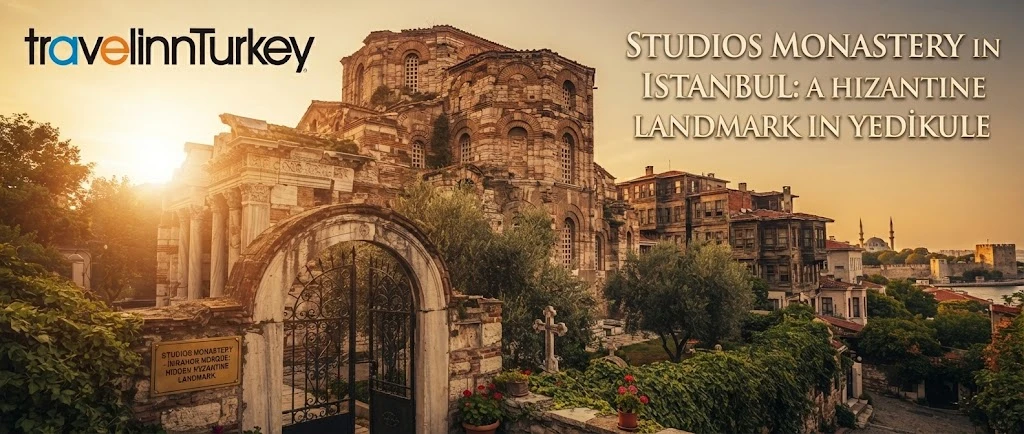
Studios Monastery in Istanbul
Niobe’s Unexpected Discovery
There are discoveries in Istanbul that begin with a guidebook.
And then there are discoveries that begin with a wall.
This one began with almost nothing.
I was walking in Yedikule, not far from the Church of Saints Constantine and Helena, whose tall brick-colored bell tower makes it surprisingly easy to find your way through the neighborhood.
I had passed the church before.
But just a few steps away, something else caught my attention.
There was a wall.
At first, I barely noticed it.
One of the side windows appeared to have been sealed with stones. There was no obvious entrance, no sign explaining what stood behind it, and nothing that immediately told me whether I was looking at an old school, a mosque, a forgotten religious building—or simply part of someone's property.
So I continued walking.
But Istanbul has a habit of leaving questions behind.
And sometimes the smallest question leads to the oldest story.
I Came Back
On another day, I decided to approach the place from the back.
Still no obvious answer.
The wall continued around the structure, keeping whatever was inside almost completely hidden.
Then, on yet another visit, something had changed.
The door was open.
Inside, I could see people working.
And then I saw them.
Columns.
Beautiful, ancient-looking columns standing inside a structure that, from the street, was almost invisible.
There was still no entrance for visitors, and I could not properly explore the interior. But it was enough.
Something important was being restored.
Someone nearby told me that it had once been a monastery.
A monastery?
That changed everything.
The Name That Opened the Door to the Past
I started searching.
And eventually the name appeared:
Studios Monastery.
More precisely, the Monastery of Studios, whose church was dedicated to Saint John the Baptist — Ioannes Prodromos.
The building is also known today as Imrahor Ilyas Bey Camii, or Imrahor Aniti.
And suddenly, the mysterious wall in Yedikule had become something completely different.
It was not an abandoned school.
It was not an ordinary mosque.
Behind that wall was part of one of the most important Byzantine monasteries of Constantinople.
The surviving church dates from the 5th century and is considered the oldest surviving church building in Istanbul.
Older Than Hagia Sophia
This was the moment when the discovery became extraordinary.
The church of the Studios Monastery was built around the middle of the 5th century, long before the construction of Hagia Sophia under Justinian.
The monastery became one of the great religious and intellectual centres of Constantinople.
Its monks were known as Studites, and the monastery became particularly important for its religious scholarship, manuscript production and spiritual life.
The complex survived centuries of political and religious upheaval.
It also witnessed the dramatic transformation of Constantinople itself.
From Byzantine monastery...
to Ottoman mosque...
to ruin...
and now, once again, a monument undergoing conservation.
But Why Was There Such a Wall?
This was one of the questions that stayed with me.
I remembered having read that churches in Ottoman Istanbul were sometimes subject to restrictions concerning their construction, height, appearance and relationship to surrounding buildings.
There is indeed a historical basis for this.
After the Ottoman conquest, the construction and repair of Christian places of worship were subject to regulations and, in many circumstances, required official permission. New churches in particular faced serious restrictions, while existing churches could be repaired only under controlled conditions.
But there is an important detail in the story of Studios.
The high wall around the complex was not necessarily an Ottoman invention.
Historical evidence indicates that the monastery was already enclosed by substantial walls in the Byzantine period. A description and depiction associated with the late Byzantine period show the church surrounded by a high enclosure.
So perhaps the wall that first seemed to hide the building was itself part of the story.
The wall was not simply hiding history.
It was history.
From Studios to Imrahor
After the Ottoman conquest, the church eventually changed function.
During the reign of Sultan Bayezid II, the building was granted to Ilyas Bey, an Ottoman official whose title, Imrahor, referred to the keeper of the imperial stables. The former monastery church was subsequently converted into a mosque and became known as Imrahor Ilyas Bey Camii.
For centuries, the building continued to experience the changing life of Istanbul.
Then came disaster.
A major fire in 1782 severely damaged the building.
The earthquake of 1894 caused further damage.
And in the winter of 1908, the already weakened roof collapsed under the weight of accumulated snow.
After that, the building was never fully restored to its former state.
The ruins remained.
The columns remained.
Fragments of the Byzantine structure remained.
And the story remained.
Look Closely at Those Columns
This is one of the details I wish every visitor could see.
The church originally had a basilica plan, with rows of columns dividing the interior into three aisles.
Some of the surviving columns and architectural elements are made of Proconnesian marble, while the surviving capitals and other fragments still reveal the sophistication of the original Byzantine decoration.
There was also an extraordinary decorative floor.
Parts of the medieval opus sectile pavement survived.
That means that beneath the ruined structure, Istanbul still preserves fragments of a highly sophisticated geometric marble floor created during the Byzantine period. Scholars have specifically studied and documented the surviving pavement as an important part of the monument's conservation.
Imagine walking here more than a thousand years ago.
Imagine the monks.
The manuscripts.
The prayers.
The marble.
The columns.
The courtyard.
And the enormous city surrounding the monastery.
The Monastery That Almost Disappeared
The Studios Monastery was not an insignificant religious building.
It played an important role in Byzantine religious and intellectual life.
The monastery was associated with manuscript production and the preservation of texts, and the Studite tradition became influential far beyond Constantinople.
Yet today, many people walking through Yedikule have no idea what is hidden behind the walls.
Even more remarkable is the fact that the surviving church is not currently an ordinary tourist attraction with a permanent visitor entrance.
From the street, it can be easy to mistake it for a neglected historical structure.
That is precisely what makes the discovery so powerful.
Then I Saw the Restoration
When I returned and saw people working inside, I did not yet know exactly what they were doing.
But I was happy.
Someone was finally taking care of the building.
That impression was correct.
The restoration of Imrahor Ilyas Bey Mosque has been undertaken under the supervision of the General Directorate of Foundations. A comprehensive conservation project had previously been approved, and restoration work began in 2023. One important step was the installation of a temporary protective roof after roughly a century without a proper roof over the main structure.
For a monument that has survived fires, earthquakes, abandonment and centuries of changing use, that is an extraordinary development.
My Accidental Discovery
Perhaps the most beautiful part of this story is that I did not discover Studios Monastery because I was looking for it.
I discovered it because I noticed something that did not make sense.
A sealed window.
A wall.
A strange building.
An unanswered question.
Then another visit.
Another angle.
An open door.
A glimpse of columns.
And finally, a name.
Studios.
That is how Istanbul sometimes reveals itself.
Not through the monuments everyone knows.
But through the things we almost walk past.
If You Walk Through Yedikule...
Look beyond the famous Yedikule Fortress.
Look beyond the great city walls.
Look beyond the better-known churches.
The area around Yedikule is one of those extraordinary parts of Istanbul where Byzantine, Ottoman and modern Istanbul exist almost on top of one another.
The Church of Saints Constantine and Helena stands nearby, and the relationship between the church, the surrounding streets and the remains of Studios creates a fascinating historical landscape. The Church of Saints Constantine and Helena itself has a long history and received its present bell tower in 1903.
And somewhere among those ordinary-looking streets stands a monument that began its life more than fifteen centuries ago.
Today, its name may be Imrahor Ilyas Bey.
But beneath that later name is another:
Studios.
And beneath the ruins is the story of Constantinople.
Niobe's Istanbul
I went looking for something I could not identify.
I found a monastery.
I thought I had found an old wall.
Instead, I had found a doorway into Byzantine Constantinople.
And perhaps that is the real magic of Istanbul:
you never know what is waiting behind the next wall.
Travel Inn Turkey — Discover the Istanbul hidden behind the obvious.
Our partners