


Valens Aqueduct in Istanbul: History and What to See
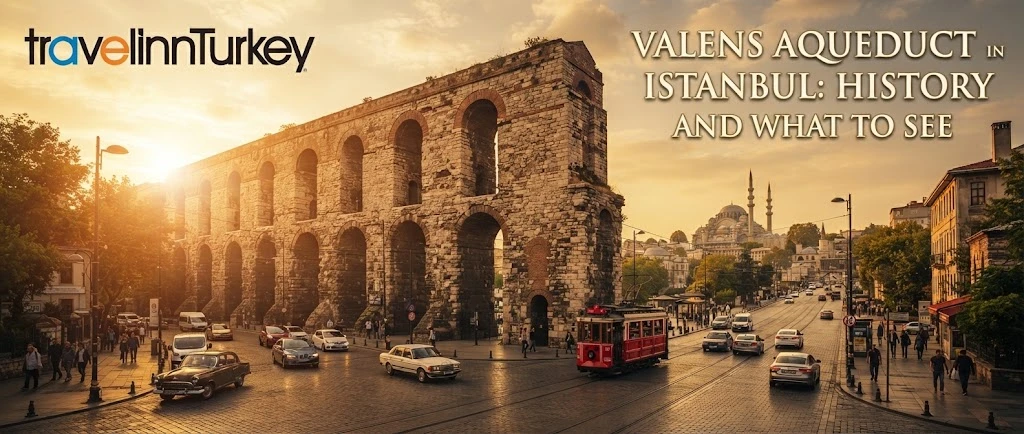
Valens Aqueduct In Istanbul
Sometimes, the places that make us curious are not the places we planned to visit.
For me, it happened while I was sitting on a bus in Istanbul.
As we were passing through the streets of Fatih, something caught my eye. It looked almost like a bridge crossing the road from one side to the other. But it was different from any bridge I had seen before.
It was made of stone.
It was enormous.
And it seemed completely out of place among the modern traffic, buildings and busy streets of Istanbul.
I kept looking at it through the bus window.
What is this?
Later, I discovered its name: the Valens Aqueduct, known in Turkish as Bozdogan Kemeri.
And suddenly, my simple bus journey became a little journey into the history of Istanbul.
A Roman aqueduct in the middle of modern Istanbul
The Valens Aqueduct is one of those monuments that makes Istanbul feel different from almost any other city.
Today, cars, buses and people pass underneath it every day. Around it are modern roads, shops, apartments and the constant movement of the city.
Yet the stone arches belong to another world.
The aqueduct was part of the enormous water-supply system of Constantinople, the city that became the capital of the Eastern Roman Empire. Its surviving structure reminds us how important water was to a growing imperial city.
The monument is commonly known as Bozdogan Kemeri in Turkish and Valens Aqueduct in English.
When I first saw it, I didn't know any of this.
I simply saw a strange stone structure crossing the city.
And that was enough to make me curious.
Who carried all those stones?
This was probably my first question.
When you look at the aqueduct from the road, it is easy to forget what its construction must have meant.
There were no modern cranes.
No trucks carrying prefabricated sections.
No machines capable of lifting enormous blocks into place with the push of a button.
Instead, generations of workers, craftsmen, engineers and laborers had to turn stone, brick, mortar and human effort into an enormous water system.
Looking at the arches today, I sometimes find myself imagining the people who built them.
Who carried the stones?
Who measured the height?
Who decided where each arch should stand?
How did they maintain the correct slope so that water could actually travel through the system?
And, perhaps most amazingly:
How long did it take?
These are the questions that make ancient monuments come alive.
The engineering behind the Valens Aqueduct
An aqueduct was not simply a stone bridge.
Its real purpose was to transport water.
Water had to travel from distant sources towards the city, following a carefully calculated route and gradient. The aqueduct allowed the water channel to cross valleys and lower areas while maintaining its necessary course.
That is why the structure can look like a bridge but function as something very different.
It was part of the infrastructure that helped support one of the great cities of the ancient and medieval world.
The scale of the water system is one of the things that makes the Valens Aqueduct so fascinating.
What we see today is only part of a much larger story.
Valens Aqueduct and Constantinople
The aqueduct is associated with the reign of the Roman Emperor Valens in the 4th century.
By this period, Constantinople was developing into an important imperial capital, and supplying its growing population with water was an enormous challenge.
The aqueduct became part of the city's wider water infrastructure.
Over the centuries, the city changed.
Empires changed.
Rulers changed.
Religions, languages and neighborhoods changed.
But the aqueduct remained.
That is one of the extraordinary things about standing beneath it today.
The road around you may be modern, but the stone above you connects the present city with Constantinople and the Roman world.
Bozdogan Kemeri: a monument hiding in plain sight
What I particularly love about the Valens Aqueduct is that you don't necessarily need to make a special archaeological journey to find it.
You can simply be travelling through Istanbul and suddenly notice it.
That was my experience.
It wasn't on my list.
It wasn't something I had planned to photograph.
It simply appeared through the bus window.
And after noticing it once, I started noticing it again.
Every time I passed, my eyes went towards those arches.
I began wondering about the people who built them and about the thousands of people who must have walked, travelled and lived around them throughout the centuries.
Istanbul is full of stories like this
Perhaps this is one of the reasons I enjoy travelling through Istanbul.
The city doesn't always announce its history.
Sometimes history is hidden inside a church.
Sometimes it is underneath a modern building.
Sometimes it is a small fountain in an unexpected street.
And sometimes it is a gigantic Roman aqueduct standing directly above a busy road.
You can be sitting on a bus, looking out of the window, and suddenly find yourself looking at something that was already here more than a thousand years ago.
That is Istanbul.
Seeing the Valens Aqueduct with Niobe
If you are exploring the historic districts of Istanbul, keep your eyes open around Fatih and the area of Bozdogan Kemeri.
Don't just look at the destination you have planned.
Look through the window.
Look up.
Look down the side streets.
Istanbul rewards curiosity.
For me, the Valens Aqueduct started with a simple question:
"What is that?"
And that question led me to one of the most fascinating reminders of Roman Constantinople that can still be seen in the modern city.
The next time I pass underneath those enormous arches, I know I will probably look up again.
And I will still wonder:
Who carried all those stones?
Perhaps that is the best thing about historic places.
Even after we learn their names and their history, they can still leave us with questions.
And sometimes, those questions are what make us want to travel further.
Niobe’s Istanbul discoveries with Travel Inn Turkey.
Our partners