


Aya Yorgi Church on Büyükada: Istanbul’s April 23 Pilgrimage
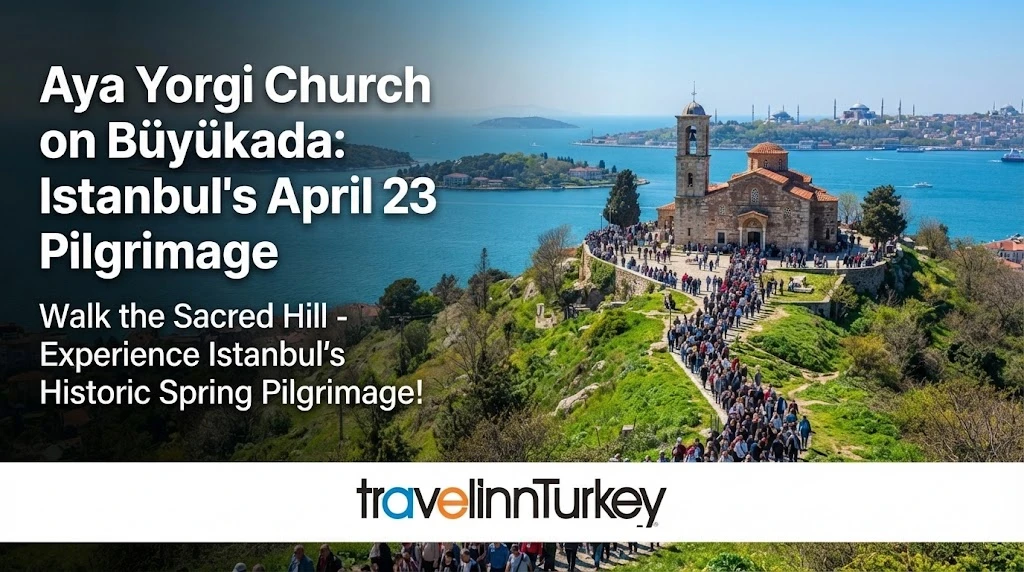
Saint George Church on Buyukada
The Sacred April 23 Pilgrimage in Istanbul
There are places in Istanbul where history speaks through ancient stones, and others where faith can be felt in the footsteps of the people who climb towards them. On Buyukada, the largest of Istanbul’s Princes’ Islands, one such place stands on a hill overlooking the sea: Aya Yorgi Church, the Greek Orthodox Monastery of Saint George. Every year, on April 23, thousands of people make their way up the hill, drawn by faith, hope, tradition, or simply the desire to experience one of Istanbul’s most remarkable cultural gatherings.
For Niobe, the journey to Aya Yorgi is not merely an excursion to a historic monument. It is an encounter with the stories people carry in their hearts, the customs passed from one generation to another, and the extraordinary way a sacred place can bring people of different backgrounds together.
A Church Above the Sea: The History of Aya Yorgi
The story of Aya Yorgi begins long before Buyukada became a popular escape from Istanbul. According to local historical accounts, the monastery’s origins date back to the Byzantine period, traditionally associated with the year 963, during the reign of Emperor Nikephoros II Phokas. The site is also linked by historians to references in Byzantine documents from later centuries. Although the precise details of its earliest history remain difficult to establish, its long religious association gives the hill a special place in the heritage of the Princes’ Islands.
The monastery is dedicated to Saint George, known in Greek as Agios Georgios and in Turkish as Aya Yorgi. Saint George was a Christian soldier traditionally associated with Cappadocia who became one of Christianity’s most beloved martyrs. His story travelled across countries and cultures, and his image is often depicted on horseback, confronting a dragon that symbolizes evil.
Over the centuries, Saint George became a figure of courage, protection and hope. His name continues to inspire devotion among Orthodox Christians, while stories about his miraculous intervention have helped make shrines dedicated to him important destinations for pilgrims.
The monastery we see today reflects several stages of construction. A smaller church and chapel complex was established in 1751, while a new stone church was built in 1905 and opened for worship in 1909. Perched on Yucetepe, one of Buyukada’s highest points, the monastery offers a striking combination of religious heritage, peaceful surroundings and sweeping views across the Sea of Marmara.
Why April 23 Is So Special
Every year, April 23 brings a remarkable change to Buyukada. The island’s streets, usually associated with leisurely walks, historic mansions and seaside cafes, become part of a much larger pilgrimage. Visitors travel from Istanbul and beyond to climb towards Aya Yorgi, where Saint George’s feast day is commemorated.
For Greek Orthodox Christians, the day has deep religious significance. It is an occasion to honour Saint George, light candles, offer prayers and seek spiritual comfort. Families may visit together, continuing a tradition that has connected generations of worshipers with the monastery.
Yet Aya Yorgi is also famous for something that reaches beyond the boundaries of a single religious community. Many Turkish Muslim visitors join the pilgrimage, hoping for health, happiness, family well-being, success or a new beginning. Some come with a specific wish in mind; others accompany relatives or friends, while many are drawn by the unique atmosphere of the day.
This shared pilgrimage has made Aya Yorgi an important example of how popular religious traditions can cross communal boundaries in Turkey. The experience is not identical for every visitor: for some, it is an act of Christian devotion; for others, it is a personal spiritual journey shaped by family customs, local stories and individual beliefs.
The Climb of Hope: Customs and Traditions
The walk towards Aya Yorgi is one of the most memorable parts of the experience. From the Lunapark area, visitors follow the uphill route towards the monastery. The path is not simply a way to reach a destination; for many people, it becomes a symbolic journey in which each step represents patience, hope and a private prayer.
One of the best-known customs involves a spool of thread. Some visitors begin the climb by unwinding a length of thread as they walk towards the church. The practice is associated with making a wish, and participants may hope that completing the journey will bring good fortune or help fulfill a heartfelt desire. Some people also choose to walk quietly or barefoot as an expression of devotion or personal sacrifice.
These practices are popular traditions rather than requirements of Greek Orthodox worship, and not every pilgrim follows them. Their meaning differs from person to person. A visitor may wish for a loved one’s recovery, a peaceful family life, a job, a home or the courage to face a difficult period.
There is something deeply human about this ritual. In a world where so much seems beyond our control, the act of walking uphill, holding a wish in the heart and taking one step after another can become a way of expressing hope.
The climb is sometimes described as a difficult or penitential journey. However, visitors should remember that the path can be steep and tiring, particularly on crowded days. Comfortable footwear, water and a little patience make the experience safer and more enjoyable.
A Shared Sacred Place for Greeks and Turks
Perhaps the most moving aspect of Aya Yorgi is the diversity of the people who come here. On April 23, Greek Orthodox pilgrims and Turkish visitors may find themselves following the same path, pausing at the same viewpoints and waiting to enter the same sacred grounds.
Their beliefs and reasons for visiting may differ, but many arrive with a similar desire: to find comfort, to express gratitude, or to hope for a better future.
This shared tradition has attracted scholarly attention, too. Research on the Aya Yorgi pilgrimage describes the monastery as a shared sacred site, demonstrating how religious spaces can acquire meanings that extend beyond the community for which they were originally established.
It is important not to confuse these customs or suggest that everyone practices the same faith. Aya Yorgi remains a Greek Orthodox monastery, with its own religious identity and traditions. The presence of visitors from other backgrounds adds another layer to its social history, illustrating a distinctive aspect of Istanbul’s cultural life.
For Niobe, this is one of the most meaningful stories the island has to offer: a place rooted in a particular religious tradition that has also become part of the personal memories and hopes of many people from different walks of life.
What to Expect When Visiting Aya Yorgi Church
Although April 23 is the best-known pilgrimage date, Buyukada is worth visiting throughout the year. On an ordinary day, the walk to Aya Yorgi offers a quieter experience, with opportunities to appreciate the island’s natural scenery and the monastery’s historical setting.
Visitors should allow time for the uphill walk and for enjoying the views from the summit. The route from the Lunapark area is approximately one kilometer, although the effort required depends on the pace, weather and individual fitness. The climb can take longer during the April 23 celebrations, when large crowds gather along the approach.
Inside the religious grounds, visitors should behave respectfully. Modest clothing, quiet conversation and consideration for people praying are appropriate. Photography should be undertaken discreetly, and visitors should follow any instructions given by church staff regarding access, services and photography.
Those planning to visit specifically on April 23 should expect busy transport services and significant crowds. It is sensible to travel early, check ferry schedules in advance and allow extra time for the walk. The church’s opening arrangements and access to particular areas may vary, especially during religious celebrations.
Buyukada itself offers plenty to discover before or after the climb, including historic wooden mansions, quiet streets, seaside promenades and cafes. A visit to Aya Yorgi can therefore become part of a fuller day exploring the cultural heritage and slower pace of life of the Princes’ Islands.
More Than a Destination: A Story of Faith and Hope
As the climb reaches its end and the view opens across the Sea of Marmara, the journey begins to feel like something more than a walk up a hill. Behind every pilgrim may be a different story: a prayer for a family member, a hope for a new beginning, a promise made during a difficult time, or a tradition that has been followed for decades.
For Greek Orthodox Christians, Aya Yorgi remains a place of devotion to Saint George. For many Turkish visitors, the pilgrimage is a familiar custom associated with wishes and hope. For travellers interested in Istanbul’s layered history, it offers a rare opportunity to witness how religious heritage continues to shape everyday life.
The enduring appeal of Aya Yorgi lies in this meeting of history and human experience. The monastery preserves memories of Byzantine Istanbul, while the annual pilgrimage reveals traditions that remain alive in modern Turkey.
For myself Niobe, I believe that discovering a destination means looking beyond its buildings and landscapes to understand the people, beliefs and stories that give it meaning. On Buyukada, the path to Saint George’s Church remind us that sometimes the most memorable journeys are not measured by distance, but by the hopes we carry along the way.
Our partners