


Santa Ruins in Gumushane: Niobe Discovers a Forgotten Mountain Settlement
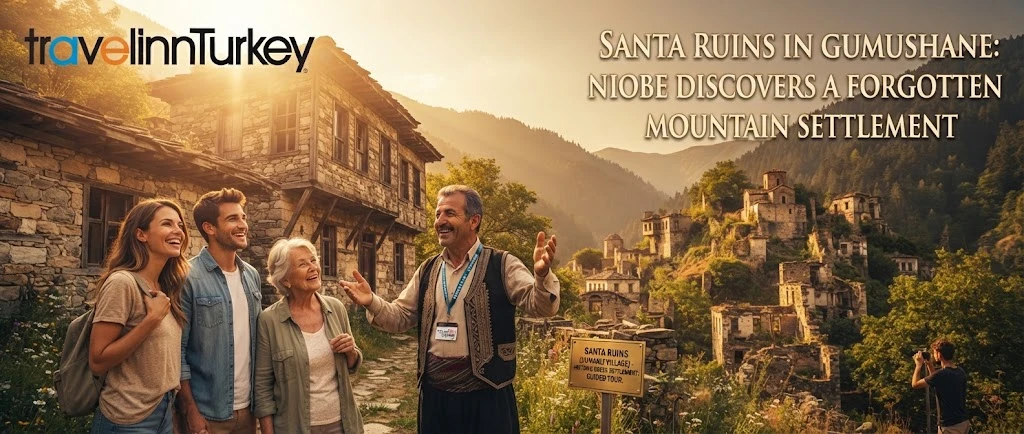
Santa Ruins in Turkey
Niobe Discovers the “Santa” Hidden in the Mountains of Gumushane
Gumushane • Santa Ruins • Karaca Cave • Tomara Waterfall • Black Sea Turkey
Santa?
The word is familiar.
Especially when the festive season is approaching, “Santa” immediately brings Christmas, snow, presents and stories of a very different kind.
But Niobe has discovered another Santa.
And this one is in Turkey.
High in the mountains of Gumushane, in the Eastern Black Sea region, there is a historic settlement known as Santa Harabeleri — the Santa Ruins.
So, naturally, Niobe had to investigate.
Her inner Hercule Poirot was already asking questions.
Why is this place called Santa?
Who lived here?
And why did an entire mountain settlement become ruins?
What Are the Santa Ruins?
The Santa Ruins are the remains of a historic Greek mining settlement in the mountains of Gumushane, northeastern Turkey, near the village of Dumanli. Founded in the 17th century, Santa developed as a group of small settlements inhabited mainly by Pontic Greeks who worked in the region’s rich mineral and silver mines. At its height, Santa was an important mining community with churches, houses, schools, workshops, and other buildings spread across the mountainous landscape.
Today, Santa is an atmospheric archaeological and cultural site surrounded by forests and dramatic mountain scenery. Visitors can walk among the stone ruins of former houses, churches, bridges, and other structures, although many buildings survive only as partial walls. The remote setting, abandoned settlement, and traces of its Greek heritage make Santa a fascinating destination for travelers interested in history, architecture, mining, and Pontic culture.
Following the trail to Santa
Santa lies within the boundaries of Dumanli Village, surrounded by the dramatic mountains and valleys of Gumushane.
The settlement developed around mining and became an important community during the Ottoman period. Historical sources describe Santa as a settlement associated with iron, silver and other mining activities. Its population became predominantly Orthodox Christian, and the settlement developed into a significant religious, commercial and cultural centre.
The Santa settlement eventually consisted of seven neighborhoods, including Binatli, Terzili, Zurnacili, Pistovlu, Ishanli, Cakalli and Sincanli-Kozlu/Cinganli, depending on the source and naming convention. More than 300 historic houses and other structures remain documented in the area.
And then Niobe discovers something even more intriguing.
A mountain town of stone
Santa is not simply a collection of abandoned buildings.
Its remains tell us about an entire community.
Stone houses climb the slopes. Historic churches, fountains, schools, bridges and other structures can still be found among the landscape. Some of the churches are associated with the settlement's of 19th-century period.
The mountains, streams and forests have slowly become part of the ruins themselves.
Walk through Santa today and it is easy to imagine the sounds that once filled these valleys:
people walking between houses,
water running through the streams,
metal being worked,
church bells,
children going to school,
and families living their everyday lives high in the mountains.
Niobe pauses.
Perhaps this is the real mystery of Santa.
Not who built it.
But how an entire community could disappear and leave its story behind in stone.
Why did Santa become a ruin?
Santa's history is closely connected with mining and population movements.
The settlement flourished particularly between the 16th and 19th centuries as mining activity developed in the surrounding region. Later, economic and social changes affected the community.
The 1923 population exchange marked a major turning point. The settlement was largely emptied, and many of its buildings were subsequently abandoned. Over time, nature began reclaiming the village.
Today Santa is protected as an archaeological and natural site, preserving an extraordinary piece of the cultural landscape of the Eastern Black Sea.
Santa without Christmas
And now Niobe understands the joke.
There is a Santa in Turkey.
But there are no reindeer.
No sleigh.
No presents.
Instead, there are mountains, stone houses, old churches, streams and forgotten stories.
This Santa belongs to another season — the season of discovery.
And Niobe is not finished...
Once she has found Santa, Niobe naturally starts looking around Gumushane.
What else is hiding here?
Her investigation leads towards the spectacular Karaca Cave, famous for its stalactites, stalagmites, columns, travertine formations and other underground formations. The cave is one of Gumushane's important tourism destinations.
Then comes Tomara Waterfall, where the landscape changes again.
From underground caves to mountain ruins, from historic settlements to waterfalls, Gumushane begins to look less like a place to simply pass through and more like a destination to investigate.
And perhaps that is exactly how Niobe likes to travel.
She does not simply ask:
“What should I see?”
She asks:
“What is hiding here?”
Taste the Gumushane countryside
Every investigation eventually makes Niobe hungry.
Gumushane has its own local flavors to discover, including pestil, kome, honey and locally grown fruits.
Pestil and kome are particularly associated with the region and make an interesting addition to a journey through Gumushane.
So after searching through old settlements and mountain valleys, Niobe's investigation can end with something much simpler:
a taste of Gumushane.
Niobe's discovery
Santa Ruins may not be the Santa you expected.
And that is precisely why Niobe found it.
Hidden among the mountains of Eastern Black Sea Turkey, Santa tells a story of mining, migration, faith, architecture and everyday life.
It is a place where history is not displayed behind glass.
It is standing among the mountains.
Waiting to be noticed.
And perhaps next time you hear the word Santa, Niobe hopes you will think of two things:
Christmas...
and Gumushane.
Discover Gumushane with Travel Inn Turkey
Gumushane offers travellers an opportunity to explore a lesser-known side of Turkey, combining historic settlements, dramatic mountain landscapes, caves, waterfalls and regional cuisine.
For Niobe, however, the real attraction is always the same:
the story behind the place.
Because sometimes the most interesting discoveries in Turkey are the ones you never knew existed.
Our partners