

The Greek Orthodox Heritage of İstiklal Street: Churches, History & Stories of Istanbul
The Greek Orthodox Heritage of Istiklal Street
Churches, History & Stories of Istanbul
When visitors walk along Istiklal Caddesi, they usually notice its historic apartment buildings, boutiques, cafes, galleries, tram and lively nightlife. Yet behind this famous pedestrian avenue lies another story—one shaped by the Greek Orthodox community of Istanbul and the multicultural society that once flourished in Pera, the historic district now known as Beyoglu.
The Greek Orthodox heritage of Istiklal Street is particularly visible around Taksim, Galatasaray and the streets branching away from the avenue. Churches, schools, community buildings, charitable institutions and historic residences preserve traces of the Rum community that played an important role in the commercial and cultural life of nineteenth-century Istanbul.
For travelers interested in religious heritage, architecture and the multicultural history of Istanbul, exploring Istiklal Street through its Greek Orthodox landmarks reveals a very different side of the avenue.
Pera and the Greek Community of Istanbul
Before Istiklal Caddesi became one of Istanbul's most famous modern streets, it was known as the Grande Rue de Pera. During the Ottoman period, Pera developed into one of the city's most cosmopolitan districts.
Greeks, Armenians, Levantines, Jews, Europeans and Muslims lived, worked and traded in and around the district. The area became particularly important during the nineteenth century as Istanbul developed stronger economic, diplomatic and cultural connections with Europe.
The Greek Orthodox population was an important part of this urban society. Greek merchants, professionals, bankers, educators and artists contributed to the economic and cultural life of the city, while Greek Orthodox churches and schools served the community.
This heritage remains visible today, although the community is considerably smaller than it was during the late Ottoman period.
Hagia Triada: The Great Greek Orthodox Landmark Near Istiklal Street
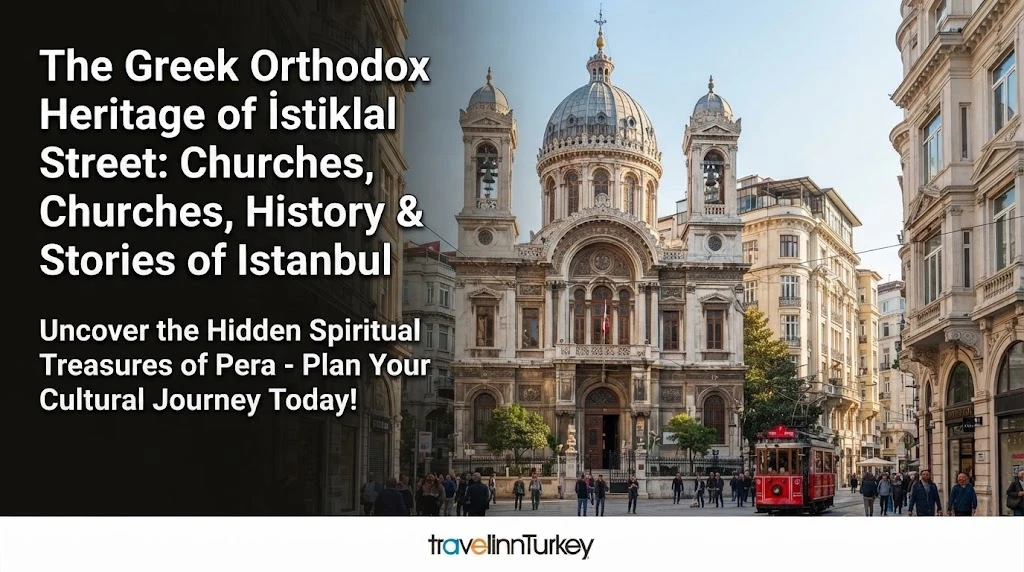
The most important Greek Orthodox landmark associated with Istiklal Street is Hagia Triada Greek Orthodox Church, also known in Turkish as Aya Triada Rum Ortodoks Kilisesi.
The church stands close to Taksim Square, where Istiklal Caddesi meets the surrounding streets. Its large dome and imposing architecture make it one of the most recognizable Christian landmarks in this part of Istanbul.
Construction began in 1876 and the church was officially opened in 1880. It was built on the site of an earlier Greek Orthodox cemetery and church. The present building reflects the architectural ambitions of the late Ottoman period, combining Neo-Baroque and Neo-Byzantine elements.
The church is particularly significant because it represents the revival and visibility of Greek Orthodox architecture in nineteenth-century Istanbul. Hagia Triada is the largest church on Istiklal Street and notes that it was the first domed Christian church built in Istanbul since the Byzantine period.
Its central dome, twin bell towers and spacious garden create a striking contrast with the busy commercial atmosphere surrounding Taksim and Istiklal.
Why Is Hagia Triada Important?
Hagia Triada is more than an architectural attraction. It represents an important period in the history of Istanbul when non-Muslim communities gained greater opportunities to construct substantial religious buildings.
The church was built during the Ottoman Tanzimat period, when reforms altered the legal and social framework governing religious minorities. Its monumental form demonstrates the confidence and resources of the Greek Orthodox community of Pera at the time.
Inside the visitors can see a richly decorated Orthodox interior, including religious paintings, marble work, icons and the traditional arrangement associated with Orthodox worship.
The church remains connected to the Greek Orthodox community of Istanbul and continues to function as a place of worship.
Panayia Evangelistria: Another Greek Orthodox Treasure of Beyoglu
Another important Greek Orthodox monument in the wider Istiklal and Beyoglu area is Panayia Evangelistria, also known as the Evangelistria Greek Orthodox Church.
The present masonry church was constructed between 1877 and 1893, replacing an earlier wooden church dedicated to the Virgin Mary. The church is associated with the Greek Orthodox Patriarchate and features a Greek-cross plan, a dome and Neo-Gothic influences.
One particularly interesting feature is the holy spring, or ayazma, located beside the church. Such sacred springs have an important place in the religious traditions of Istanbul's Orthodox Christian communities.
For travelers interested in discovering Istanbul beyond its major monuments, churches such as Evangelistria demonstrate how much religious history survives in the side streets of Beyoglu.
Greek Schools and Community Life
Greek Orthodox heritage in Istiklal Street is not limited to churches.
Religious buildings formed only one part of a much larger community network. Greek Orthodox communities traditionally supported schools, charitable organizations, associations and other institutions that helped preserve language, education, religion and cultural traditions.
Hagia Triada itself is associated with educational and community buildings, including the Zappeion Greek Lyceum.
These institutions remind visitors that Pera was not simply a district where different religious buildings happened to stand next to one another. It was a living multicultural neighborhood in which communities maintained their own schools, religious institutions, businesses and social networks.
The Greek Influence on Pera's Urban Culture
The Greek contribution to Pera extended beyond religious life.
Greek merchants and entrepreneurs participated in the commercial development of the district, while Greek intellectuals, artists, educators and professionals contributed to the cultural environment of nineteenth- and early twentieth-century Istanbul.
The transformation of Pera into a sophisticated European-style district created an environment in which different languages, religions and architectural traditions existed side by side.
Walking along Istiklal today, visitors can still see evidence of this multicultural past in historic facades, passages, apartment buildings, schools, churches and former commercial establishments.
This is one reason why Istiklal Caddesi is best understood not simply as a shopping street but as a historical urban corridor.
The Sismanoglio Megaro and Greek Cultural Presence
Another important connection between modern Greece and Istiklal Street is the Sismanoglio Megaro, which belongs to the Consulate General of Greece in Istanbul.
The Greek Consulate General explains that the building stands on what was historically the Grande Rue de Pera, today's Istiklal Caddesi. The building was acquired and transformed by the Sismanoglou family, a Cappadocian Greek merchant and banking family.
Today, the building continues to serve as an important venue for Greek cultural activities in Istanbul.
Its presence illustrates an important point: the Greek connection with Istiklal is not merely a memory of the Ottoman past. Greek cultural and institutional activity continues to have a presence in contemporary Beyoglu.
A Multicultural Street of Churches
One of the fascinating aspects of exploring Istiklal Street is the proximity of religious buildings belonging to different Christian traditions.
Along and around the historic avenue, visitors encounter Greek Orthodox, Armenian, Roman Catholic and Anglican heritage.
The Church of St. Anthony of Padua, for example, is Roman Catholic rather than Greek Orthodox. It is nevertheless an essential part of understanding Istiklal's multicultural religious landscape.
Not every historic church on Istiklal Street is Greek Orthodox, but together these buildings tell the larger story of Istanbul's cosmopolitan past.
Greek Orthodox and Byzantine Heritage Are Not the Same Thing
It is also useful to distinguish between Byzantine heritage and the later Greek Orthodox community of Ottoman and modern Istanbul.
The Byzantine Empire was a medieval Christian empire centered on Constantinople. After 1453, however, the Greek Orthodox community continued to exist under Ottoman rule, developing its own institutions and neighborhoods.
Many people therefore assume that every Greek Orthodox church in modern Istanbul dates from the Byzantine period. This is not the case.
Hagia Triada, for example, is a nineteenth-century Ottoman Greek Orthodox church, not a surviving Byzantine church. Its architecture deliberately incorporates Byzantine references, but its historical context is completely different.
Understanding this distinction makes a walking tour of Istiklal much more meaningful.
The 19th Century: The Golden Age of Pera
The nineteenth century was one of the most transformative periods in Istanbul's history.
Pera developed into a center of diplomacy, commerce, entertainment and international culture. European-style hotels, theatres, shops, cafes, embassies, churches and apartment buildings transformed the district.
The Greek Orthodox community was an important participant in this transformation.
The construction of monumental churches such as Hagia Triada demonstrates the wealth, organization and cultural confidence of the community during this period.
At the same time, Pera's architecture became increasingly eclectic, combining Ottoman, European, Greek, Armenian and other influences.
The result was a unique urban environment that still defines Istiklal Street today.
The Difficult History of Istanbul's Greek Community
The history of Istanbul's Greek Orthodox community also includes periods of severe difficulty.
Political tensions, demographic changes and episodes of violence profoundly affected the Greek population of Istanbul during the twentieth century.
Hagia Triada itself was damaged and attacked during the 6–7 September 1955 Istanbul pogrom, when widespread violence targeted Istanbul's Greek minority and other Christian communities. The church was damaged and looted but survived.
Remembering these events is important when discussing the Greek heritage of Istiklal Street. The surviving churches are not simply beautiful historic buildings; they are witnesses to a complicated history of coexistence, transformation, loss and survival.
What Travelers Can See Today
Visitors exploring the Greek Orthodox heritage of Istiklal Street can combine several types of historical experiences.
Start near Taksim Square and look for Hagia Triada. From there, walk down Istiklal Caddesi while paying attention to the historic buildings and side streets.
Continue toward Galatasaray and Tunel, where the architectural landscape reveals layers from the Ottoman, Levantine, Armenian, Greek and European communities.
Rather than concentrating only on famous monuments, look above the modern shops. Historic apartment facades, inscriptions, entrances and architectural details often reveal the multicultural identity of old Pera.
A good walking route should also include several of the Christian landmarks surrounding Istiklal so that visitors can compare Greek Orthodox, Armenian, Catholic and Anglican traditions.
How to Visit Greek Orthodox Churches Respectfully
Many of Istanbul's churches remain active places of worship rather than museums.
Travelers should therefore behave as they would in any functioning religious building. Dress respectfully, keep voices low and avoid photographing people during religious services.
Opening arrangements can change because churches may close for services, religious holidays or community events. It is therefore wise to check current visiting arrangements before planning a dedicated church tour.
Most importantly, remember that these buildings are places of worship for living communities, not simply historical monuments.
A Different Way to Experience Istiklal Street
Millions of people walk along Istiklal Caddesi without realizing how many layers of history surround them.
The street can be experienced as a shopping destination, nightlife district, architectural route, food destination or cultural corridor. But its religious heritage provides another way of understanding it.
The Greek Orthodox churches and institutions of Beyoglu reveal the story of a community that helped shape Istanbul's commercial and cultural identity.
Hagia Triada's dome rising near Taksim, the historic Greek institutions hidden behind imposing facades and the smaller Orthodox landmarks tucked into surrounding streets all contribute to the story of old Pera.
Discover the Greek Heritage of Istanbul with Travel Inn Turkey
At Travel Inn Turkey, we believe that discovering Istanbul means going beyond the most famous landmarks.
A walk along Istiklal Street can become a journey through centuries of Byzantine, Ottoman and modern history, revealing the Greek Orthodox, Armenian, Jewish, Catholic, Levantine and Muslim communities that helped create the cosmopolitan character of the city.
For travelers interested in religious heritage, architecture and the lesser-known stories of Istanbul, the Greek Orthodox heritage of Istiklal Street offers an especially rewarding experience.
Next time you walk along Istiklal Caddesi, look beyond the shops and crowds. Behind the modern street lies the historic Grande Rue de Pera—a place where communities, languages, religions and cultures met, lived and shaped Istanbul.
Travel Inn Turkey can help you discover this deeper side of Istanbul through carefully planned cultural and historical experiences.
Our partners