


Hidden Churches of Cappadocia: Forgotten Byzantine Sites Beyond the Tourist Trail
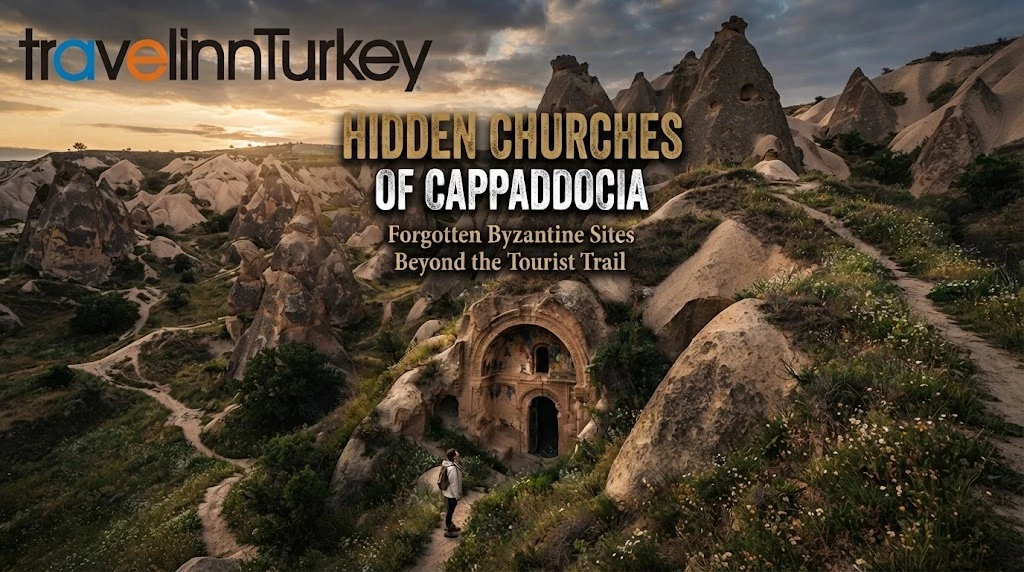
Hidden Churches of Cappadocia
FORGOTTEN BYZANTINE SITES BEYOND THE TOURIST TRAIL
When people think of Cappadocia, they usually picture hot-air balloons floating above fairy chimneys, the underground cities of Derinkuyu and Kaymakli, or the famous frescoes of Goreme.
But beyond these celebrated places lies another Cappadocia — quieter, more rural and far less visited.
Across valleys, villages and agricultural landscapes are small churches, chapels and monasteries that rarely appear in the standard tourist itinerary. Some are carved directly into volcanic rock. Others stand as stone buildings among houses that are still inhabited today. A few have survived only as fragments: a doorway, an apse, a faded cross or a wall covered by centuries of dust.
Together, they tell a different story of Cappadocia.
It is a story not only about Byzantine Christianity, but also about villages, farmers, families, migrations, changing communities and the complicated passage from the Cappadocia of the past to the Cappadocia of today.
A landscape shaped by faith
Cappadocia's extraordinary landscape was not simply a backdrop to human history. People learned to live inside it.
The soft volcanic rock created by the region's ancient eruptions could be carved relatively easily. Over centuries, inhabitants transformed cliffs and rock formations into homes, storage rooms, monasteries and places of worship.
UNESCO describes the wider Cappadocian landscape as containing rock-hewn sanctuaries, troglodyte villages and underground settlements whose history reaches back to the 4th century. More than 200 individual rock-hewn churches are recorded within the Goreme World Heritage property alone.
The churches were not isolated monuments in the modern sense.
They were part of everyday life.
A small chapel might stand close to a village. A monastery could possess vineyards, gardens, fields, animals and a bakery. A church could be a place where generations of villagers gathered for religious celebrations, funerals and feast days.
This is perhaps what makes the rural churches of Cappadocia so fascinating: they were built for people, not for tourists.
From the Byzantine centuries to the village of yesterday
Christian communities had a deep presence in Cappadocia for centuries. Monasticism developed particularly strongly from Late Antiquity onward, and after the end of the Byzantine Iconoclasm period in the 9th century, many churches were decorated with increasingly elaborate painted scenes.
Yet the story did not end with Byzantium.
Christian communities continued to live in Cappadocia under later Ottoman rule. Villages developed their own schools, houses, churches, monasteries and traditions.
One of the clearest examples is today's Mustafapasa, formerly Sinasos.
During the 19th century, Sinasos was a prosperous settlement in which Orthodox Greeks and Muslims lived alongside one another. The town developed impressive houses as well as churches and other communal buildings.
The village still preserves several religious buildings, including the Church of Constantine and Helena, built in 1729 and repaired in 1850, as well as the rock-carved Church of Saint Basil and religious buildings in the Monastery Valley.
Walking through Mustafapasa today, it is possible to see how different layers of history occupy the same streets.
A church.
An Ottoman house.
A mosque.
A former Greek mansion.
A modern cafe.
They are not separate histories. They are pieces of the same village.
The villages that changed forever
The beginning of the 20th century brought enormous changes to Cappadocia.
The 1923 Treaty of Lausanne established the framework for the population exchange between Greece and Turkey, and in 1924 many Orthodox Christian families left their homes in Cappadocia for Greece.
Mustafapasa provides a particularly powerful example. Historical sources associated with the settlement record hundreds of Greek families leaving during the population exchange, while Muslim families arriving from Greece settled in the town.
The departure of communities transformed the meaning of the churches.
Buildings that had once been filled with people suddenly became empty.
Some continued to be maintained.
Some were adapted to new uses.
Others gradually deteriorated.
And some disappeared almost completely from everyday memory.
This is why visiting a rural Cappadocian church today can feel strangely emotional. You are not simply looking at an old building. You are looking at a place from which an entire community once departed.
Churches that became part of village life again
The story is not always one of abandonment.
Cappadocia contains remarkable examples of buildings whose functions changed as communities changed.
The Koramaz Valley, for example, contains dozens of rock churches alongside underground settlements, traditional houses and pigeon lofts. UNESCO's description of the valley notes that some structures changed function over time: spaces originally created for shelter could later become churches, while some churches were subsequently used for other purposes.
This changing use is an important part of rural Cappadocia.
A cave might once have been sacred.
Later, it might become a storeroom.
A former religious space might become part of a farm.
A monastery's land might become agricultural land.
The stone remains, even when the original purpose is forgotten.
The Monastery Valley: a glimpse of another Cappadocia
Near Mustafapasa, the Monastery Valley offers one of the most evocative examples of this hidden religious landscape.
Here, religious structures were integrated into the valley itself. The complex includes the Church of Saint Stephanos, the monastery dedicated to Saint Nicholas, the Church of Saint Prodromos, Saint Barbara and the Church of Saint John the Evangelist.
The Saint Nicholas monastery was more than a place of prayer.
Historical information about the complex describes vineyards, gardens, fields, animals, a bakery and even a library and archive. The monastery was connected to the wider social life of the community and supported schools and poorer inhabitants.
This changes the way we should imagine a Cappadocian monastery.
It was not necessarily a lonely building occupied by a few monks.
It could be an economic, educational and social center woven into village life.
The churches nobody photographs
Today, the most famous Cappadocian churches attract thousands of visitors.
But in the countryside, the experience can be completely different.
You may walk along an unassuming village road and discover an old stone doorway.
There may be no ticket office.
No souvenir shop.
No queue.
Perhaps only a small sign indicates that a church once stood there.
Inside, the light may enter through a tiny opening. The walls may be darkened by time. Paint may survive only in fragments.
And suddenly the scale of history becomes personal.
The church is no longer an archaeological object.
It becomes a question:
Who stood here before us?
Who painted the walls?
Who brought their children here?
Who celebrated Easter here?
Who was buried nearby?
Who left?
And who remembers the names today?
Rural Cappadocia today
Modern Cappadocia is changing rapidly.
Tourism has brought new hotels, restaurants, balloon flights, hiking routes and restored historic houses. Villages once known mainly for agriculture are increasingly connected to international tourism.
This creates opportunities for preservation — but also challenges.
UNESCO has specifically identified erosion, tourism pressure and development as threats to the cultural landscape and its rock-hewn churches. Some churches, including El Nazar, Elmali and Meryemana, have been identified as requiring priority conservation measures.
The dilemma is therefore not simply how to attract visitors.
It is how to allow people to discover Cappadocia without turning its remaining quiet places into attractions that lose the very character that makes them special.
Looking at Cappadocia through the eyes of the villagers
Perhaps the best way to understand the forgotten churches is not to visit them as isolated monuments.
Instead, look at the village around them.
Notice the old stone houses.
Look at the vineyards.
Follow the narrow streets.
Listen to the stories of local residents.
Look for traces of older names.
Observe how a church sits in relation to houses, fields, fountains and roads.
This reveals something that a conventional archaeological visit can miss.
The churches belonged to landscapes of human life.
They were surrounded by work, family, agriculture, celebrations, arguments, births and deaths.
The people who built them did not think they were creating something called "heritage."
They were simply creating a place for their community.
A journey between two Cappadocias
There are really two Cappadocias.
One is the Cappadocia we know from photographs: balloons, fairy chimneys, spectacular valleys and famous rock churches.
The other is much quieter.
It is found in villages such as Mustafapasa, in lesser-known valleys and among agricultural landscapes where traces of older communities remain.
One Cappadocia looks toward the future.
The other still carries the voices of the past.
The most rewarding journey is to experience both.
Visit the famous churches, but then leave the main tourist routes.
Walk slowly through a village.
Enter a small museum.
Speak with a local resident.
Look at an old church doorway.
Imagine the people who once opened it every morning.
And remember that the history of Cappadocia is not only carved into magnificent monuments.
Sometimes, it survives in a nearly forgotten chapel, a faded fresco or an old village stone.
The churches are still speaking
The rural churches of Cappadocia may no longer function as they once did, but they have not become silent.
Their walls still preserve fragments of belief.
Their architecture still reveals the skills of their builders.
Their surroundings still tell us how communities lived.
And their present condition tells another story — one about migration, memory, conservation and the difficult relationship between heritage and modern tourism.
Perhaps this is why the forgotten churches of rural Cappadocia deserve our attention.
Not because they are grander than Goreme.
They are not.
But because they bring us closer to the human Cappadocia — the Cappadocia of ordinary people who lived, prayed, worked and raised families among the extraordinary rocks of Anatolia.
And when we leave these quiet places behind, we should remember that we have not simply visited the remains of the past.
We have walked through a landscape where the past and present are still living side by side.
Travel Inn Turkey for travelers who want to go deeper!
Our partners