


Justinian’s Lost Cistern and the Palace of Hiereia: Discovering Byzantine Fenerbahçe, Istanbul
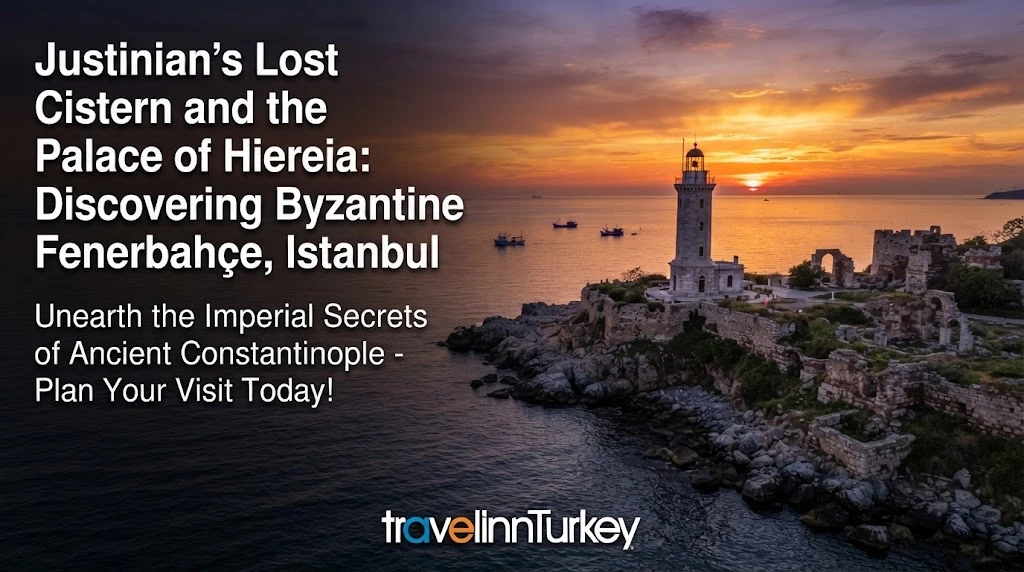
The Lost Cistern of Justinian and the Palace of Hiereia
Discovering Byzantine Istanbul’s Forgotten Heritage in Fenerbahce
Istanbul is a city built upon layers of history, where ancient walls, forgotten water systems, buried churches and vanished imperial residences lie beneath modern streets. Known in antiquity as Byzantium and later as Constantinople, the city was once the magnificent capital of the Byzantine Empire. Its imperial landscape extended far beyond the historic peninsula, reaching across the Bosphorus to the Asian shore, where emperors built palaces, gardens, harbours and cisterns.
Among the lesser-known archaeological treasures of Asian Istanbul are the remains associated with the Cistern of Justinian and the Palace of Hiereia in Fenerbahce, Kadikoy. These remains tell a story of imperial ambition, sophisticated water engineering and a royal landscape that has almost disappeared from view.
Today, Fenerbahce is better known for its seaside promenades, lighthouse, marina and green spaces. Yet beneath this modern neighbourhood lies the memory of a Byzantine imperial residence that once welcomed emperors and witnessed important political and religious events.
For me Niobe, exploring these forgotten places offers another way to discover Istanbul: not only through its famous monuments, but also through the archaeological traces that reveal how much of the ancient city remains hidden.
The Cistern of Justinian in Fenerbahce: A Forgotten Water System
The ruins of the Byzantine cistern at Fenerbahce are associated with the ancient imperial complex of Hiereia, which developed during the reign of Emperor Justinian I (527–565). Archaeological research has identified surviving lower masonry from a substantial cistern discovered again during construction excavations in 2016.
The structure is important because it provides physical evidence of the water infrastructure that supported the palace and its surrounding landscape. Archaeologists have also identified traces of water channels in the wider area, suggesting that water was conveyed towards the cistern from elsewhere.
Unlike the famous Basilica Cistern in Sultanahmet, the remains at Fenerbahce are fragmentary and do not form a comparable underground visitor attraction. The surviving masonry does not establish the original roof or vaulting of the structure, and the precise date of its construction is uncertain.
Nevertheless, these modest ruins are historically significant. They help us understand how the Byzantine emperors maintained their residences outside the densely built centre of Constantinople, where reliable water supplies were essential for daily life, gardens, baths and ceremonial activities.
The Palace of Hiereia: An Imperial Residence on the Asian Shore
The Palace of Hiereia, also written as Hieria or Hiereion, stood on the Fenerbahce peninsula, southeast of ancient Chalcedon, the predecessor of modern Kadikoy. Its position overlooking the waters near the Bosphorus made it a desirable imperial retreat, away from the political pressures of the capital while remaining within easy reach of Constantinople.
Emperor Justinian I established a magnificent palace complex here during the sixth century. According to the Byzantine historian Procopius, Justinian also built a church dedicated to the Virgin Mary at Hiereia. Historical accounts associate the wider complex with a harbour and other facilities befitting an imperial residence.
The palace was not simply a private retreat. Its location allowed emperors to arrive by sea, receive visitors and participate in ceremonies connected with their journeys between the Asian shore and Constantinople.
Although almost all the palace buildings have disappeared, historical texts preserve its memory. The cistern, water channels and other archaeological traces provide important clues to the physical landscape in which the imperial residence once stood.
Emperors, Gardens and the Cistern That Became a Garden
One of the most fascinating details in the history of Hiereia concerns the changing purpose of its great cistern.
During the reign of Emperor Heraclius (610–641), the cistern was reportedly filled with earth and planted with trees and vegetables. A structure originally designed to store water was transformed into a garden, demonstrating how imperial spaces could change according to the preferences and practical needs of their occupants.
Later, Emperor Basil I (867–886) ordered the cistern to be restored. According to the Chronicle of Theophanes Continuatus, Basil recognised that the palace gardens were extensive but that the residence lacked an adequate supply of clean water. He therefore had the earth removed and the reservoir returned to its original function.
This account offers a rare glimpse into the practical management of a Byzantine palace. It also reveals how closely gardens, architecture and water infrastructure were connected in imperial life.
The history of the Hiereia cistern is therefore more than a story of ancient engineering. It is a story of changing priorities, imperial habits and the continual adaptation of the built environment.
Empress Theodora and the Byzantine Palace of Hiereia
The Palace of Hiereia is associated with Empress Theodora, the influential wife of Justinian I, and with several later Byzantine rulers. Its attractive setting on the Asian shore made it a favoured imperial residence.
Justinian's building program transformed Constantinople and its surroundings. The emperor commissioned churches, fortifications, public works and monumental architecture throughout the empire. The Palace of Hiereia formed part of this wider effort to establish residences that reflected imperial wealth and authority.
The palace complex appears to have included landscaped spaces and ceremonial facilities, while its harbour connected the residence to the maritime routes of the region. Although the precise arrangement of its buildings is no longer recoverable, the historical evidence suggests that Hiereia was considerably more elaborate than the scattered remains visible today might imply.
The contrast between the historical palace and the modern neighbourhood is striking. Where imperial guests once arrived and court life unfolded, visitors today encounter parks, roads, residential buildings and the peaceful waterfront of Fenerbahce.
The Council of Hiereia in 754: A Palace at the Centre of Religious History
The Palace of Hiereia was also the setting for one of the most significant religious assemblies of the Byzantine period.
In 754, during the reign of Emperor Constantine V, an important council met at Hiereia and supported the imperial policy against the veneration of religious images. This controversy became known as Byzantine Iconoclasm.
The council's decisions were subsequently rejected by the Second Council of Nicaea in 787, which restored the legitimacy of the veneration of icons within the Byzantine Church.
The meeting at Hiereia demonstrates that the palace was not merely a place of leisure. It also served as a venue for major political and theological events that shaped Byzantine religious history.
For visitors interested in the history of Christianity, this forgotten corner of Kadikoy offers a remarkable connection to debates that influenced the religious and artistic traditions of the medieval Mediterranean.
Fenerbahce and the Forgotten Harbours of Byzantine Constantinople
The history of Hiereia cannot be separated from its maritime setting. The palace stood near the sea and had its own harbour, while another harbour associated with Justinian, the Harbour of Eutropios, lay around the area of modern Kalamis.
These harbours helped connect the Asian suburbs with Constantinople and supported the movement of people and supplies. They also formed part of a broader network of coastal facilities serving the capital.
Today, Fenerbahce and Kalamis are associated with marinas, sailing and seaside recreation. Their modern appearance conceals a much older maritime landscape in which harbours, imperial residences and water-management systems worked together.
Although the original harbour structures have largely disappeared, historical accounts and archaeological studies help reconstruct the importance of this shoreline during the Byzantine era.
Walking along the peninsula today, it is worth remembering that the present coastline has witnessed centuries of changing use, from ancient settlements and Byzantine imperial estates to Ottoman gardens and the modern city.
Istanbul: A City of Cisterns Without a Complete Count
One of the most extraordinary aspects of Byzantine Constantinople is the scale of its water infrastructure. The city depended on aqueducts, reservoirs, open cisterns and covered water-storage structures to provide water for its population and monumental buildings.
The First Hill of historic Constantinople, now largely occupied by the Topkapi Palace complex, contains the remains of at least 33 Byzantine cisterns documented in archaeological research. These structures represent only part of the wider water-management landscape of the historic city.
Some cisterns survive as monumental spaces, such as the Basilica Cistern and the Cistern of Philoxenos, commonly known as Binbirdirek. Others survive only as fragments incorporated into later buildings, while many are known from historical descriptions, archaeological excavations or old maps.
The same challenge applies to Byzantine palaces. Imperial residences could be enlarged, rebuilt, abandoned or transformed over centuries. Their original names sometimes changed, and their remains were reused in Ottoman and modern construction.
Consequently, it is difficult to establish a definitive count of every palace, cistern and imperial residence that once existed in Constantinople and its surrounding settlements.
The idea of a city that has lost count of its cisterns and palaces captures something essential about Istanbul's archaeological character. Its history is too extensive to be contained within a list of famous monuments.
From Byzantine Imperial Lands to Ottoman Fenerbahce
After the Byzantine period, the landscape of Fenerbahce continued to evolve. During the Ottoman era, the peninsula became associated with gardens and imperial use, while the lighthouse gave the neighbourhood the name by which it is known today.
The Turkish name Fenerbahce is commonly understood as “lighthouse garden,” reflecting the combination of the lighthouse and the area's landscaped character.
Over time, the remains of earlier buildings were lost, covered or reused. The gradual transformation of the peninsula means that the original palace complex cannot now be explored as an intact archaeological site.
Yet the survival of the cistern remains and the historical evidence for the palace ensure that Hiereia remains an important chapter in the history of Kadikoy.
This continuity of occupation is characteristic of Istanbul, where Roman, Byzantine, Ottoman and modern layers overlap, sometimes visibly and sometimes beneath the surface.
How to Discover the Byzantine Heritage of Fenerbahce Today
Visitors interested in the Palace of Hiereia and the cistern can explore the wider Fenerbahce peninsula and its surrounding neighbourhood, keeping in mind that the archaeological remains are limited and are not presented as a complete palace museum.
The Fenerbahce Lighthouse and the nearby waterfront provide useful landmarks for understanding the peninsula's geography. The wider area also offers an opportunity to explore the historical relationship between the Asian shore, ancient Chalcedon and Constantinople.
Because the surviving cistern remains are associated with archaeological discoveries within a developed urban area, access to the precise structure may be restricted. Visitors should not assume that the ruins are open to the public or enter private property or construction sites.
A visit can be combined with a walk through Kadikoy, Kalamis and the Fenerbahce waterfront, offering a broader picture of the area that once supported Byzantine imperial residences and harbours.
For travellers who want to go beyond Istanbul's best-known monuments, this part of the city rewards curiosity and historical imagination.
Discovering the Istanbul That Lies Beyond the Famous Monuments
Istanbul means looking beyond the landmarks that appear on every travel itinerary. The city is also shaped by forgotten structures, fragmentary inscriptions, buried cisterns and the traces of palaces whose splendour survives mainly in historical records.
The ruins associated with the Cistern of Justinian and the Palace of Hiereia remind me that the Byzantine capital extended far beyond the walls and monuments of its historic centre. Its Asian shore was part of an imperial landscape of residences, churches, gardens, harbours and sophisticated water systems.
The cistern may no longer hold water, and the palace may have vanished beneath the modern city, but their historical significance remains.
Perhaps this is one of the most compelling reasons to explore Istanbul: every surviving fragment opens a window onto a much larger world, and every forgotten ruin raises new questions about the city that once stood here.
A city full of cisterns and palaces that lost their count — Istanbul still has stories waiting to be rediscovered.
Our partners