


Fildami Cistern in Istanbul: The Byzantine Cistern of Hebdomon
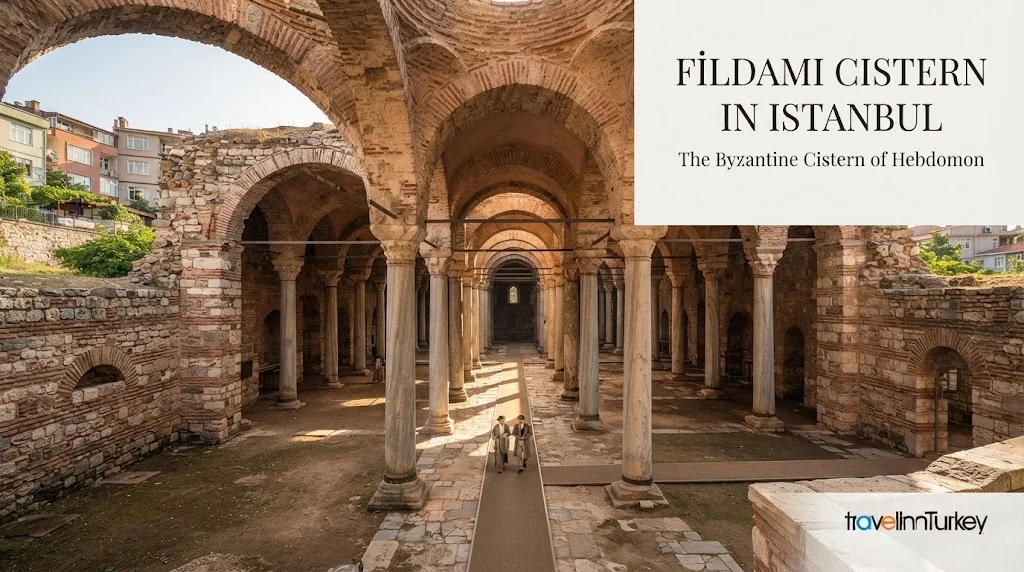
Fildami Cistern in Istanbul
The Byzantine Cistern of Hebdomon
There are places in Istanbul that you can easily walk, past without realizing the extraordinary story hidden behind their walls. Fildami Cistern in Bakirkoy is one of them.
When Niobe began looking more closely at the lesser-known historical corners of Istanbul, she discovered that this enormous open-air reservoir was once known as the Cistern of the Hebdomon.
Today, Fildami stands in Osmaniye, Bakirkoy, but during the Byzantine period this area was known as Hebdomon, meaning “the Seventh.” It was an important suburb outside the ancient city walls, associated with imperial residences, military activity and the road leading west from Constantinople.
One of Istanbul's four great open-air cisterns
Fildami is one of only four major open-air Byzantine cisterns that survive in Istanbul. Three are located within the historic walled city, while Fildami is the remarkable example outside the walls, in present-day Bakirkoy.
Unlike the famous underground Basilica Cistern, Fildami was an enormous reservoir open to the sky.
Its surviving structure measures approximately 127 metres by 76 metres, covering almost 9,700 square metres. Its massive walls were designed to withstand the enormous pressure of the water stored inside. Some sections of the walls are several metres thick.
Standing beside those walls, Niobe could not help wondering how different this landscape must have looked when the reservoir was filled with water.
Why was Fildami built?
The precise construction date remains a subject of scholarly discussion. Sources place its construction broadly between the Late Antique/early Byzantine period and the 7th–8th centuries, while architectural evidence has also led researchers to associate it with the 5th–6th centuries.
Its purpose, however, is much clearer.
The reservoir formed part of the water infrastructure serving the important Hebdomon area. It is thought to have supplied water to imperial and military installations, including the area associated with the imperial palaces of Magnaura and Jucundianae, as well as the nearby military camp.
This makes Fildami more than simply an ancient water tank. It is a reminder that Byzantine Constantinople depended upon an enormous and sophisticated system for collecting, transporting and storing water.
From Byzantine reservoir to “Elephant Stable”
And then the story takes an unexpected turn.
During the Ottoman period, the abandoned reservoir became associated with elephants. The name Fildami is generally explained as meaning “elephant stable” or “elephant enclosure.” Sources describe the tradition that elephants belonging to the army or palace were kept here.
Niobe particularly liked this part of the story.
Imagine standing inside the enormous walls of a Byzantine reservoir and realizing that, centuries later, the same space had a completely different life.
Water once filled the great basin.
Later, elephants were associated with the site.
History rarely leaves a place with only one story.
Fildami as a “Cukurbostan”
After losing its original function, the cistern was also used as a sunken garden or agricultural area, part of the tradition of Istanbul's cukurbostan spaces.
This is another fascinating transformation: a monumental piece of Byzantine infrastructure becoming part of everyday urban life.
Today, the surrounding neighbourhood has changed dramatically, but the enormous masonry walls still preserve the memory of the ancient landscape.
What can you see today?
Visitors can still appreciate the scale of Fildami by walking around its surviving walls and looking down into the vast interior.
The construction is particularly impressive. The walls use alternating courses of stone and brick, a characteristic technique of Byzantine construction. The surviving masonry, massive buttresses and structural details reveal how engineers had to control the pressure created by such a huge volume of water.
Fildami had also a modern life. In the late 20th century it was adapted for use as an open-air event and concert venue, although concerts later ceased because of concerns about vibrations affecting the historic structure and nearby surroundings.
Today, the site is administered locally and is part of the historical landscape of Bakirkoy.
Niobe's thought
For Niobe, Fildami is not simply another Byzantine monument to tick off a sightseeing list.
It is a place where several different versions of Istanbul meet.
Byzantine Constantinople needed enormous reservoirs to survive.
Hebdomon was an important imperial and military suburb.
The Ottoman world gave the abandoned reservoir another purpose and its memorable name.
And modern Istanbul has grown all around it.
Perhaps this is what makes discovering lesser-known Istanbul so rewarding. You do not always need to stand in front of the Hagia Sophia or walk through the Grand Bazaar to feel history.
Sometimes history is waiting quietly behind a neighbourhood street in Bakirkoy.
And sometimes, like Niobe, you simply have to be curious enough to look.
Travel Inn Turkey invites you to discover not only the famous Istanbul, but also the hidden places where the city's extraordinary stories continue to live.
Our partners