


Kanuni Sultan Suleyman Fountain in Istanbul: A Hidden Ottoman Fountain on the Hippodrome’s Sphendone
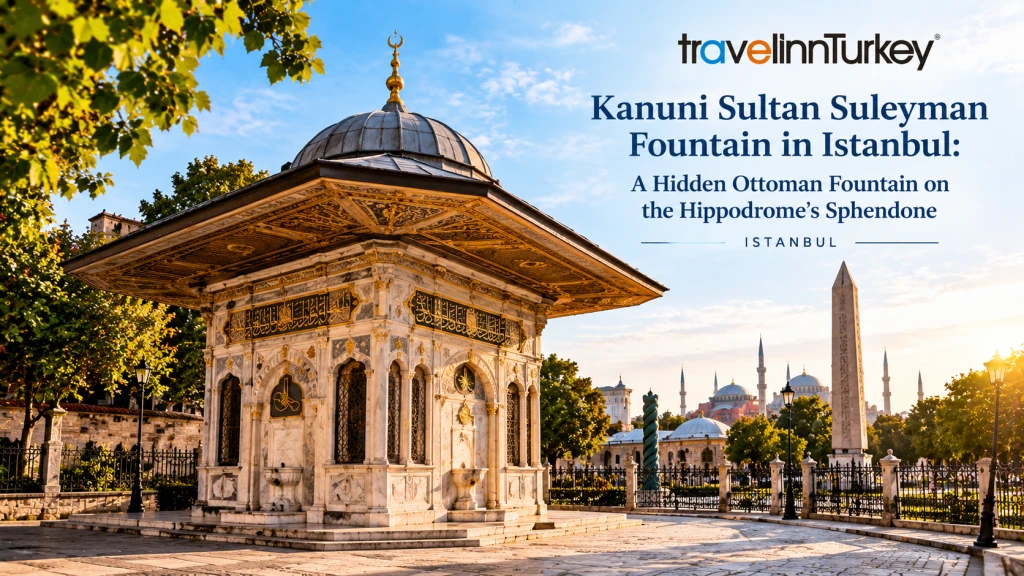
Kanuni Sultan Suleyman Fountain in Istanbul
A Hidden Ottoman Fountain Beside the Hippodrome
In the heart of Istanbul's Old City, close to the Hippodrome and Kucuk Ayasofya, a small Ottoman fountain tells a much bigger story than its modest appearance suggests.
The Kanuni Sultan Suleyman Fountain, known in Turkish as Kanuni Sultan Suleyman Cesmesi, stands on the surviving Sphendone of the ancient Hippodrome in the Kucuk Ayasofya neighborhood. Dating from the 16th century, the fountain is associated with Sultan Suleyman the Magnificent and was later restored by his sister, Hatice Sultan.
What makes this fountain particularly fascinating is not only its Ottoman history. It is built into the inner face of the vaulted substructure of the ancient Byzantine Sphendone and was supplied by a water system running beneath the Hippodrome.
After a major restoration completed in 2026, the historic fountain has once again been connected to water, bringing this little-known monument back to life.
Where Is the Kanuni Sultan Suleyman Fountain?
The fountain is located in Kucuk Ayasofya Mahallesi in Fatih, Istanbul, on Ucler Hamami Sokak, beside the surviving southern curved structure of the ancient Hippodrome known as the Sphendone.
This puts the fountain within Istanbul's historic peninsula and within easy reach of some of the city's most famous monuments, including:
- Sultanahmet Square
- the Hippodrome of Constantinople
- Hagia Sophia
- the Blue Mosque
- the Basilica Cistern
- Kucuk Ayasofya Mosque
- the Great Palace area
The location is particularly interesting because the fountain is not an isolated Ottoman monument. It is physically connected with the remains of the Byzantine Hippodrome.
Fatih Municipality identifies the fountain as a 16th-century historic fountain situated on the Sphendone wall.
What Is the Sphendone of the Hippodrome?
The Sphendone is the enormous curved southern end of the ancient Hippodrome of Constantinople.
The Hippodrome was one of the most important public spaces of Byzantine Constantinople. It was used for chariot races, ceremonies and major public events and stood close to the imperial palace complex.
Because the ground slopes toward the south, the builders created a massive vaulted substructure to support the Hippodrome. Much of this impressive structure survives beneath and around the modern streets of Sultanahmet.
The Kanuni Sultan Suleyman Fountain was constructed against the inner surface of the vaulted Sphendone structure.
This means that when you look at the fountain today, you are looking at a monument from the Ottoman period that is physically incorporated into a much older Byzantine structure.
An Ottoman Fountain Built on a Byzantine Structure
The fountain dates from the 16th century, during the reign of Sultan Suleyman I, better known in the West as Suleyman the Magnificent.
According to Fatih Municipality, the fountain was commissioned by Kanuni Sultan Suleyman and later restored or renewed through the efforts of his sister Hatice Sultan.
Its architecture is relatively modest compared with Istanbul's monumental Ottoman fountains.
The fountain has a pointed brick arch and a recessed niche, characteristics that reflect the practical architecture of Ottoman neighborhood fountains.
Over the centuries, however, parts of the fountain were lost or damaged. Its original water basin and marble elements did not survive intact.
The recent restoration aimed to recover the historic appearance of the fountain while preserving its original character.
What Was Beneath the Sphendone?
This is where the story becomes even more interesting.
The massive substructure beneath the Sphendone was not simply a supporting structure for the Hippodrome. Parts of its vaulted spaces were adapted for use as water-storage facilities.
Archaeological and architectural research on the Hippodrome's underground structures identifies a large cistern within the eastern part of the Sphendone substructure. The cistern was connected to a water pipeline associated with the city's wider water-supply network.
The underground water system formed part of the complex hydraulic landscape of Byzantine Constantinople.
This is important when visiting the Kanuni Sultan Suleyman Fountain because the fountain is therefore connected to a much older story of Istanbul's water infrastructure.
The fountain is not the cistern
It is important to make one distinction clear.
The Kanuni Sultan Suleyman Fountain is not itself the Byzantine cistern.
The fountain is an Ottoman water monument built into the Sphendone. Beneath and within the Sphendone are ancient vaulted structures, including a large cistern identified by researchers.
The two should therefore be described as historically and physically connected elements, rather than as the same structure.
From Byzantine Water System to Ottoman Fountain
Istanbul's water infrastructure changed considerably over the centuries.
The Romans and Byzantines constructed aqueducts, pipelines, reservoirs and cisterns to bring and store water for Constantinople. Cisterns became particularly important because they provided reliable reserves inside the city.
The underground cistern beneath the Sphendone was connected to a water-supply line running through the area. Research into the underground structures of the Hippodrome has identified a water distribution point and connections with the wider Byzantine water network.
After the Ottoman conquest of Constantinople in 1453, many existing Byzantine water systems continued to be used, repaired and adapted.
This tradition continued particularly strongly during the reign of Sultan Süleyman.
The Ottoman government invested heavily in Istanbul's water infrastructure, including the restoration and expansion of older Roman-Byzantine systems. The Kirkcesme water system, associated with Mimar Sinan and the reign of Suleyman, became one of the most important water projects of Ottoman Istanbul.
The Kanuni Sultan Suleyman Fountain provides a fascinating small-scale example of this much larger history.
The 2026 Restoration: The Fountain Flows Again
One of the most important recent developments is the fountain's 2026 restoration.
Fatih Municipality carried out an extensive restoration of the 16th-century fountain while seeking to preserve its historic identity. The work included removing later additions, exposing sections that had fallen below the modern road level, cleaning the stone and brick surfaces and completing missing elements.
The missing marble fountain slab (ayna tasi) and basin were recreated according to the approved restoration project.
Parts of the historic inscription that had suffered material loss were also completed.
Most importantly for visitors, the fountain was returned to its water supply and reopened for use following the restoration.
This makes 2026 an important moment in the modern history of the monument.
For many years, visitors could pass nearby without realizing that this small structure was an Ottoman fountain built directly into one of the most important surviving structures of the ancient Hippodrome.
Today, its restoration makes the relationship between Istanbul's Ottoman and Byzantine layers easier to appreciate.
Where Did the Fountain's Water Come From?
Research carried out during the restoration identified an important connection with the historic water infrastructure beneath the Hippodrome.
According to Fatih Municipality, the fountain was supplied by a water transmission line beneath the Hippodrome that was also used during the Ottoman period.
This is one of the most valuable pieces of information for understanding the fountain.
The monument was not simply placed beside the ancient Hippodrome for decorative reasons. Its location was connected to the city's long-established water infrastructure.
The story therefore links three different periods:
Byzantine Constantinople → Ottoman Istanbul → modern Istanbul
The underground water system belongs to the much older history of the Hippodrome, while the fountain represents the Ottoman period's continued use and adaptation of Istanbul's water infrastructure.
Why Was Sultan Suleyman So Important to Istanbul's Water System?
Sultan Suleyman's reign was one of the most important periods in the development of Istanbul's water infrastructure.
As the population of the Ottoman capital grew, the existing water supply had to be repaired and expanded. Mimar Sinan played a major role in the development of the city's water system during Suleyman's reign.
The Ottoman authorities repaired earlier Roman-Byzantine waterways and expanded the network with new structures, reservoirs and aqueducts.
The Kirkcesme system became one of the great engineering projects of 16th-century Istanbul. According to the Turkish Ministry of Culture and Tourism, the system incorporated surviving Roman infrastructure and was extensively reconstructed and enlarged during the reign of Suleyman.
The Kanuni Sultan Suleyman Fountain belongs to this broader culture of water provision that shaped Istanbul during the 16th century.
A Small Monument With Three Layers of Istanbul History
The greatest attraction of the fountain is perhaps its scale.
It is not one of Istanbul's giant monuments. There is no enormous dome, monumental courtyard or elaborate imperial complex.
Instead, it is a small fountain attached to an ancient wall.
But that wall represents the Sphendone of the Byzantine Hippodrome.
Behind and below the Sphendone are ancient vaulted structures and water infrastructure.
The fountain itself represents the Ottoman period.
And the recent restoration represents modern Istanbul's continuing effort to preserve its historic layers.
In one small location, visitors can therefore encounter Roman-Byzantine engineering, Ottoman water culture and modern conservation.
Can You Visit the Kanuni Sultan Suleyman Fountain?
Yes. The fountain is located in the public streets of the Kucuk Ayasofya area, on Ucler Hamami Sokak.
Unlike major museums and monuments, it is a small street monument rather than a large ticketed attraction.
The best way to visit it is as part of a walking tour of the southern side of the historic Hippodrome.
After visiting Sultanahmet Square and the main Hippodrome monuments, continue toward the Sphendone and Kucuk Ayasofya. The fountain provides an opportunity to see a much less famous part of Istanbul's historical landscape.
Visitors should remember that the underground cistern and vaulted Sphendone structures are not the same thing as the fountain itself, and access to underground archaeological areas may differ from access to the street monument.
What Makes This Fountain Worth Seeing?
There are hundreds of historic fountains in Istanbul, but the Kanuni Sultan Suleyman Fountain is unusual because of its setting.
Its significance comes from the combination of:
- a 16th-century Ottoman fountain
- Sultan Suleyman's reign
- the Sphendone of the Byzantine Hippodrome
- ancient underground water structures
- Ottoman use of the historic water network
- the association with Hatice Sultan
- and its recent 2026 restoration
It is an excellent example of something that makes Istanbul unique: the city's history is rarely confined to a single period.
A Byzantine structure can become part of an Ottoman monument, while an ancient water system can continue to serve later generations.
A Hidden Historical Detail in Sultanahmet
Most visitors to Istanbul's Old City come to see Hagia Sophia, the Blue Mosque, the Basilica Cistern and the Hippodrome.
The Kanuni Sultan Suleyman Fountain offers something different.
It is a reminder that the historic peninsula contains many smaller monuments that are easy to overlook.
The fountain may take only a few minutes to see, but understanding its location changes the way you see the entire Hippodrome.
The enormous curved Sphendone is no longer simply an ancient wall. It becomes part of a story about engineering, water, imperial power and the continuous reuse of Istanbul's historic structures.
Final Thoughts
The Kanuni Sultan Suleyman Fountain in Kucuk Ayasofya is a small Ottoman monument with an unusually deep history.
Built in the 16th century during the reign of Sultan Suleyman and incorporated into the surviving Sphendone of the ancient Hippodrome, it stands directly within one of Istanbul's most important Byzantine archaeological landscapes.
Beneath the Sphendone are ancient vaulted structures, including a major cistern connected to Constantinople's historic water network. Later, Ottoman water infrastructure continued to use and adapt parts of the older system.
In 2026, Fatih Municipality restored the fountain, reconstructed missing elements and restored its water supply, allowing the historic fountain to flow again.
For travellers interested in hidden Istanbul, Byzantine history, Ottoman architecture and the ancient water systems of Constantinople, this small fountain deserves a place on the walking map of Sultanahmet.
Sometimes the most revealing monuments in Istanbul are not the largest ones.
Sometimes they are the ones hidden in plain sight.
Our partners