

Niobe Discovers Ortakoy: Kumpir, Bells and Hidden Stories by the Bosphorus
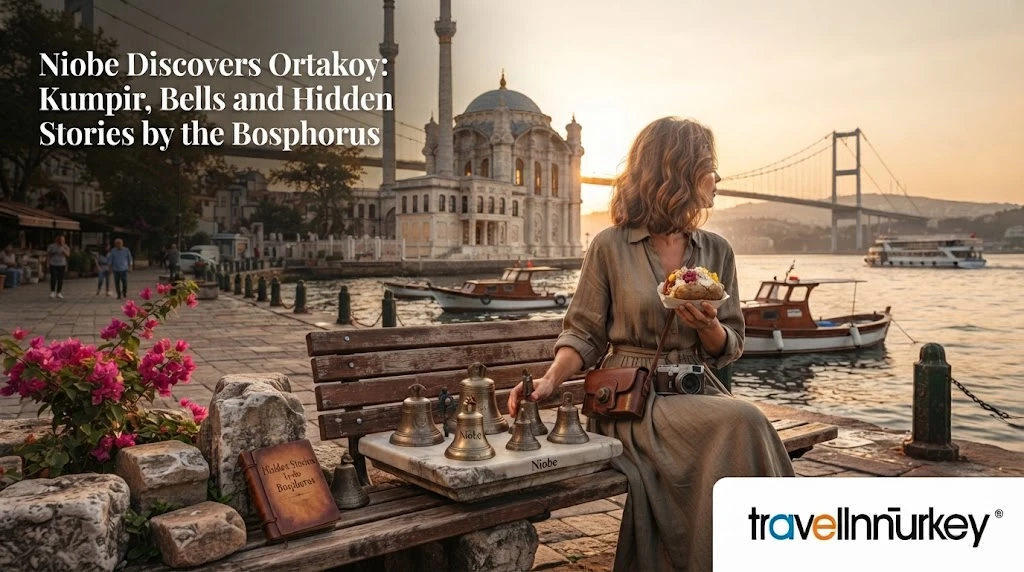
Niobe Discovers Ortakoy
Kumpir, Bells and Hidden Stories by the Bosphorus
Ortakoy is a historic waterfront neighborhood in Besiktas, Istanbul, on the European side of the Bosphorus. It is known for Ortakoy Mosque, Bosphorus views, kumpir, cafes and its multicultural heritage.
I thought I was simply going for a walk along the Bosphorus.
Of course, that was my first mistake.
In Istanbul, a simple walk rarely remains simple.
This time, a church bell caught my attention.
I was walking through Ortakoy, one of Istanbul’s most beautiful neighborhoods, when I heard the sound of a bell coming from somewhere nearby. I followed it — because naturally, when Niobe hears a mysterious bell, she has to investigate!
And that is how I discovered Saint Foka Church.
A church hidden behind the streets
The Ayios Fokas Greek Orthodox Church is one of those places that can easily escape your attention if you are only looking for the famous sights of Ortakoy.
The present church dates from the 19th century, while the history of the site goes much further back. A Byzantine monastery dedicated to Saint Foka once stood here, and the area itself was known as Ayios Fokas during the Byzantine period.
Suddenly, the church bell sounded different to me.
It was not simply a bell.
It was a little reminder that Ortakoy has been listening to people, prayers and footsteps for centuries.
But why is it called Ortakoy?
Now I had another question.
Why Ortakoy?
The Turkish name literally means “Middle Village.”
The neighborhood sits beside the Bosphorus, between important areas of the European shore, and historically developed as a meeting place for different communities.
But its story goes even further back.
Ancient Ortakoy has been associated with the name Arkheion, while during the Byzantine period it became known as Ayios Fokas, connected with the monastery dedicated to Saint Foka. Later, the neighborhood became known as Mesochori, before the Turkish name Ortakoy became established.
And perhaps “Middle Village” is actually a very good name.
Because Ortakoy has always felt like a meeting point.
People, religions, cultures, boats and travellers all seem to meet here.
From Byzantine days to Ottoman Istanbul
Imagine Ortakoy centuries ago.
There were fishermen, boatmen, gardens and small settlements around the Bosphorus. The waterfront was active, and boats connected people with other parts of the city.
Later, Ortakoy became one of those remarkable Istanbul neighborhoods where different communities lived close to one another.
Greeks, Armenians, Jews and Muslims all contributed to the character of the area.
Even today, you can feel this history when you walk through its streets. A mosque may appear around one corner, a church behind another building, and historic houses and waterfront mansions remind you that this was never an ordinary neighborhood.
Local street food
After all this history, I needed to eat something.
Immediately.
Luckily, Ortakoy had the answer.
Kumpir.
A giant baked potato, opened and filled with whatever your imagination — or your appetite — demands.
I watched the potato being prepared and thought:
“How can one potato possibly contain so many things?”
I decided not to investigate.
I simply ate it.
And I can confirm that historical research is much easier after lunch.
Ortakoy is particularly famous for its kumpir stalls around the waterfront, where the food has become part of the neighborhood experience.
Boats, Bosphorus and another Istanbul
With my kumpir successfully finished, I continued towards the sea.
The Bosphorus was busy.
Boats were arriving and leaving, carrying people between different parts of Istanbul.
This is one of the things I love about the city.
The Bosphorus is not just something beautiful to photograph.
It is a road.
A road made of water.
People still use it to travel, meet friends, go home, explore another neighborhood or simply enjoy the city from the sea.
I stood by the waterfront watching the boats and wondered how different — and yet how similar — this scene must have looked centuries ago.
The boats have changed.
The city has changed.
But Istanbul is still moving.
And what about Ortakoy today?
Today, Ortakoy is one of the most popular areas of Istanbul for both visitors and locals.
Its waterfront cafes, restaurants, small streets, historic buildings and spectacular Bosphorus views make it a wonderful place for a relaxed afternoon.
And then there is the famous Ortakoy Mosque, standing dramatically beside the water.
But there is another side to Ortakoy too.
It is not only a tourist postcard.
It is also an educational neighborhood.
Galatasaray University is located in Ortakoy, together with other educational institutions, giving the area a lively student atmosphere.
So when you walk through Ortakoy, you are walking through a neighborhood where history, university life, cafes, religion, food and the Bosphorus all meet.
My Ortakoy lesson
I came to Ortakoy for a walk.
A church bell changed my plans.
Then Saint Foka introduced me to the different religions that exist in Turkey.
The streets told me about the communities live here.
The boats reminded me that the Bosphorus has always connected people.
And the kumpir reminded me that exploring Istanbul is hungry work.
That is what I personally learned for Ortakoy.
A place where you can hear a church bell, see a mosque, watch boats cross the Bosphorus, meet students, discover centuries of history — and finish everything with a very large potato.
So, if you are visiting Istanbul, don't only come to Ortakoy for the famous photograph.
Come slowly.
Listen.
Look behind the main streets.
Follow a bell.
Watch the boats.
And perhaps let Niobe lead you to her next discovery.
Niobe_
Our partners