


Mogile Osmańskie w Stambule: Co Mogą Opowiedzieć Turbany Na Grobach
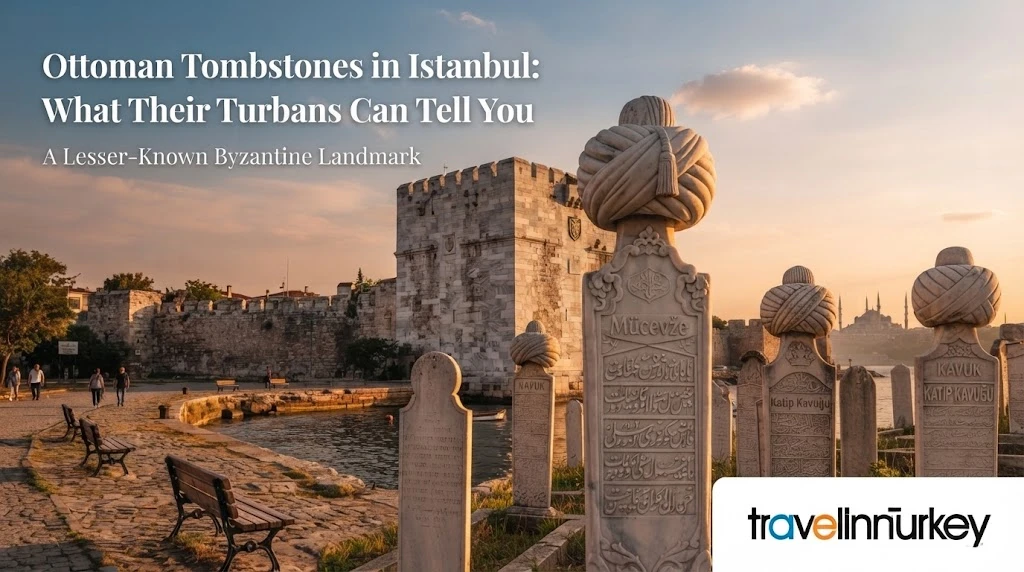
Ottoman Tombstones in Istanbul
What their Turbans Can Tell You
Another Story of Niobe — Discovering the Ottoman History Hidden in Istanbul's Streets
There are moments in Istanbul when you think you are simply walking from one place to another.
And then Istanbul stops you.
It may be a mosque.
A fountain.
A doorway.
Or sometimes, something much quieter — an Ottoman tomb standing beside a busy street.
That happened to me again.
I was walking near Eminonu, surrounded by the sounds of modern Istanbul: people rushing somewhere, ferries arriving and leaving, shopkeepers calling to customers and visitors searching for their next photograph.
And then I noticed a tomb.
Not just the tomb itself.
The stones.
The names.
The dates.
And, above all, the strange stone headgear carved at the top of the graves.
I had seen Ottoman tombstones many times before, but suddenly I began looking at them differently.
Could you really understand something about the person beneath the stone simply by looking at the tombstone?
The answer is fascinating.
An Ottoman Tombstone Was Almost Like an Identity Card
Ottoman cemeteries were not simply places where the dead were buried.
They could also tell the living who was lying beneath the marble.
The shape of the headstone, the inscription, the decoration and especially the headgear carved at the top could provide clues about the deceased.
A man's stone might be crowned with a representation of a turban, kavuk or, in later periods, a fez.
These were not random decorations.
Ottoman headgear was closely connected with social identity, occupation and rank. Researchers studying Ottoman cemeteries have identified numerous different forms of kavuk, sarik, turban and other headgear.
So I looked again.
The stone was suddenly no longer just a stone.
It was telling me something.
Can You Tell How Old Someone Was From the Turban?
This is where I had to be careful.
At first glance, it is tempting to think that a large or small turban carved above a grave tells us the age of the person.
But that is not generally correct.
The carved headgear primarily tells us about status, occupation, rank or identity, rather than the person's age.
The inscription is much more important for discovering who the person was and how long they lived.
And sometimes the physical form of the grave itself gives another clue.
A noticeably smaller grave monument can indicate a child.
So the Ottoman cemetery becomes a kind of visual language.
You don't necessarily need to read every word of Ottoman Turkish to begin understanding it.
You can look.
You can observe.
And then you can investigate.
As one study of Ottoman gravestones explains, the headgear represented on men's tombstones could correspond to the headgear worn by the deceased during life, reflecting their social position.
And Then I Started Looking at the Names
What fascinated me most was the age.
Some of the people remembered in these tombs lived long lives.
Others did not.
The Ottoman dynasty produced 36 sultans, but not all reached old age.
Several died surprisingly young.
Osman II, remembered as Genc Osman — Young Osman — died in 1622 at only about 18 years of age.
Murad IV died in 1640 at 27.
Ahmed I, the young sultan who commissioned the magnificent Sultan Ahmed Mosque, died at only 27.
And Mustafa IV died at 28.
Four Ottoman sultans therefore died before reaching their thirties.
Suddenly, the marble tombs of Istanbul seemed very different to me.
Behind the magnificent titles — Sultan, Padishah, Khan — there were also human lives.
Abdulhamid I's children including Hadice Sultan at nine months, Ayse Sultan at 45 days, Sehzade Ahmed at two, Sehzade Mehmed at about four and a half, and Sehzade Suleyman at seven.
Lives that ended before they actually live.
The Tomb Near Eminonu
Around Eminonu, this becomes especially striking.
Behind the Yeni Cami, the New Mosque, stands the Turhan Sultan Tomb, one of the important Ottoman dynastic mausoleums of the district.
It is not simply a single grave.
Inside and around Ottoman imperial tombs, you can encounter the memory of an entire dynasty.
The tombs preserve the names of sultans, princes and members of the imperial family, turning a small corner of the modern city into a place where generations of Ottoman history remain physically present.
And that is something I love about Istanbul.
History isn't always behind museum glass.
Sometimes it is beside the pavement.
Sometimes it is behind a mosque.
Sometimes it is hidden behind a shop.
And sometimes you walk past it without even realizing what you have just seen.
Istanbul's Diseased Were Once Part of Everyday Life
This is perhaps what surprised me most.
Ottoman cemeteries were much more integrated into the city than many modern cemeteries are today.
People encountered graves while walking through neighborhoods, mosque courtyards and public spaces.
Death was not necessarily hidden away at the edge of the city.
It was part of everyday life.
Modern Istanbul has grown around many of these old burial places, so that today a visitor can find an Ottoman graveyard surrounded by shops, restaurants, traffic and thousands of people going about their daily lives.
And perhaps this is why these places feel so different.
You are standing between two worlds.
The Istanbul of today is moving around you.
The Istanbul of centuries ago is lying quietly beneath the marble.
Then I Watched a Man Stop
But there was another moment I will remember.
A man was walking past the tomb.
He stopped.
For only a few seconds.
He raised his hands in prayer.
He stood quietly.
Then with his both hands touch his face.
And continued walking.
Nobody around him stopped.
Nobody made an announcement.
There was no ceremony.
It was simply part of life.
For him, perhaps, this was completely ordinary.
For me, it was another Istanbul story.
Because the city has a remarkable way of allowing the past and the present to exist beside each other.
A person can hurry to catch a ferry in Eminonu and, only a few metres away, another person can pause before a centuries-old tomb, pray and or request a bless.
Niobe's Istanbul Lesson
That day I understood something.
Perhaps visiting an Ottoman tomb is not only about finding the name of a sultan.
It is about learning how Istanbul remembers.
Look at the marble.
Read the inscription.
Notice the carved headgear.
Look at the size and shape of the grave.
Ask who is buried there.
Ask how old they were.
Ask what their position was.
And then look around you.
Because while you are reading the history of the Ottoman Empire, Istanbul is continuing to live around you.
A tram passes.
A shop opens.
A ferry sounds its horn.
Someone stops to pray.
Someone else takes a photograph.
And the tomb remains quietly where it has been for centuries.
Perhaps that is the most beautiful lesson of all.
In Istanbul, history does not always ask you to enter a museum.
Sometimes it simply asks you to stop walking for a few seconds.
And look.
Niobe's Istanbul Note
The next time you pass an Ottoman tombstone, don't look only at the name.
Look at the stone above it.
Look at the headgear.
Look at the inscription.
And ask yourself:
Who was this person when Istanbul was a completely different city?
Then perhaps you will understand why walking through Istanbul can feel like walking through a living history book.
Nasi partnerzy