


Axo (Hasaköy) Cappadocia: Discover Agia Makrina Church and a Lost Greek Village
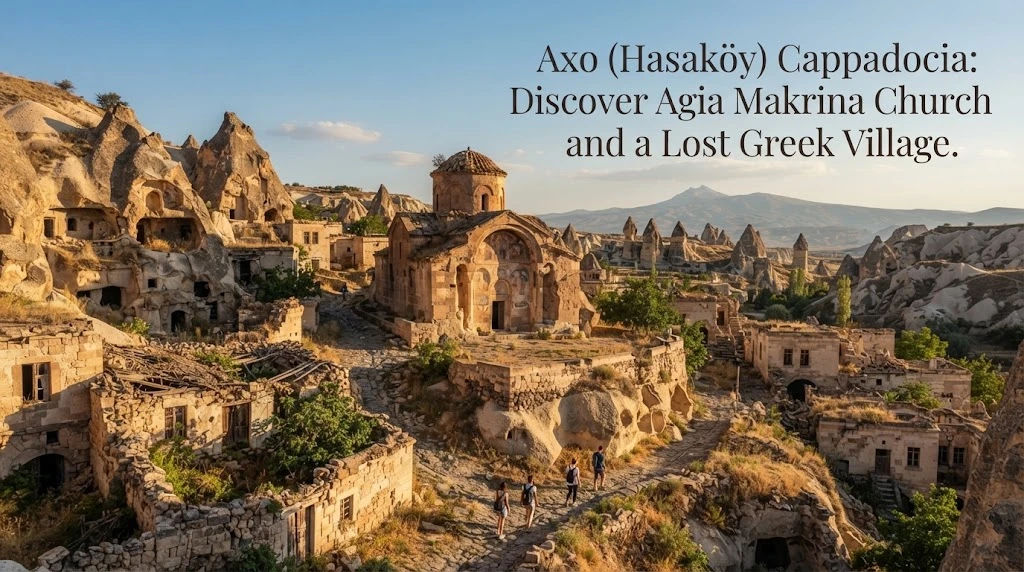
Axos (Hasakoy) Cappadocia
Discover Agia Makrina Church and the Lost Greek Village
Axos, known today as Hasakoy, is a historic village in the Nigde region of Cappadocia and one of the former Greek Orthodox settlements of Central Anatolia. Although it is far less known than Goreme, Urgup or Derinkuyu, Axos offers an important glimpse into the history of the Cappadocian Greeks and the Christian communities that lived in this region for centuries.
Axos Before 1923: A Greek Orthodox Village in Cappadocia
Historically known as Axos, Akso, Aksos or Naksos, the village was one of the Cappadocian settlements where Orthodox Christians preserved their own local form of Greek. The community spoke a distinctive Cappadocian Greek dialect, alongside Turkish, reflecting the complex linguistic and cultural environment of Ottoman Cappadocia.
Early 20th-century visitors recorded Axos as a substantial village. In 1911, British scholars R. M. Dawkins and W. R. Halliday visited the settlement while documenting the Greek dialects and everyday life of Central Anatolia. Their photographs provide a valuable visual record of the village before the population exchange.
Historical descriptions portray Axos as a predominantly Christian agricultural community. At the beginning of the 20th century, the village consisted largely of traditional houses and was surrounded by the agricultural landscape of the Cappadocian plain. One contemporary account described approximately 800 houses and noted that the inhabitants spoke both Turkish and the local Cappadocian Greek dialect.
The village also possessed a remarkable religious heritage. According to historical research, Axos once had eight churches and chapels. Of these, the Church of Agia Makrina (Saint Makrina) is the most important surviving monument.
Agia Makrina Church
The Agia Makrina Church is a stone-built Orthodox church dating from the 19th century, with the surviving building associated with 1843. Its architecture and surviving features provide an important connection to the religious life of the former Greek community of Axos.
For visitors interested in Greek Orthodox history, Byzantine and post-Byzantine heritage, Cappadocian Greeks and Christian Cappadocia, the church offers a very different experience from the famous rock formations and hot-air balloons of the region.
What Happened to Axos After 1923
The history of Axos changed dramatically following the Greco-Turkish population exchange of 1923–1924, carried out under the Treaty of Lausanne. Like many Greek Orthodox communities of Cappadocia, the Greek inhabitants of Axos left Anatolia and were resettled in Greece. The departure of these communities brought an end to centuries of continuous Greek Orthodox village life in the region.
The people of Axos took their memories, traditions, family histories and distinctive dialect with them. Elements of the cultural heritage of Axos continued within the communities established in Greece, while the historic village remained in Cappadocia.
Axos Today: Hasakoy
Today, the village is officially known as Hasakoy and belongs to the Nigde area of Turkey. It is located approximately 28 kilometers northwest of Nigde, on the wider Cappadocian landscape.
Modern Hasakoy is very different from the Greek Orthodox village described by travelers in the early 20th century. The community, language and social life have changed considerably since the population exchange. Nevertheless, important traces of the earlier settlement remain.
The Agia Makrina Church, together with the former Greek school and the old cemetery and surviving gravestones, forms part of the historical memory of Axos and provides physical evidence of the community that once lived here.
Why Visit Axos?
Axos is particularly worthwhile for travelers who want to explore the lesser-known history of Cappadocia. Rather than visiting only the region's famous tourist attractions, a journey to Hasakoy allows visitors to discover the story of an actual Cappadocian community and understand how Greek, Orthodox Christian and Anatolian traditions existed together in this part of Central Anatolia.
For those tracing Cappadocian Greek ancestry, researching family history or exploring the Christian heritage of Turkey, Axos can be an especially meaningful destination.
Agia Makrina Church and historic Axos are therefore more than archaeological sites. They are reminders of a living community, its language, faith and traditions, and of the dramatic changes that transformed Cappadocia in the early 20th century.
Our partners