


Hagia Sophia in Istanbul: 1,500 Years of History
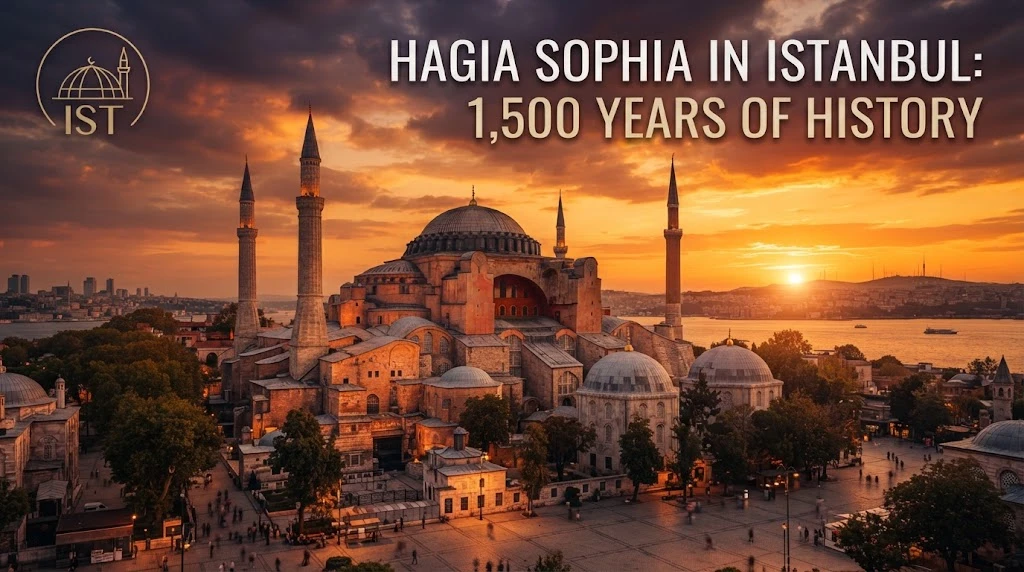
Hagia Sophia
The first time I stepped inside Hagia Sophia, I felt something I had never quite felt before.
It was not simply the feeling of entering a monument.
It was the feeling of entering another time.
For a moment, the people around me seemed to disappear. The sounds became distant, and I found myself imagining Constantinople as it once was—a city filled with emperors, merchants, soldiers, servants and ordinary people, all moving through the same streets that I had just walked.
And there it was.
Hagia Sophia
Standing before me, enormous and almost impossible to comprehend.
I looked up… and forgot to speak
The first thing I did was look up.
The immense dome seemed to float above me, allowing light to enter from the windows and spread softly across the interior.
I imagined the people who had stood here centuries before me.
I could almost see an emperor entering with his procession, surrounded by officials and guards. I imagined citizens gathering for important liturgies, looking toward the magnificent sanctuary and listening to prayers echoing beneath the enormous dome.
How must it have felt to stand here when the church was at the center of Constantinople's religious and imperial life?
I tried to imagine the candles, the incense, the chanting and the movement of thousands of people.
The building suddenly stopped feeling like an old monument.
It felt alive.
A church beside another great church
Before visiting, I had been reading about the history of Constantinople.
One detail particularly caught my attention.
Very close to Hagia Sophia stood another important church—Hagia Irene (Saint Irene).
I found myself thinking about the two churches standing so close together, witnessing the changing life of Constantinople through the centuries.
Today, when you walk through the gardens of the area, it is difficult not to imagine what this area must have looked like when these magnificent churches were surrounded by the imperial world of Byzantium.
Hagia Sophia and Hagia Irene were not isolated buildings.
They were part of a living city.
A city of emperors and citizens.
A city of ceremonies, faith, politics, celebrations and dramatic changes.
And I was standing right in the middle of it.
So much history has passed through these walls
Hagia Sophia has lived through centuries of change.
It was built in the 6th century during the reign of Emperor Justinian and became one of the most extraordinary architectural achievements of the Byzantine world.
Centuries later, Constantinople changed forever.
The city became Istanbul, and Hagia Sophia became a mosque.
Later, it served as a museum, welcoming visitors from every corner of the world.
Today, it once again functions as a mosque and the upper floor is used as a museum.
But standing inside, I realized something important:
Buildings can change their purpose, but history does not disappear.
The architecture still tells its story.
The enormous dome is still there.
The marble columns are still there.
The galleries, arches, decorations and layers of history remain.
Different generations have left their marks, but none of them could erase what came before.
I tried to hear the past
I closed my eyes for a moment.
I imagined the sound of a Byzantine liturgy filling the building.
The emperor and his people gathered together.
The clergy moving through the sacred space.
The light of candles reflecting from marble and gold.
Voices rising toward the dome.
Then I opened my eyes.
The centuries were gone again.
But somehow, I could still feel them.
That is what makes Hagia Sophia so extraordinary.
You don't simply look at history here.
You feel surrounded by it.
And then I noticed the details
I began walking slowly, looking at everything around me.
The enormous columns.
The marble surfaces.
The arches disappearing into the shadows.
The extraordinary height of the interior.
The light entering through the windows.
Everywhere I looked, there seemed to be another detail asking me to stop.
I wondered how many people had walked exactly where I was walking.
How many had looked toward the same dome?
How many had arrived here full of joy, fear, hope or sadness?
How many important moments in the history of this city had taken place within these walls?
Suddenly, my visit was no longer about taking photographs.
I wanted to remember the feeling.
Hagia Sophia is not just a place to visit
There are monuments you visit for an hour and remember for a photograph.
And then there are places that stay with you.
For me, Hagia Sophia belongs to the second category.
It reminded me that Istanbul is not a city with only one story.
It is a city built layer upon layer—Roman, Byzantine, Ottoman and modern.
And Hagia Sophia is perhaps one of the most powerful places to feel those layers.
Standing beneath that enormous dome, I felt incredibly small.
But at the same time, I felt connected to something enormous.
To people who lived 1,500 years ago.
To a city that changed names, rulers and religions.
To generations who came here before me and left behind a story for those who would arrive centuries later.
My first step into Hagia Sophia
When I finally walked back outside, Istanbul felt different. There is a saying that whoever enters Hagia Sophia once, will return.
Then the tram bell rang, bringing me back to the present.
Sultanahmet square was crowded.
People were talking and visitors were taking photographs.
But I was still somewhere between the present and the past.
I looked back at Hagia Sophia one more time.
And I smiled.
Because I understood something I had only read about in books before:
Some places don't simply tell you about history. They make you feel as though you have briefly lived inside it.
Hagia Sophia was that place for me.
And if you ever come to Istanbul, don't simply put it on your sightseeing checklist.
Walk inside slowly.
Look up.
Listen.
Imagine.
Let the centuries speak.
Because somewhere beneath that extraordinary dome, 1,500 years of Istanbul are still waiting to be felt.
Niobe_
Our partners