


Boğdan Sarayı (Moldavian Palace) in Istanbul: Niobe’s Search for a Lost Palace
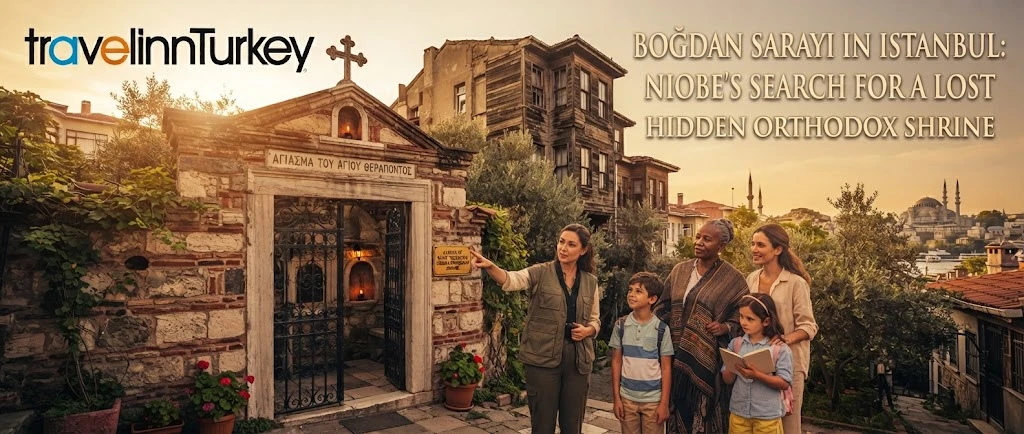
Bogdan Palace
Niobe’s Search for Another Lost Palace of Istanbul
By Niobe | Travel Inn Turkey
I have started to suspect that Istanbul has too many palaces.
Or perhaps I simply have not found enough of them yet.
Every time I think I have finished my list, someone mentions another name.
A palace.
A mansion.
An imperial residence.
A foreign prince's house.
A Byzantine aristocratic residence.
Sometimes there is a magnificent building waiting for me.
Sometimes there is only a name.
And sometimes, like today, there is almost nothing left at all.
That is how I discovered Bogdan Sarayi — Bogdan Palace.
And naturally, I had to go looking for it.
Where is Bogdan Palace?
Bogdan Palace was associated with Moldavia, historically known in Turkish as Bogdan, and with the Moldavian princes who maintained a presence in Constantinople/Istanbul.
Historical sources place the palace in the northwestern part of the old city, in the area between Fener and Karaggmruk, close to today's Draman area. The surviving remains are associated with Dervis Ali and Draman.
But when I arrived, I had to remind myself:
I was not looking for a palace with enormous gates.
There would be no grand staircase.
No ballroom.
No marble courtyard waiting for me.
The palace has almost completely disappeared.
And that somehow made the search even more interesting.
A palace that almost vanished
According to the Turkish Islamic Encyclopedia, Bogdan Palace was used by the Moldavian voivodes and their representatives in Istanbul. Dimitrie Cantemir associated its construction with the reign of Sultan Bayezid II and the beginning of the 16th century, although historical accounts differ concerning its exact origins and chronology.
The complex survived for centuries before eventually falling into decline.
A major fire in the 18th century is associated with its destruction, after which the extensive property was used for years as a garden. Later urban development gradually swallowed the area.
And this is where my imagination starts working.
I try to picture the place when it was alive.
People arriving from Moldavia.
Messengers carrying letters.
Officials travelling between the Danubian principality and Constantinople.
Visitors entering through the gates.
Servants moving through the compound.
And somewhere inside it, an extraordinary little Byzantine structure was preserved.
The tiny Byzantine chapel
This is the part of Bogdan Palace that fascinates me most.
The palace disappeared.
But a tiny Byzantine chapel survived.
Historical research identifies the surviving structure as a small Byzantine religious building whose original dedication is uncertain. It was later associated with St Nicholas and became part of the Moldavian palace complex.
It is remarkably small.
And yet its history is enormous.
The structure is generally dated to the Byzantine period, with scholarly discussion placing its construction somewhere between the Komnenian and Palaiologan eras. Its unusual north-south orientation has also led researchers to suggest that it may originally have served a funerary purpose rather than functioning as an ordinary church.
Imagine that.
A little Byzantine building.
Then a palace.
Then a Moldavian residence.
Then foreign diplomats.
Then fire.
Then abandonment.
Then archaeological interest.
Then modern Istanbul growing around it.
All those centuries compressed into one tiny surviving fragment.
Was this really a palace?
This is where my palace-counting becomes complicated.
If I were making a list of Istanbul's most impressive palaces, Bogdan Palace would obviously look very different from Topkapi Palace, Dolmabahce Palace or Beylerbeyi Palace.
But that is exactly why I want it on my list.
A palace does not have to survive as a palace.
Sometimes the historical importance is hidden in what remains.
The name Bogdan Sarayi reflects its later role as a residence associated with the Moldavian rulers and their representatives. The surviving chapel is therefore one of the most important clues to the former complex.
For me, this turns the search into something more exciting than simply visiting beautiful buildings.
I am trying to reconstruct Istanbul.
Niobe versus the palaces of Europe
I cannot help comparing it with the palaces I have seen elsewhere in Europe.
In Vienna, Paris, Madrid or St Petersburg, a palace often announces itself.
You know immediately what you are looking at.
There may be enormous façades, formal gardens, statues, fountains and ceremonial entrances.
Istanbul plays a different game.
Here, sometimes the palace is obvious.
And sometimes the city asks you to become a detective.
A street name.
An old map.
A surviving wall.
A chapel.
A foundation hidden beneath later buildings.
A few lines in an old book.
And suddenly you realize:
There was a palace here.
That is what makes Istanbul's lost palaces so addictive.
What happened to Bogdan Palace?
By the 18th century, the palace had fallen into serious decline, and the complex was destroyed by fire. The land was subsequently used as a garden for a long period. Later maps continued to show the area as open garden land before the neighborhood was progressively built over.
The surviving Byzantine chapel also deteriorated.
Its upper portion eventually disappeared, leaving the lower part of the structure. Historical accounts describe archaeological investigations in the early 20th century, when three sarcophagi were reportedly found in the crypt.
For many years, the remains were difficult to access.
But there is an encouraging modern chapter.
The Fatih Municipality reports that the remaining site was transferred into public ownership in 2022 and that conservation, restoration and environmental-arrangement projects have been prepared.
So perhaps this is not the end of Bogdan Palace's story.
Perhaps it is another beginning.
How many palaces does Istanbul have?
This is becoming my problem.
I started with the famous ones.
Then I discovered the smaller ones.
Then the lost ones.
Then the Byzantine residences.
Then foreign palaces.
Then pavilions.
Then mansions that once functioned as residences for rulers or ambassadors.
And now I have reached places where almost nothing remains.
So how do I count them?
Maybe I shouldn't.
Maybe I should make a different list:
Palaces you can still enter.
Palaces you can still see.
Palaces that survive only in fragments.
Palaces known from historical records.
Palaces that have completely disappeared.
And perhaps one day I will have an Istanbul palace map covered with hundreds of little marks.
Bogdan Palace will definitely have one.
Travel Inn Turkey joins the search
Luckily, I am not doing this alone.
Travel Inn Turkey is beside me as I explore Istanbul's forgotten history.
Together, we look beyond the famous monuments.
We follow old neighborhoods.
We search for Byzantine remains.
We look for Ottoman residences.
We compare Istanbul's palaces with the great palaces of Europe.
And sometimes we arrive at a place where the palace itself has disappeared.
That is when the adventure becomes even more interesting.
Because travelling is not always about finding what is still standing.
Sometimes it is about discovering what once stood there.
My next palace
I have a feeling this list is going to become very long.
I still have questions.
Where were all the Byzantine imperial residences?
Which palaces disappeared beneath modern Istanbul?
Where did foreign rulers stay?
Which mansions were important enough to be called palaces?
And how many of them can still be located today?
So I am continuing my search.
One palace at a time.
One street at a time.
One forgotten name at a time.
And if you see me walking through Istanbul looking at an apparently ordinary wall and suddenly opening an old map...
Please don't interrupt me.
I may have just found another palace.
Niobe_
Our partners