


A Mysterious Inscription in Kumkapı, Istanbul
A Mysterious Inscription in Kumkapi, Istanbul
There are places in Istanbul that announce their history proudly.
And then there are places that say almost nothing.
You simply walk past them.
You might see an old facade, a beautiful doorway or a few Greek letters carved into stone, and continue your walk without realizing that you have just passed a small piece of Istanbul's Greek history.
That is exactly what happened to Niobe in Kumkapi.
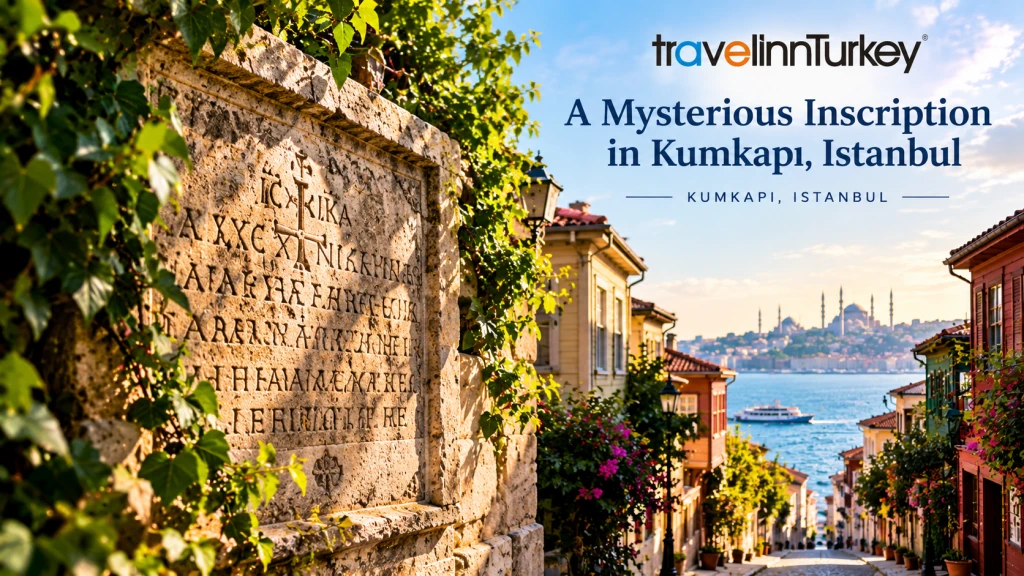
While walking through the historic neighborhood of Kontoskali, today known as Kumkapi, near the Greek Orthodox Church of Agia Kyriaki, something caught her attention.
It was not a famous monument.
It was not a museum.
It was an old building.
But above it, carved into the stone, were Greek letters:
«ΦΙΛΟΜΟΥΣΟΣ ΑΔΕΛΦΟΤΗΣ ΗΩΣ ΑΝΙΔΡΥΣΑΤΟ»
Niobe stopped.
What was this building?
Who were the people who had placed these words here?
And what was the Φιλόμουσος Αδελφότης Ηώς — Philomousos Adelphotis Eos?
That inscription became the beginning of another journey.
A school beside a historic church
The building is associated with the educational history of the Greek Orthodox community of Kontoskali/Kumkapi.
The area was historically home to an important Greek Orthodox population, and Agia Kyriaki remained one of the community's principal churches and the nearby Greek Orthodox church of Panagia Elpida.
Schools were an essential part of this community life.
For the Greek Orthodox communities of Constantinople, the church, school, charitable associations and neighborhood institutions were closely connected. Education was not simply about lessons in a classroom; schools helped preserve language, culture and communal life.
That makes the surviving school-related buildings particularly interesting today.
The mysterious words: “Η Ήως”
The name Ηώς (Eos) is especially intriguing.
The word refers to Dawn, the personification of dawn in ancient Greek mythology, and the name was adopted by several Greek educational and cultural associations.
Research into the Greek community of Kontoskali confirms the existence of a Greek association called «Η Ήως». A study of the community records mentions the Greek association of Kontoskali “Η Ήως” and records correspondence involving its representatives in 1922.
This is an important clue when standing in front of the inscription.
The stone is therefore not simply decoration.
It connects the surviving building with the network of Greek communal organizations that once operated in Istanbul and is also associated with the Philomousos Brotherhood of Kontoskali “Eos” (Filomousos Adelfotis Kontoskaliou Eos), one of the many Greek educational and cultural brotherhoods that flourished in Constantinople during the 19th and early 20th centuries. Such associations played an important role in supporting education, culture and community life within the Greek Orthodox population. The presence of the “Eos” brotherhood in this area reflects the rich Greek communal history of Kumkapi (Kontoskali) and its close connection with the nearby Church of Saint Kyriaki and the former Greek community school.
A city where the school has disappeared, but the inscription remains
Today, the neighborhood looks very different from the world in which the school functioned.
The streets are busy.
Businesses occupy buildings that once had completely different purposes.
The Greek population of the neighborhood has greatly diminished.
Yet occasionally, something remains.
A church.
A school facade.
A marble inscription.
A few Greek letters.
And suddenly, the historical map of Istanbul becomes visible again.
This is what makes walking through Kumkapi so rewarding.
You do not always have to enter a museum to encounter history.
Sometimes history is above the door of a building.
Niobe's question
Niobe looked at the inscription and naturally wanted to know more.
Was this once a boys' school?
Who studied here?
Who paid for its construction?
What did the classrooms look like?
How many children entered through these doors?
And what happened to the school when the Greek community of Kumkapi began to disappear?
These questions are perhaps more important than the building itself.
Because they allow us to imagine the people who once gave life to it.
Children arriving for lessons.
Teachers entering classrooms.
Parents discussing education.
Members of the community supporting their school.
And a neighborhood in which Greek was once heard naturally in the streets.
Another piece of Istanbul waiting to be discovered
Research into Kontoskali's educational buildings reveals that the community had more than one school. A 2011 account concerning the old Kontoskali boys' school notes that another school building stood beside the church of Agia Kyriaki, while the old boys' school discussed in that article was beside Panagia Elpida.
This makes Niobe's discovery even more interesting.
It suggests that the story of Greek education in Kumkapi was not represented by one building alone, but by a wider educational network connected with the churches and institutions of the community.
This is Niobe's advice:
Don't only look at the famous monuments of Istanbul.
Look above the shop signs.
Look at doorways.
Look at marble plaques.
Look at Greek inscriptions.
Look at buildings that appear ordinary today.
Because sometimes a forgotten inscription can lead you to a story that does not appear in the usual Istanbul guidebooks.
And this is how Niobe's walks continue.
One street.
One building.
One inscription.
One question.
Today, even when traces of this history are easy to overlook, the building offers visitors a small window into the multicultural past of Kumkapi. For those who enjoy discovering Istanbul beyond its famous monuments, a walk through this neighborhood can reveal stories, buildings and memories that quietly preserve the city’s Greek heritage.
Travel Inn Turkey_
Our partners