


Çemberlitaş: The Column of Constantine in Istanbul
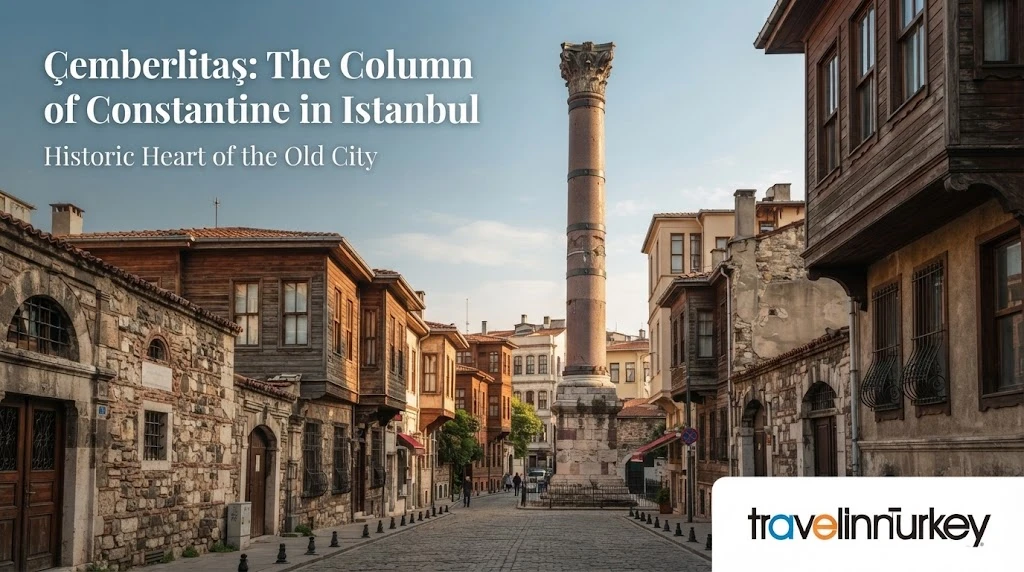
Cemberlitas, The Column of Constantine
A Journey with Niobe through the Byzantine Heart of Istanbul.
There are places in Istanbul where you can stand in the middle of a busy modern street and, if you know where to look, suddenly find yourself standing in the middle of another world.
For me, Cemberlitas was one of those places.
I was walking along the ancient Mese Odos, the great ceremonial avenue of Constantinople, following the same general route that today takes us along Divanyolu towards the Grand Bazaar.
Trams were passing and cars too.
People were rushing towards shops, restaurants and cafes.
Tourists were taking photographs.
And then I saw it.
A massive ancient column standing quietly beside the modern city.
Cemberlitas.
At first, it looked almost like another monument that had simply become part of Istanbul's streetscape.
But I stopped.
I looked up.
And then I began to wonder:
Who had stood here before me?
How many emperors had passed this way?
How many processions?
How many soldiers, merchants, pilgrims and travellers?
And what did this street look like when Constantinople was one of the most important cities in the Roman and Byzantine world?
That was when the story of Cemberlitas began for me.
The Column of Constantine
The monument dates from the 4th century and is associated with Constantine the Great, the emperor who transformed the ancient city of Byzantium into Constantinople and established it as the new imperial capital of the Roman Empire.
The column was erected around 330 AD, close to the moment when Constantinople was inaugurated as the new imperial capital.
But what we see today is not exactly what the people of Constantine's Constantinople would have seen.
Originally, the column was considerably more elaborate.
Its great marble drums were topped by a monumental capital and, above everything, a statue of Constantine himself.
Imagine standing on the Mese nearly seventeen centuries ago.
Above you, the emperor appeared at the summit of a towering imperial monument.
Below you, the most important ceremonial avenue of the new capital stretched through the city.
The message was impossible to miss:
This was an imperial city.
And Constantine was its founder.
But Cemberlitas Was Never Alone
This is the part of the story I find most fascinating.
When we look at Cemberlitas today, it is easy to think of it as an isolated monument.
It wasn't.
The column belonged to a much larger urban landscape.
Around it were forums, churches, palaces, public buildings, ceremonial monuments and underground structures.
The ancient Mese connected some of the most important places in Constantinople.
And if you walk from Cemberlitas towards Sultanahmet today, you can still encounter fragments of that extraordinary world.
This is where I began to see Istanbul differently.
Instead of asking:
"What is this monument?"
I began asking:
"What was around it?"
From Cemberlitas to the Forum of Constantine
Just beside the column was the ancient Forum of Constantine, one of the great public spaces created during the transformation of Constantinople.
The forum was not simply an open square.
It was part of the political and ceremonial heart of the new imperial capital.
Imagine marble buildings surrounding the square.
Imagine merchants, officials and ordinary citizens moving through the space.
Imagine imperial ceremonies taking place nearby.
And imagine the enormous Column of Constantine rising from the center of the forum.
Today, much of that world has disappeared beneath modern Istanbul.
But the location survives.
The streets preserve the memory.
And Cemberlitas remains one of the strongest physical reminders of the imperial city that once occupied this landscape.
The Mese Odos: The Road of Emperors
From Cemberlitas, I continued towards Sultanahmet.
This modern road follows the approximate route of the ancient Mese Odos, the main ceremonial and commercial artery of Constantinople.
And suddenly, the walk became more exciting.
Because I was no longer simply walking through Istanbul.
I was following an ancient route.
The same general corridor once carried imperial processions towards the city's great monuments.
Along this route stood some of the most important landmarks of Constantinople.
The further I walked, the more pieces of the ancient city began to appear.
From Cemberlitas Towards Nuruosmaniye and the Grand Bazaar
Eventually, my journey brought me towards the area of Nuruosmaniye and the Grand Bazaar.
Today this is one of the busiest commercial parts of Istanbul.
But the ancient route continues beneath the modern city.
The Mese once continued westwards, carrying people towards the great forums and eventually towards the ceremonial and administrative heart of Constantinople.
Today, instead of imperial officials and Byzantine soldiers, we meet shopkeepers, travellers, shoppers and tourists.
The city has changed.
But the road remains.
And that may be the most beautiful thing about Istanbul.
Cemberlitas Survived When Empires Disappeared
As I returned my attention to the column, I began thinking about everything it had witnessed.
Constantine's Constantinople.
The later Roman and Byzantine emperors.
The great ceremonies of the imperial city.
Earthquakes.
Fires.
Political upheavals.
The transformation of Constantinople.
The Ottoman conquest.
Centuries of Ottoman Istanbul.
And finally the modern city.
The column survived through all of it.
Its original statue disappeared.
Its marble changed.
Its surface was damaged.
Iron reinforcement was added.
Fire and earthquakes altered its appearance.
Yet the monument remained.
That is why Cemberlitas is more than an ancient column.
It is a witness.
Niobe's Istanbul
I stood there for another few minutes.
People continued walking past me.
The tram moved along the street.
Someone stopped to take a photograph.
Someone else was checking his phone.
The city continued with its normal afternoon rhythm.
But now I couldn't see Cemberlitas as simply a monument.
I saw it as the beginning of a journey.
From here, I could follow the ancient Mese.
I could search for the Forum of Constantine.
I could continue towards the Million.
Then Hagia Sophia.
The Hippodrome.
The Basilica Cistern.
The Great Palace.
The old churches.
The underground cisterns.
The ancient walls.
And eventually the Grand Bazaar.
Each place was another chapter.
Each street another page.
And suddenly I understood something about Istanbul:
You don't always discover its history by entering a museum.
Sometimes you discover it simply by walking.
Walk with Niobe Through Byzantine Istanbul
This is why I want to keep exploring Istanbul with Travel Inn Turkey.
Not only the places everyone already knows.
Not only Hagia Sophia, the Blue Mosque and the Grand Bazaar.
But the monuments between them.
The columns.
The cisterns.
The forgotten churches.
The ancient roads.
The palace remains.
The surviving walls.
The archaeological fragments.
The stories hidden beneath modern buildings.
And the places that you can walk past every day without realizing that you are walking through one of the most extraordinary historical landscapes in the world.
Cemberlitas is not the end of the story.
It was an invitation.
An invitation to slow down.
To look closer.
To ask questions.
And to follow the ancient streets of Constantinople one monument at a time.
Come with me,
I am Niobe, and there are still so many stories of Istanbul waiting to be discovered.
Travel Inn Turkey — discover Istanbul beyond the famous landmarks, where every street can become a journey through history.
Our partners