


Meet Niobe, Travel Inn Turkey's Storyteller
MEET NIOBE
Some journeys begin with a plane ticket. Mine began with an Erasmus application.
I came to Turkey as a young Erasmus student, thinking I would spend a few months studying, meeting new people, and experiencing something different. I had no idea that I was about to fall in love with a country.
Not just with its ancient cities or beautiful landscapes. Not just with Istanbul, Cappadocia, Ephesus, or the endless list of places I had marked on my map.
I fell in love with something much harder to describe: Turkish hospitality.
I stayed with a Turkish family, and very quickly I discovered that being a guest in a home here meant something special. A meal was never simply a meal. A cup of tea was rarely just a cup of tea. There was always another question, another story, another place someone wanted to show me:
"Have you been there?"
"You must visit this place."
"You haven't tried this yet?"
And, of course, the question I heard more times than I can remember:
"Where are you going tomorrow?"
That question became almost a way of life for me.
One Country, Hundreds of Journeys
During my Erasmus stay, almost every day felt different. I travelled by plane, train, bus, ferry, car, and sometimes by whatever other means of transportation happened to get me where I wanted to go. I discovered that travelling in Turkey could be an adventure even before arriving at the destination.
I visited ancient cities, archaeological sites, villages, mountains, coastlines, and towns that I had never heard of before coming here.
I walked through places where civilizations lived thousands of years ago.
I stood among Roman ruins.
I watched the sunrise over extraordinary landscapes.
I sat at tables with people I had met only hours before.
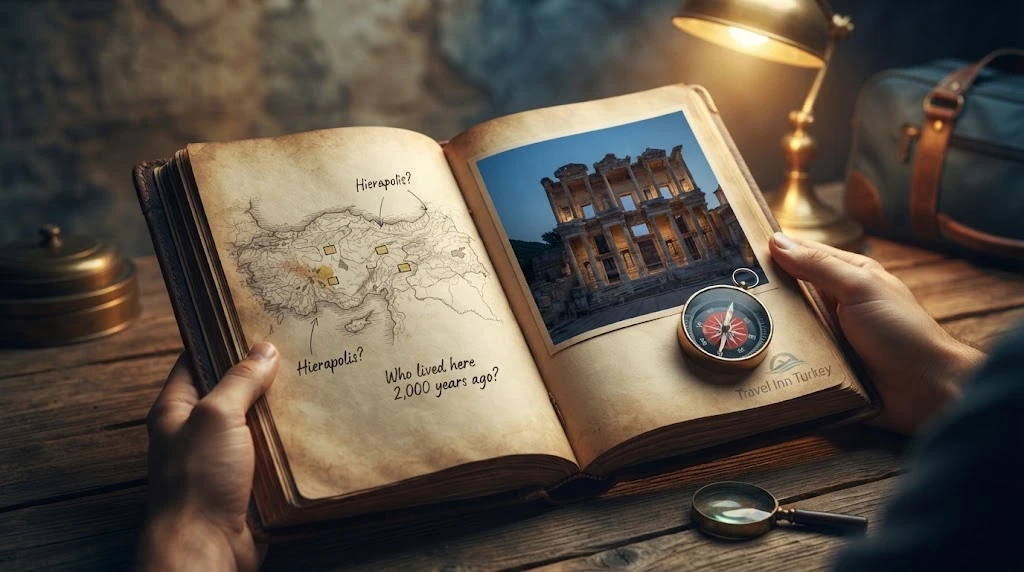
And slowly, my map became covered with little marks. But there was a problem: there were still far too many places left unmarked. Some were circled, some had stars beside them, some had a serious "MUST VISIT" written across them, and some were simply impossible to fit into my Erasmus schedule.
Eventually, my studies came to an end. I packed my bags and returned home.
But something strange happened. My suitcase came home. My studies came home. My everyday life came home. But somehow, my mind stayed in Turkey.
Turkey Was Not Finished with Me
For a while, I tried to continue normally. I finished my studies, made plans, and returned to my routine.
But every time I heard Turkish, saw a photograph of Turkey, or smelled something that reminded me of a Turkish kitchen, I was transported back. Back to that family home. Back to the journeys, the conversations, the places I had visited—and most importantly, back to all the places I had not yet visited.
That was when I understood something: perhaps my relationship with Turkey wasn't supposed to end when my Erasmus experience ended. Perhaps it was only beginning.
So, after finishing my studies, I decided to continue my long—and probably never-ending—love affair with this extraordinary country. And that is where my new adventure begins.
So... Who Is Niobe?
Hello. I'm Niobe.
I am a traveller, a curious explorer, a collector of stories, and, apparently, someone who asks far too many questions:
Why is this place here?
Who lived here?
Why does this village have that name?
What did people eat?
How did they travel?
What happened here 2,000 years ago?
What is this strange rock?
And perhaps the most important question of all:
"Where can we go next?"
Luckily, I have found people who don't seem to mind my endless questions. Travel Inn Turkey has agreed to come along for the journey. They will help me investigate the places I visited before, discover the ones I missed, and uncover destinations I have never even heard of.
Together, we will travel through Turkey's famous landmarks and its hidden corners. And I won't be keeping the stories to myself—I will share them with you.
My First Destination Has My Name
There was really only one place where I could begin. A place called Niobe.
Yes. There is actually a place in Turkey named after me. Well... perhaps I should say that I am named after her.
Welcome to Niobe's Rock, near Manisa.
At the foot of Mount Spil, overlooking the landscape around Manisa, stands a natural rock formation known as Niobe Kaya (Niobe's Rock) or, more poetically, Aglayan Kaya (The Weeping Rock). Look at it from the right direction, and you can imagine the outline of a woman's face.
And behind that face lies one of the saddest stories of ancient mythology.
The Woman Behind the Rock
According to the ancient story, Niobe was the daughter of Tantalus and was associated with Mount Sipylus (known today as Mount Spil). She became the wife of Amphion, king of Thebes, and was celebrated for having many children.
But Niobe became too proud. She compared herself with Leto, the mother of the gods Apollo and Artemis, who had only two children. Niobe believed having a large family made her superior.
It was a dangerous boast.
Leto's children took revenge: Apollo and Artemis killed Niobe's children, leaving her devastated by grief. She wept and mourned until, according to the legend, Zeus transformed her into stone. The grieving mother became part of the mountain itself.
This ancient association wasn't invented for modern tourism. Homer refers to Niobe in the Iliad, and later writers connected her directly with the rock near ancient Magnesia (today's Manisa).
Is the Rock Really Crying?
Well... that depends on who you ask.
The shape of the rock is natural, formed by erosion, but its appearance has encouraged generations to see the face of a grieving woman. Traditionally, water droplets associated with the rock were interpreted as Niobe's tears. The Turkish name Aglayan Kaya ("Weeping Rock") keeps that poetic tradition alive.
Standing there, I couldn't help wondering what Niobe herself would think:
Would she be surprised that thousands of years later people are still telling her story?
Would she be happy that her name is remembered?
Or would she simply ask us to stop talking and let her have a little peace?
I suspect the last one.
More Than a Rock
What fascinates me about Niobe's Rock is that it is not simply a geological formation. It sits at the meeting point of nature, mythology, history, and memory.
The mountain is real. The rock is real. The ancient stories are real pieces of human culture. But the emotions inside the story—pride, love, loss, grief, and remembrance—are just as powerful today as they were thousands of years ago.
That is something I have always loved about travelling in Turkey: You don't simply visit a place. You discover layers.
Look beneath the modern city, and you may find an Ottoman story.
Look beneath that, and you may find a Roman one.
Go deeper, and suddenly you are standing in a landscape connected to Greek mythology, ancient Anatolian cultures, or civilizations that disappeared long before our modern world existed.
And sometimes... you simply find a rock. A rock that makes you stop. A rock that makes you look twice. A rock that has been telling a story for thousands of years.
And This Is Only the Beginning
So, this is me. Niobe.
I have a map, and it is still full of pins. Some are places I have already visited, many are places I still want to discover, and there are probably hundreds more that I don't even know about yet. That is the exciting part!
From now on, I will take you with me:
We will revisit some of the places I discovered during my Erasmus years.
We will explore destinations I never managed to reach.
We will search for hidden villages, ancient cities, forgotten stories, local traditions, unusual foods, and extraordinary landscapes.
And I will keep asking questions. Lots of questions.
Follow me to explore more of Turkey's ancient sites, beautiful destinations, local culture, and unforgettable experiences.
Discover and explore Turkey with my journey partner, Travel Inn Turkey.
Our partners