

Historic Schools of Güzelyurt: A Forgotten Chapter of Cappadocia
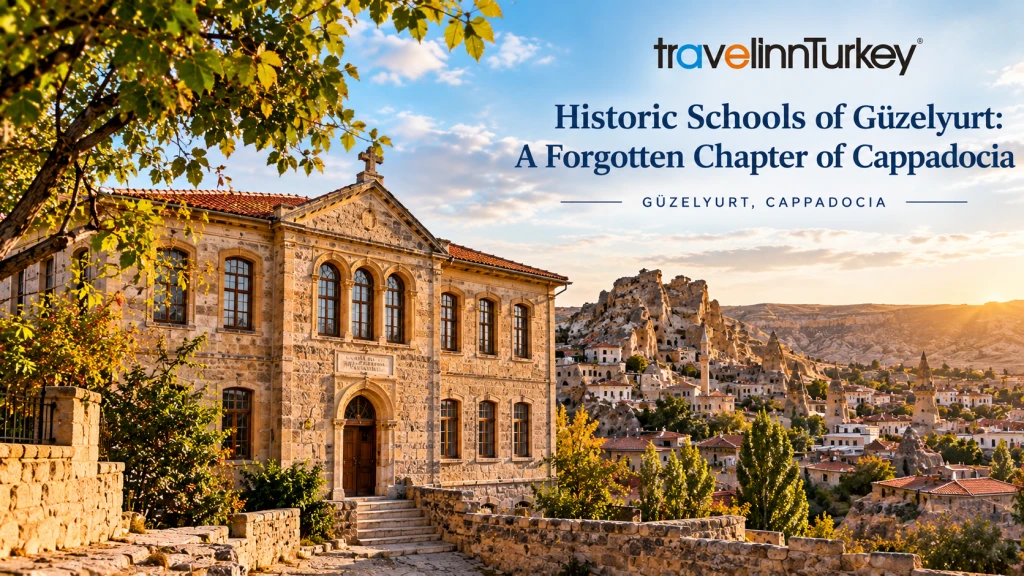
Historic Schools of Guzelyurt, Cappadocia
A Surviving Piece of Education
There are places in Cappadocia where a traveller does not simply look at a building.
There are places where the stones seem to remember.
In the quiet streets of Guzelyurt, the town historically known as Gelveri and earlier associated with Karballa / Karvali, stand the remains of a remarkable chapter in Cappadocia's history: the schools where generations of the local Orthodox Christian community were educated.
Today, entering these old buildings can create a feeling that is difficult to describe. For descendants of the people who once lived here, a doorway is not simply an entrance. It can be a connection with grandparents, parents, teachers, childhood and a homeland left behind.
For today's visitor, it is an invitation to remember that Cappadocia was also a land of schools, books, teachers and children.
Karvali – today’s Guzelyurt
The historic settlement today is called Guzelyurt, in Aksaray Province.
The municipality explains that the settlement was known as Karballa during the Roman and Byzantine periods and later as Gelveri. The official name Guzelyurt was adopted in 1965.
The town is approximately 35 kilometers from Aksaray and remains one of the places where Cappadocia' s distinctive rock-cut architecture, historic houses, churches and underground spaces can still be experienced.
The old name appears in several forms in historical sources — Karballa, Karvala, Karvali, Gelveri and others. A modern traveller may therefore encounter different spellings for the same historic community.
A community that believed in education
Education became increasingly important among Cappadocia' s Orthodox Christian communities during the nineteenth century.
In Gelveri, there were separate educational institutions for boys and girls, together with a kindergarten. A scholarly study of Cappadocian education records that by the late nineteenth century Gelveri had a boys' school, girls' school and kindergarten, and that Modern Greek was being taught from around 1890.
This is particularly interesting because the local population had a complex linguistic identity.
Many Cappadocian Orthodox Christians spoke Turkish in everyday life while using the Greek alphabet for writing. They are often described as Karamanli or Karamanlides in historical literature.
The school was therefore more than a place where children learned to read.
It was a place where language, religion, history and community identity were preserved.
The Greek Boys’ School – Gelveri Erkek Rum Mektebi
One of the most important surviving educational buildings is known in Turkish as the:
Gelveri Erkek Rum Mektebi
— the Greek Orthodox Boys’ School of Gelveri.
According to the Aksaray cultural-history publication Aksaray'in Hafizasi, the lower part of the school was completed in 1870, while the upper floor was completed in 1891.
Other historical material records the building as the Gelveri Erkek Rum Mektebi, while a recent historical publication on Karvali notes the inauguration of the city's boys' school in 1891.
Imagine the doorway more than a century ago.
Children arriving in the morning.
Teachers preparing their lessons.
Books being carried through the entrance.
Voices filling the classrooms.
For the people of that community, this was not an archaeological monument.
It was simply their school.
The Girls’ School – Gelveri Kiz Mektebi
The education of girls was also an important part of the community's development.
The Gelveri Kiz Mektebi, or Greek Girls' School of Gelveri, was constructed during the 1910s, according to the Aksaray cultural-history publication.
Another historical account identifies a girls' school in Gelveri and discusses the broader development of girls' education among Ottoman Greek communities.
The school represented something important for its time:
education was not intended only for boys.
Girls were also being given access to organised schooling, knowledge and cultural education.
This makes the buildings particularly meaningful today.
They are not simply examples of old architecture.
They represent the aspirations of parents who wanted their children to have an education.
What did the children learn?
The educational programs of Cappadocian Greek schools could be surprisingly broad.
Depending on the institution and period, subjects included Greek language and literature, ancient Greek, mathematics, history, religion, geography, science and practical subjects.
The wider educational development of Cappadocian Orthodox communities during the nineteenth century shows an increasing effort to establish organized schools, teachers and educational associations.
Education was closely connected with the survival of the community.
A school meant that the next generation could inherit more than houses and land.
They could inherit language, stories, faith, knowledge and memory.
What happened after 1924?
The history of these schools cannot be separated from one of the greatest transformations in the history of Cappadocia.
Until the population exchange, Guzelyurt/Gelveri was home to both Christian and Muslim communities.
The municipality of Guzelyurt records that the population exchange took place in 1924, with the Orthodox Christian population of the area leaving for Greece. Many were settled in Nea Karvali, near Kavala, where a new community was established.
The old community therefore disappeared from the town within a relatively short historical period.
The schools lost their original purpose.
But the buildings remained.
And that is why their entrances can feel so powerful today.
What is the Boys’ School used for today?
One of the most fascinating aspects of this story is that the old Gelveri Erkek Rum Mektebi has not simply disappeared.
According to Aksaray'in Hafizasi, the former Greek boys' school is today used as a hotel.
This gives the building a remarkable second life.
A building that once welcomed children to their lessons can now welcome travellers.
The function has changed completely.
The meaning has not.
The walls have moved from education to hospitality, but they continue to carry the memory of the people who built and used them.
And the Girls’ School?
The former girls' school belongs to the same story, although its present-day use and accessibility should be checked locally before presenting it to visitors as an open tourist site.
A historical building can survive physically while its original function, ownership and accessibility may have changed.
Now it is a surviving piece of the educational history of old Gelveri.
A town that still lives
Guzelyurt today is not an open-air museum.
People live here.
Families have homes, businesses and everyday routines. Tourism has become an important part of the local economy, while traditional crafts and local culture continue to form part of the identity of the town.
The local authorities have also supported the revival of Gelveri pottery and traditional earth-working, an old craft that had declined after the mid-twentieth century.
Walking through the old streets therefore gives the traveller two experiences at once:
the Guzelyurt of today and the Gelveri of yesterday.
That is what makes the town special.
The population of old Gelveri
Historical demographic records give us a sense of the size of the community.
A study concerning the Aksaray Greek Girls' School records that in 1913, Gelveri had 621 households and 3,129 Greek inhabitants.
This is an important figure because it reminds us that we are not talking about a tiny settlement with only a handful of families.
There was a substantial community here.
There were homes.
Businesses.
Churches.
Associations.
Schools.
Teachers.
Children.
And a social world that has largely disappeared from the physical landscape.
Standing at the school entrance
Perhaps the most moving part of visiting these buildings is the entrance.
Imagine a former student standing here again after decades.
Perhaps they left as a child.
Perhaps their parents left.
Perhaps their grandparents were born in Gelveri.
The door may look ordinary.
But for someone whose family came from this town, it may represent an entire lost world.
This is why historic schools deserve a different kind of respect from visitors.
They should not be treated merely as photographic backgrounds.
They are places where previous generations learned, dreamed and prepared themselves for life.
And when we enter them today, we should remember that we are walking through somebody else's childhood.
A lesson for the next generation
There is another reason to preserve these buildings.
Young people visiting Cappadocia today can see the school and understand that history is not only about emperors, churches and battles.
History is also about children.
A boy carrying a book.
A girl entering a classroom.
A teacher writing on a board.
A family saving money so that their child could receive an education.
These are universal stories.
The names and languages may have changed.
The people are gone.
But the aspiration remains familiar.
Every generation wants the next generation to have a better future.
That is perhaps the most beautiful message these old school buildings can give us.
Niobe discovers the school
When Niobe arrived in Guzelyurt, she had expected Cappadocia to surprise her with rock churches, underground cities and extraordinary landscapes.
She did not expect a school doorway to stop her.
She stood quietly in front of the old building.
For a moment, she imagined the street more than a hundred years ago.
Children running through the entrance.
Teachers calling them back.
Books under their arms.
Parents waiting outside.
Then she looked at the same doorway today.
Silence.
Stone.
A different Turkey.
A different generation.
But the same building.
Niobe touched the old stone and thought:
“Perhaps this is what history really is. Not something behind glass, but something that waits quietly for us to notice it.”
When we travel through Cappadocia, we should not only visit the places that are famous. We should also listen to the places that remember.
For the next generation, these schools can become more than remnants of a vanished community.
They can become a lesson in respect.
Respect for education.
Respect for different cultures.
Respect for the people who lived here before us.
And respect for the responsibility of preserving what remains.
Travel with Travel Inn Turkey
For travellers interested in the deeper history of Cappadocia, Guzelyurt can be combined with other historical and Orthodox sites in the region.
A journey through Guzelyurt, the Monastery Valley, the Church of St Gregory the Theologian, old Gelveri houses and the historic schools offers a different perspective on Cappadocia — one that goes beyond the famous valleys and fairy chimneys.
With Travel Inn Turkey, the journey can become not simply a sightseeing tour, but a journey through the memories of the people who once called Cappadocia home.
Because sometimes the most important places in Cappadocia are the ones that whisper rather than shout.
Our partners