


Little Hagia Sophia in Istanbul: Tracing Its Byzantine Christian Past
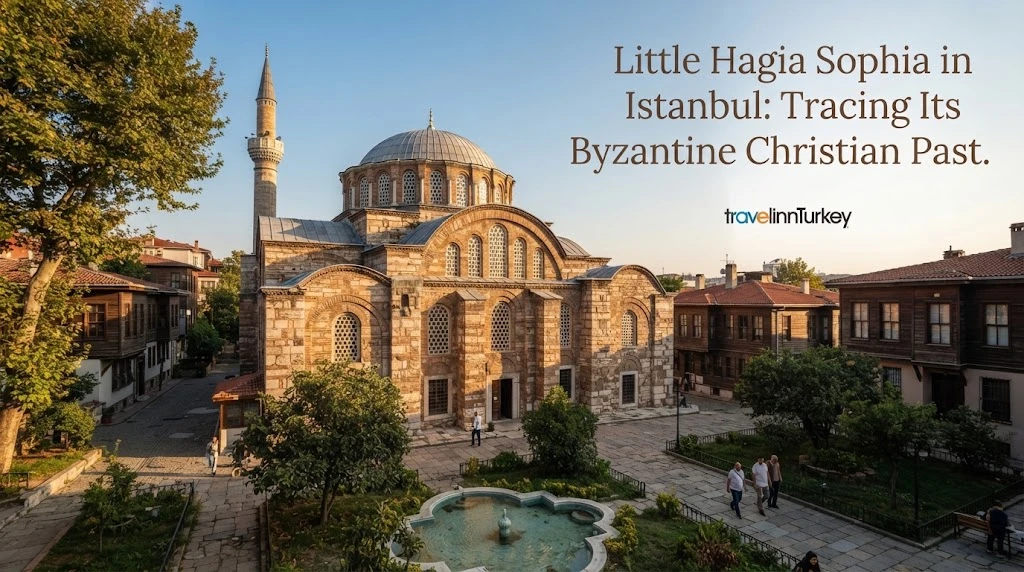
Little Hagia Sophia in Istanbul
Tracing its Byzantine Christian Past
Today, Niobe followed another trace of Christianity through Istanbul — and discovered that sometimes history doesn't disappear. It simply changes its clothes.
My list of Christian places in Istanbul is getting dangerously long.
Every time I think I have reached the end, another church, another saint, another Byzantine story seems to whisper, “You haven't finished yet.”
So today I went looking for Saints Sergius and Bacchus.
Today, most people know the church as Kucuk Ayasofya — the Little Hagia Sophia. It is now a mosque, but step inside and you are immediately reminded that this building has lived several lives.
And what a life it has had.
A church built in the age of Justinian
The Church of Saints Sergius and Bacchus dates from the sixth century, during the reign of the Byzantine Emperor Justinian I. The building was completed around 536, although scholars continue to debate its exact date and purpose.
Justinian is, of course, the emperor behind the great Hagia Sophia.
But before I reached the famous giant next door, I found this smaller, much more intimate building.
And suddenly I understood why it is called the Little Hagia Sophia.
The comparison isn't simply about size. The building has a remarkable centralised design, with a dome rising above an octagonal arrangement of piers. Its architects were experimenting with forms that would soon lead Byzantine architecture in fascinating new directions.
It felt almost as if I had walked into a laboratory of Byzantine architecture.
A very beautiful laboratory.
Look up, Niobe!
The best advice I could give another curious traveller is:
Don't just walk in and look around. Look up.
Around the interior, there is something that immediately caught my attention — an ancient Greek inscription running along the architectural decoration.
The inscription honours Emperor Justinian, Empress Theodora and Saint Sergius.
And there it was.
Words carved into stone more than a thousand years ago.
I stood there thinking about how many people must have looked at those same letters before me.
Emperors.
Priests.
Worshippers.
Travellers.
People who lived and died in Constantinople.
And now me, Niobe, trying to understand what they were trying to tell the future.
Why Sergius and Bacchus?
Two soldiers, two martyrs
Sergius and Bacchus were traditionally remembered as Roman soldiers who were martyred because of their Christian faith.
According to the tradition surrounding Justinian, the two saints had a particularly important connection with the emperor. A legend says that they appeared in a vision connected with Justinian's fate and helped demonstrate his innocence. Justinian later became emperor and honoured them by establishing a church dedicated to them.
Whether every detail of the story belongs to history or legend, one thing is certain:
Justinian wanted these saints remembered.
And he built something extraordinary in their honour.
And then history changed again...
Today, I wasn't walking through a functioning Byzantine church.
I was visiting a mosque.
The building was converted into a mosque during the Ottoman period, with the transformation generally dated to the late 15th or early 16th century. Islamic elements were added, including a mihrab and minbar, while the building's Byzantine structure remained.
And this is one of the things I love about Istanbul.
The building doesn't pretend that only one chapter ever existed.
Christianity is still there.
Islam is there.
The Byzantine Empire is there.
The Ottoman Empire is there.
And modern Istanbul is there too.
All occupying the same space.
All leaving something behind.
The traces are everywhere
I have started to realize that following Christianity through Istanbul isn't simply about visiting churches.
It is about looking carefully.
An inscription.
A column.
A surviving architectural detail.
A former church that is now a mosque.
A monastery hidden behind a modern street.
A name that survived even when the building changed function.
The Little Hagia Sophia reminded me of that again.
The Christian past isn't always presented in front of you with a big sign saying:
“Here I am!”
Sometimes you have to look above your head.
Sometimes you have to read the stone.
Sometimes you have to ask what a building was before it became what you see today.
And sometimes you simply have to stand quietly in the middle of it and imagine.
My list is getting longer...
So, I came today to learn about Saints Sergius and Bacchus.
I left with another question:
How many Christian traces are still waiting for me in Istanbul?
The answer, judging by my notebook, is:
A LOT.
My list is long.
Very long.
And I have a feeling Niobe is going to be following those traces for quite some time.
After all, Istanbul has had nearly two thousand years to collect stories.
And I have only just started looking for them.
Next stop?
Well...
You'll have to follow Niobe to find out.
Our partners