


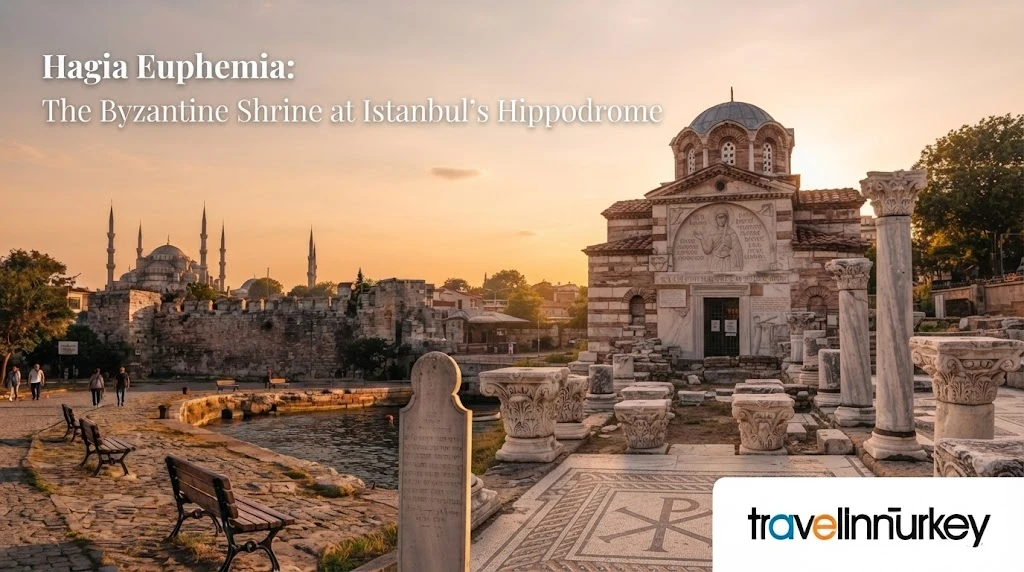
Hagia Euphemia: The Byzantine Shrine at Istanbul’s Hippodrome
Niobe’s Unexpected Discovery
Hagia Euphemia the Byzantine Shrine at Istanbul's Hippodrome
Some discoveries are planned.
Others simply happen.
And sometimes, the most fascinating places in Istanbul are the ones you never intended to find.
That was exactly what happened to me one beautiful day while walking around the Hippodrome of Constantinople.
I wasn't looking for a church.
I wasn't following a historical map.
I wasn't even searching for another Byzantine monument.
I simply saw a friend sitting near a fence and decided to walk over and say hello.
And then I noticed it.
A small sign.
A name.
Hagia Euphemia.
I stopped.
For a moment, the noise of modern Istanbul seemed to disappear.
I stood there reading the information carefully, trying to understand what was hidden beneath my feet and around me. Until that moment, I had walked past this place without really noticing it.
How many other people had done exactly the same?
Every day, locals, visitors and tourists pass through the Hippodrome. They photograph the ancient monuments, walk between the obelisks, visit the Blue Mosque and Hagia Sophia, and continue their journeys.
Yet here, almost quietly, was another chapter of Constantinople.
A chapter that many people might never notice.
I sat down and imagined the past
The weather was beautiful, so I sat for a while on a nearby fence.
And suddenly I started asking myself a simple question:
What was this place before it became an archaeological site surrounded by modern Istanbul?
It was difficult to imagine.
Today, people pass by carrying shopping bags, holding cameras, checking their phones and looking for their next destination.
But centuries ago, this area was part of Constantinople.
The Hippodrome was one of the great public and ceremonial spaces of the Byzantine capital. Nearby stood palaces, churches and other buildings connected with the imperial world.
And Hagia Euphemia had its own remarkable story.
The surviving structure was originally part of a palace complex and is associated with the palace of the high-ranking official Antiochos. Its central reception hall was later transformed into a church dedicated to Saint Euphemia.
Suddenly, the small archaeological remains in front of me did not seem small anymore.
They belonged to a much larger story.
Saint Euphemia brought me back to another Istanbul
And then I remembered something.
I had already visited another church dedicated to Saint Euphemia.
Not here.
On the Asian side of Istanbul, in Kadıkoy.
That memory suddenly connected two different parts of the city for me.
One Saint.
Two sides of Istanbul.
Two different places.
And centuries of history between them.
The story of Saint Euphemia is deeply connected with Chalcedon, today's Kadıkoy. Her original shrine was there, and her cult became particularly important after the Council of Chalcedon in 451. Later, during the seventh century, her relics were transferred to Constantinople and housed near the Hippodrome.
I looked at the remains again.
Now I wasn't simply looking at stones.
I was looking at a connection between ancient Chalcedon and Constantinople.
Between the Asian and European sides of today's Istanbul.
Between the Istanbul I know today and the Constantinople that existed many centuries ago.
A church hidden in plain sight
What fascinated me most was how easy it was to miss.
There was no grand entrance announcing:
“Here stands an important Byzantine church.”
There was no huge monument dominating the skyline.
Just archaeological remains, a sign, the surrounding streets and people continuing with their day.
Yet this place once had enormous religious and historical importance.
The church became the Church of Saint Euphemia in the Hippodrome, known in Greek as Ἁγία Εὐφημία ἐν τῷ Ἱπποδρομίῳ.
It survived dramatic periods of Byzantine history, including the Iconoclast controversy, later restoration, and the Latin occupation of Constantinople. Archaeological excavations eventually revealed important remains of the church and fragments of its medieval fresco decoration.
The site was re-discovered archaeologically in the twentieth century. Excavations began after remains and frescoes were identified in the area, with further investigations in the 1940s and 1950s.
And I had discovered it simply because I went to say hello to a friend.
The unexpected discoveries are sometimes the best
I smiled.
This was exactly the kind of discovery I love about Istanbul.
You can plan an entire day.
You can prepare an itinerary.
You can mark every famous monument on your map.
And then Istanbul suddenly gives you something you weren't looking for.
A small sign.
A forgotten ruin.
An ancient church.
A story hiding behind a modern fence.
That afternoon, Hagia Euphemia became one more unexpected chapter in my journey through Istanbul.
I had come simply to say hello.
Instead, I found myself sitting beside the Hippodrome, imagining emperors, courtiers, worshipers and pilgrims who had once walked through this same part of Constantinople.
And I kept thinking about the people passing by me.
How many knew what was here?
How many had stopped to read the sign?
How many would simply walk past?
Perhaps that is what makes Istanbul so extraordinary.
Its history does not always stand in front of you as a magnificent monument.
Sometimes it waits quietly.
Sometimes you have to notice a small sign.
Sometimes you have to stop.
And sometimes, like Niobe, you simply have to be in the right place at the right moment.
Who Was Saint Euphemia?
Saint Euphemia was an early Christian martyr associated with Chalcedon, across the Bosphorus from Constantinople. According to Christian tradition, she suffered martyrdom during the persecutions of the early 4th century, traditionally dated to around 303–307 AD. Her original shrine was at Chalcedon, but when the Persian threat reached the region in the 7th century, her relics were transferred to Constantinople for protection. A church dedicated to her was established in the former palace complex near the Hippodrome, making Saint Euphemia an important figure in the religious life of Byzantine Constantinople.
Where Is Hagia Euphemia in Istanbul?
The remains of Hagia Euphemia are located in the Sultanahmet area of Istanbul, close to the ancient Hippodrome of Constantinople, today's Sultanahmet Square. The site lies within one of the most historically important parts of the Historic Peninsula, where Byzantine imperial, religious and public buildings once stood beside the Hippodrome. Although the church itself is no longer standing as a complete building, archaeological remains preserve an important part of its story beneath the modern city.
The Byzantine Shrine at the Hippodrome
The Church of Saint Euphemia became a Byzantine shrine associated with the relics of the saint and developed into an important place of pilgrimage. It was created within an earlier architectural complex and contained liturgical features including the sanctuary, altar area, chancel barrier and seating for the clergy. Its position beside the Hippodrome placed it directly within the ceremonial and political heart of Constantinople, where religious life and imperial public life existed side by side.
The Connection with the Palace of Antiochos
One of the most fascinating aspects of Hagia Euphemia is its connection with the Palace of Antiochos. Antiochos was a powerful court official during the reign of Emperor Theodosius II in the 5th century. Archaeological evidence indicates that the church was established within part of the earlier palace complex, particularly its distinctive hexagonal hall. A column base discovered during excavations carried an inscription identifying Antiochos, helping archaeologists connect the remains with his palace.
What Archaeologists Discovered
The site was brought back to scholarly attention in the 20th century. In 1939, the discovery of a wall decorated with frescoes helped identify the remains as the Church of Saint Euphemia. Further excavations in 1942 revealed the unusual hexagonal hall and semicircular portico associated with the Palace of Antiochos, while excavations in 1951–52 uncovered the inscribed column base that provided important evidence for identifying the complex. Additional archaeological work followed in the 1960s.
The Byzantine Frescoes
Among the most remarkable discoveries at Hagia Euphemia are the Byzantine frescoes. Fourteen surviving panels depict scenes from the life and martyrdom of Saint Euphemia, providing an exceptional visual record of Byzantine religious art. The surviving paintings are particularly important because they belong to the later Byzantine period and preserve scenes that help us understand how the saint's story was represented in Constantinople. Another surviving scene depicts the Forty Martyrs of Sebaste, adding further significance to the decoration of the church.
What Happened to the Shrine?
The church experienced several difficult periods during its long history. It was damaged during the Latin occupation of Constantinople and was subsequently restored and redecorated. The church continued to exist into the final centuries of the Byzantine Empire, when it was again decorated with frescoes. Eventually, however, the building disappeared as later structures transformed this part of Sultanahmet. The remains suffered further damage during construction in the 20th century, when the area around the former Ibrahim Pasha Palace and the later courthouse was redeveloped.
Where Are the Remains Today?
Today, what survives of Hagia Euphemia is archaeological rather than a complete standing church. Parts of the Byzantine architectural remains and the precious frescoes have been preserved, allowing visitors and researchers to glimpse a small but extraordinary fragment of Constantinople's religious past. The surviving remains are especially valuable because they preserve evidence of both the earlier Palace of Antiochos and its later transformation into a Christian shrine.
Can You Visit Hagia Euphemia Today?
Hagia Euphemia is not comparable to major Istanbul monuments such as Hagia Sophia or the Blue Mosque, where visitors can simply enter a complete historic building. The archaeological remains have historically had restricted accessibility, and conservation and restoration work has been undertaken to protect the frescoes and architectural fragments. The Vehbi Koc Foundation notes that restoration has aimed to conserve the remains, provide protective roofing and ultimately make the site accessible to the public as a museum. Visitors should therefore check the current access arrangements before planning a visit.
Hagia Euphemia and the Byzantine Heritage of Sultanahmet
For Niobe, perhaps the most fascinating part of Hagia Euphemia is not simply what remains above the ground, but what its story reveals about Sultanahmet. Today's square, streets and monuments stand over layers of Roman, Byzantine and Ottoman history. The Church of Saint Euphemia, the Palace of Antiochos and the ancient Hippodrome belonged to different chapters of the same extraordinary urban landscape. This is why walking through Sultanahmet can feel like walking through several cities at once: beneath the modern streets are traces of Constantinople, and among the famous monuments are quieter archaeological sites such as Hagia Euphemia that preserve stories most visitors never notice. Istanbul's Historic Areas, including the Hippodrome and many other Byzantine monuments of the Historic Peninsula, are recognized by UNESCO for their exceptional historical and cultural significance.
Another discovery. Another story.
As I finally stood up and continued my walk, I knew this was not the end of the story.
It was the beginning of another one.
I had already met Saint Euphemia on the Asian side of Istanbul.
Now I had unexpectedly met her again beside the ancient Hippodrome.
Two places.
Two sides of the city.
One remarkable Byzantine story.
And once again, Istanbul had reminded me that the best discoveries are not always the ones we plan.
Sometimes...
the city finds the story for us.
And this one became another story for Niobe.
Our partners