

Turkish Baklava: The Sweet Layers of Turkey
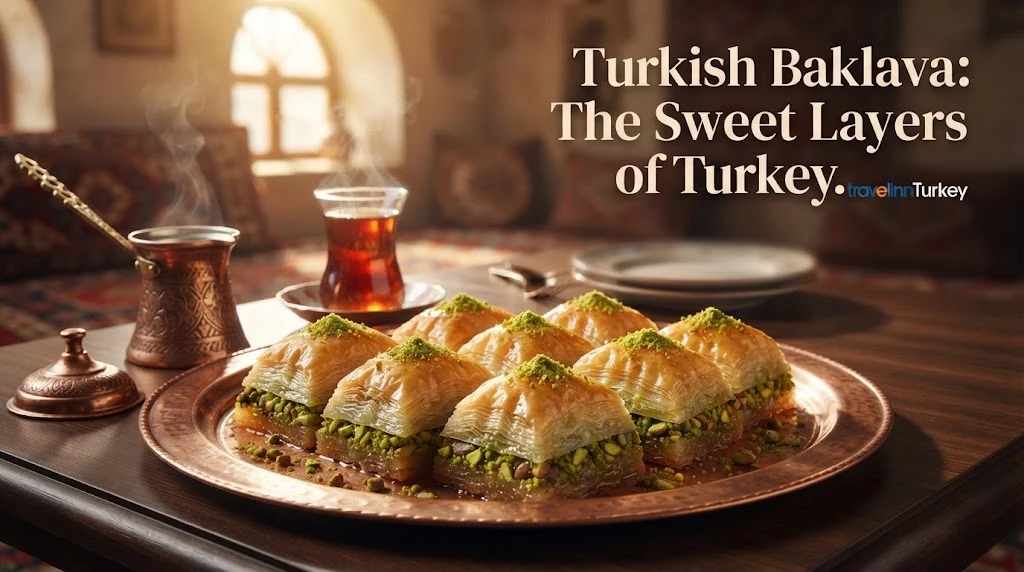
Turkish Baklava: The Sweet Layers of Turkey
A Sweet Surprise Behind the Glass
I thought I knew what baklava looked like. Squares, diamonds, golden layers, and pistachios scattered on top. Then, somewhere on my journey through Turkey, I saw a tower. Not a stone tower or an ancient tower, but a baklava tower.
It stood proudly behind the glass of a small pastry shop, made from layer upon layer of delicate pastry, butter, and pistachios, with syrup shining between the folds. I stared at it in disbelief. “Is that really baklava?” I asked. The man behind the counter smiled. “Of course.” He said it as though I had just asked whether the sky was really blue.
I pointed at the tower. “And people eat that?” He laughed. “That's the idea.” So, I ordered one.
The First Bite: Architecture You Can Eat
The first bite was dangerously good. The pastry cracked softly, the pistachios followed, and then came the sweetness—rich, warm, and unmistakably Turkish.
I suddenly understood something. Baklava isn't just a dessert; it is architecture you can eat. The layers are its floors, the pistachios are its decoration, and the syrup is the secret holding everything together. And the pastry chef? The architect.
Meet the Kadayif Tower: A Delicious Discovery
But my adventure wasn't finished. A little later, I discovered another tower. This one was made from kadayif—those delicate, golden threads of shredded pastry that look almost like fine golden hair. It was taller, darker, and wonderfully untidy. I called it the Kadayif Tower.
The chef looked at me. “Kunefe,” he corrected. “Ah,” I said. “So the tower has a name.” He nodded and then added something that made me laugh: “Every tower needs a name.”
Kunefe: When Cheese Becomes Dessert
The kadayif was different from the baklava. It was crispy on the outside, soft and warm inside, and hidden in the middle was cheese. Cheese!
I looked at the chef in disbelief. “You put cheese in dessert?” He smiled. I took another bite, and the warm cheese stretched between the pastry and the syrup. Suddenly, my carefully constructed rules about what dessert should be were completely destroyed.
More Than Dessert: A Taste of Turkish Culture
That afternoon, I stopped thinking about desserts as things you simply order at the end of a meal. In Turkey, they can be an experience, a conversation, a tradition, a reason to sit down with a stranger, or a reason for someone to explain how their grandmother used to make them. And sometimes, apparently, a reason to build a tower.
I left the pastry shop with sticky fingers and a smile. I had come looking for something sweet, but I found a little piece of Turkish culture instead.
The Unexpected Magic of Travelling in Turkey
Perhaps that is the problem with travelling. You leave home thinking you know what you are looking for, and then Turkey quietly puts something completely unexpected in front of you. You take a bite, and suddenly, everything changes.
The Great Baklava Dilemma: How Much Can You Eat?
And then I faced the two questions every traveller in Turkey eventually has to answer: How many pieces of baklava can one person possibly eat? And how many sealed boxes can a suitcase legally—or emotionally—carry home?
I had no answer to the first question. My stomach said, “Enough.” My eyes said, “One more.”
A Sweet Souvenir: Leave Room in Your Suitcase
So, dear traveller, if you visit Turkey for the sweet towers, remember my advice: leave some space in your suitcase and absolutely no space in your self-control. After all, calories disappear.
And remember: the best baklava is the one you actually loved enough to carry home, not the one you bought because the box looked pretty.
Niobe_
Our partners