


Catholic Churches in Istanbul’s Pera District | Latin Heritage
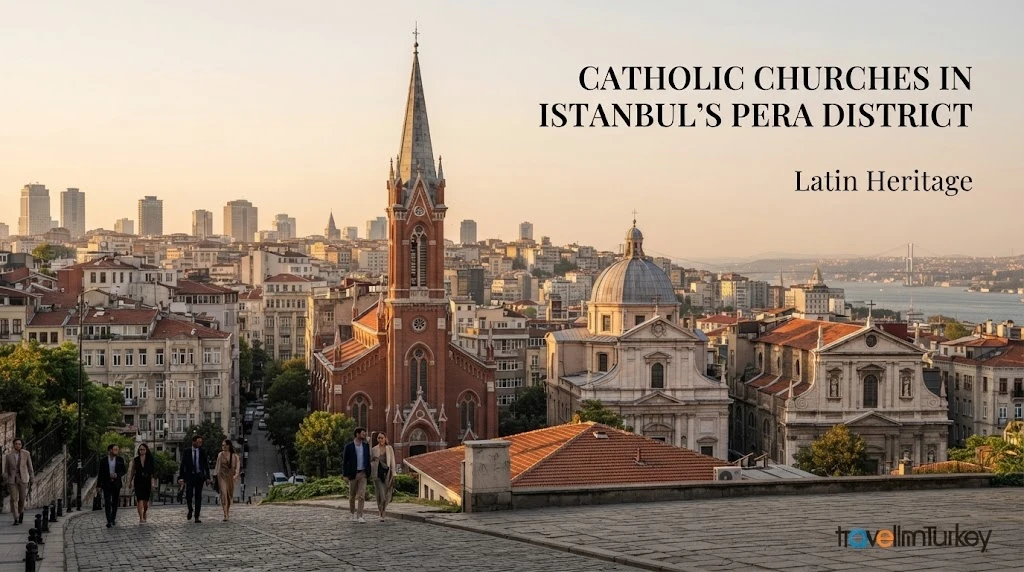
Catholic Churches in Istanbul's Pera District
Discovering Istanbul’s Latin Heritage with Niobe
There are places in Istanbul where history does not simply stand behind a museum door. It remains hidden behind an old facade, at the end of a staircase, inside a courtyard, or just a few steps away from the crowds of Istiklal Avenue.
Old Pera is one of those places.
Today, Beyoglu is known for its cafes, restaurants, historic apartment buildings, galleries and the lively atmosphere of Istiklal Caddesi. But beneath this modern rhythm lies another Pera — a cosmopolitan district shaped by Levantines, Europeans, diplomats, merchants and different Christian communities.
Among its most fascinating traces are the Catholic churches of Old Pera.
So, as I walked through the old streets of Pera, I decided to look beyond the famous landmarks and discover the churches that quietly tell another chapter of Istanbul's story.
This was another discovery of Niobe, together with Travel Inn Turkey.
Pera: Where Istanbul Met Europe
The historic district known as Pera developed beyond the medieval Genovese settlement of Galata and gradually became one of Istanbul's most cosmopolitan areas.
From the 17th and especially the 18th century onwards, Catholic institutions became an important part of the landscape. Foreign embassies, Levantine families, merchants and religious communities contributed to the transformation of Pera.
The Catholic presence was not represented by a single community or nationality. Italian, French and other European connections could be found around the churches and institutions of the district.
The long axis of the neighborhood was the Grande Rue de Pera, today's Istiklal Caddesi. Two particularly important Catholic parish churches eventually became landmarks of this landscape: Santa Maria Draperis and Saint Anthony of Padua. Historical research also places the Dominican Church of Saints Peter and Paul in nearby Galata within this wider Catholic landscape.
For a traveller today, these churches offer something special: the opportunity to experience Istanbul not only as an Ottoman and Byzantine city, but also as a meeting place of Mediterranean and European cultures.
Santa Maria Draperis: A Church Hidden Below Istiklal
My first discovery is one that can easily be missed while walking along Istiklal Avenue.
Church of Santa Maria Draperis stands at No. 215 on Istiklal Caddesi, but the church itself reached by descending a staircase from the avenue.
That small change in level creates an entirely different atmosphere.
The origins of the Catholic community associated with Santa Maria Draperis reach back to the 16th century. In 1584, Clara Maria Draperis donated a house and chapel to the Franciscan Observants. The chapel was later destroyed by fire, and the community moved to Pera. The church suffered several disasters over the centuries before being rebuilt in 1769 after the fire of 1767.
I find this history particularly fascinating because the church's story is also a story of survival.
Fire after fire, rebuilding after rebuilding, the Catholic presence continued.
Inside, the church has a three-aisled arrangement, a barrel-vaulted ceiling and a main altar associated with the historic Marian icon donated by the Draperis family. The entrance from Istiklal Avenue is particularly distinctive, with its staircase and neoclassical treatment.
It is easy to walk past this entrance without realizing that one of the historic Catholic churches of Istanbul is just below the busy avenue.
And that is exactly why I love exploring Pera.
Sometimes the most interesting discoveries are the ones you almost miss.
St. Anthony of Padua: The Landmark of Catholic Istiklal
A little further along Istiklal Caddesi, another church immediately captures attention.
Church of Saint Anthony of Padua is one of the most recognizable Catholic landmarks of Istanbul and the largest Catholic church in the city.
The church that we see today dates from the early 20th century. Construction began in 1906, and the present basilica was completed in 1912. It was designed by architects Giulio Mongeri and Edoardo de Nari in a Venetian Neo-Gothic style, reflecting the strong Italian connection of the Catholic community in Pera.
But the story of St. Anthony in Pera began much earlier.
An earlier church dedicated to St. Anthony was established in the 18th century. The community later rebuilt the church following major fires and urban changes. By the beginning of the 20th century, the growing Catholic population required a much larger building, resulting in the monumental basilica we see today.
Standing in front of the red-brick church, I cannot help thinking about how dramatically Pera has changed.
Trams pass.
Visitors take photographs.
Shops and cafes surround the church.
And yet the basilica continues to preserve the memory of another Istanbul — an Istanbul where Italian, French, Levantine and other European communities were an integral part of the neighborhood.
The Italian Character of St. Anthony
The architecture of St. Anthony tells part of the story before we even enter.
The Venetian Neo-Gothic design, red brick façade and monumental scale distinguish it from many of Istanbul's other historic places of worship.
The church was closely connected with Istanbul's Italian Catholic community. Its development also reflected the changing political and social importance of the Italian presence in the city during the late Ottoman period.
There is also an interesting connection with Pope John XXIII, who served as the Vatican's ambassador to Turkey before becoming pope and preached at St. Anthony for many years.
For visitors interested in religious history, architecture or the multicultural history of Istanbul, St. Anthony offers several stories at once.
Beyond Pera: Saints Peter and Paul in Galata
My journey does not have to stop at Istiklal Avenue.
Walking downhill toward Galata leads to another important Catholic church:
Church of Saints Peter and Paul, Istanbul.
Although technically in Galata rather than Pera, the church belongs to the same wider historical landscape of Istanbul's Latin Catholic communities.
Together with Santa Maria Draperis and St. Anthony, it formed part of the network of Catholic parishes serving the Levantine population of the area. Historical sources describe these churches as important parish centres within the Catholic landscape of Galata and Pera.
This is one of the reasons I recommend exploring Pera and Galata together.
The boundaries on today's map are not necessarily the boundaries of the historical story.
St. Benoit and the Wider Catholic Heritage of Galata
Another important stop in the wider neighborhood is Church Of St. Benoit in Karakoy.
St. Benoit belongs to the broader history of Catholic and Levantine Istanbul and reminds us that the Latin presence was never limited to a single street.
When exploring this part of Istanbul, it is fascinating to move between churches, former foreign institutions, historic hans, apartment buildings and old commercial streets.
Each reveals another part of the same cosmopolitan story.
Why Are the Catholic Churches of Old Pera Important?
For me, these churches are important not simply because they are religious buildings.
They help explain how Istanbul became one of the world's great meeting points of cultures.
Old Pera was shaped by:
- Ottoman society
- Levantine families
- Italian and French communities
- European diplomats and merchants
- Catholic religious orders
- Greek Orthodox communities
- Armenian communities
- Jewish residents and businesses
- international trade and cultural exchange
The churches remain physical evidence of this multicultural environment.
They also demonstrate how religious buildings adapted to the changing city — surviving fires, earthquakes, redevelopment and demographic changes.
A Different Way to Explore Istiklal Avenue
Most visitors walk Istiklal Avenue looking at shops, historic buildings, cafes and the famous red tram.
But Niobe suggests something different.
Look up.
Then look behind the façades.
Look down the side streets.
Notice the old apartment buildings.
Follow the staircases.
Look for the churches hidden behind gates and courtyards.
Pera becomes much more interesting when you stop treating Istiklal Caddesi simply as a shopping street and start reading it as a historical landscape.
Niobe's Pera Discovery
As I continued walking through Pera, I realized that the Catholic churches were not isolated monuments.
They were pieces of a much larger story.
Santa Maria Draperis tells a story of Franciscan presence, devotion and survival.
St. Anthony tells the story of the Italian community and the transformation of Pera in the early 20th century.
Saints Peter and Paul connects the story with the historic Catholic presence of Galata.
And St. Benoit adds another chapter to the long history of Catholic institutions around the Golden Horn and Galata.
Together, they create a fascinating route through a lesser-known side of Istanbul.
This is the kind of Istanbul I enjoy discovering — not only the monuments everyone knows, but also the stories hiding in plain sight.
Travel Inn Turkey
Follow Niobe as she explores the Latin Heritage of Istanbul beneath the modern city.
Our partners